How to Write a Resume: Expert Tips & Examples
Your resume is the first thing recruiters see when considering you as a candidate. Learning how to write a resume that wins them over could make the difference between an immediate rejection and landing that all-important interview. Here's what you need to know.

A well-written resume is your greatest asset when it comes to finding a new job. Getting the basics right and showcasing your experience well gives you the best shot at landing an interview.
In this guide, you’ll learn:
- How to write each section of your resume professionally
- Expert tips on how to format a good CV (with examples)
- The common mistakes to avoid when writing a resume
Let’s kick things off by taking a look at the main rules to consider when writing a resume.
The 5 rules to consider when writing your resume
Interview-winning resumes don’t happen by accident. To get things right, you’ll need to follow some ground rules. With that in mind, here are five things you always need to do.
- Tailor your resume to the job listing. Using a one-size-fits-all approach is a huge mistake. Your resume should directly target the role for which you’re applying. Recruiters can tell whether you’ve done your homework. Take the time to fully read the job description, and align your resume with the demands of the vacancy.
- Write a compelling resume summary. Your resume summary or objective lets you state your value to the recruiter. Don’t waste that opportunity. Make it short, snappy, and persuasive. It should showcase your skills, achievements, and experience.
- Use a clear structure with headings and keywords. 73% of recruiters use Applicant Tracking Systems (ATS), at least occasionally. Optimizing your resume for this software is a must. Including relevant keywords is a good place to start. Use clear headings to guide the recruiter and the software to the information they are looking for.
- Showcase your impact with quantifiable results. The old saying ‘show, don’t tell’ is the golden rule of resume writing. Rather than simply stating what you can do, be clear about the results you’ve gained in the past. Use metrics (such as numbers, timelines, and statistics) to evidence any claims you happen to make
- Stick to one or two pages max. In the United States, resumes should generally be one page long unless you are very far into your career or you work in an industry where longer resumes are common. be between one and two pages long. Since space is limited, make sure everything you add to your resume is of value.
Now you're clear on the basics, let's dive straight into the sections you'll need to include.
What are the main sections of a resume?
Learning how to write a resume means starting with the basics. There are five main sections that every modern-day resume needs to include, as follows:
- Personal details. You should include your name, job title, location, contact details, and any important links in your resume header.
- Professional summary. Either write a summary covering your career highlights or, if you lack experience, an objective detailing your goals.
- Work experience. This is arguably the most important part of a resume. Your work experience section covers your relevant past roles with strong metrics.
- Education. Next, you’ll need to include your formal education in reverse-chronological order. Note: You can put certificates here or in a dedicated section.
- Skills. Great resumes include a mix of hard and soft skills. You should also tailor your skills section to meet the criteria in the job description.
When you’ve completed these sections, there are some optional extras you may include. For example, you can add in awards, certifications, publications, or volunteer work sections.
To see how these sections work together, check out our professionally designed resume templates below. Our layouts make it easy to organize relevant information and present it clearly and professionally.
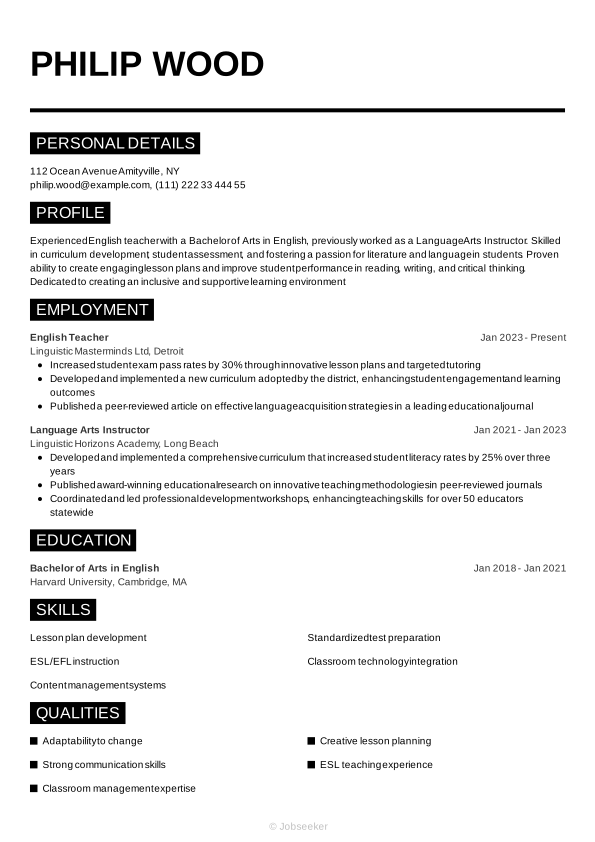
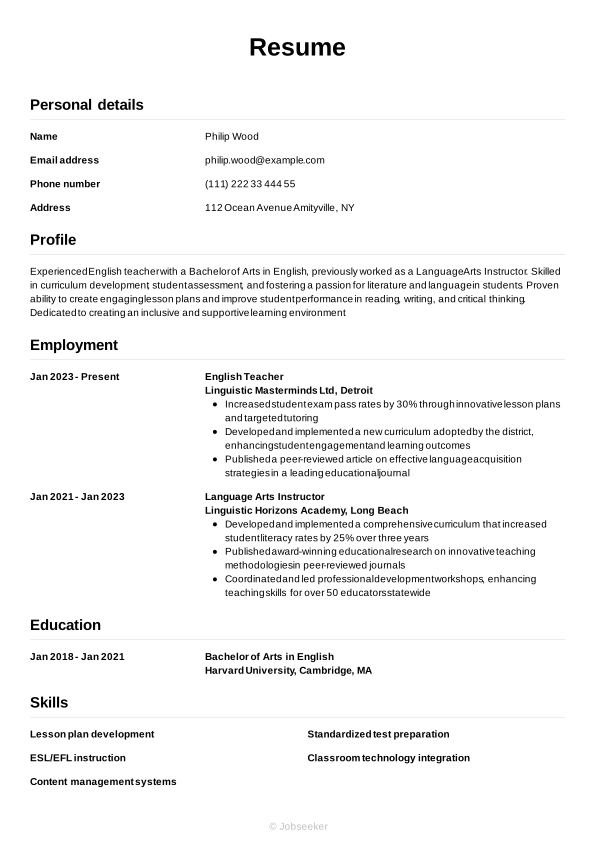
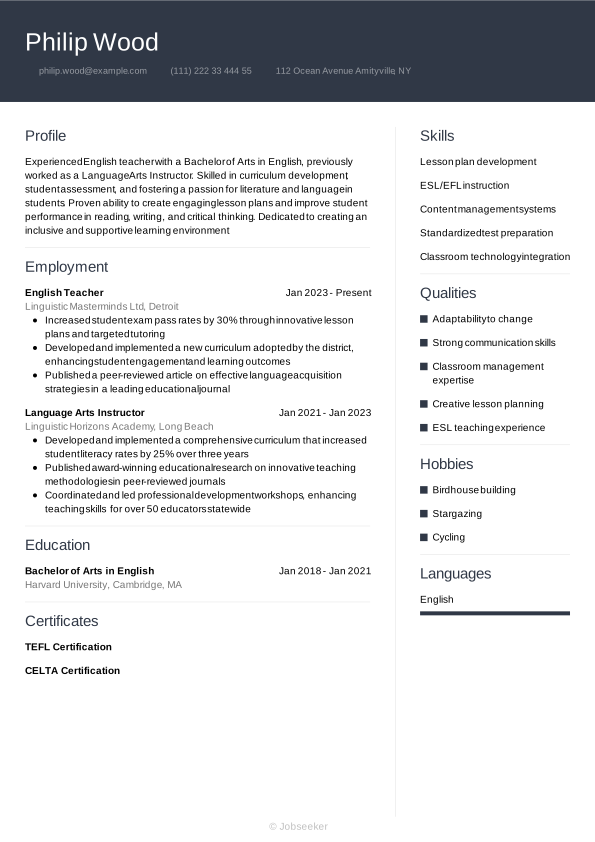
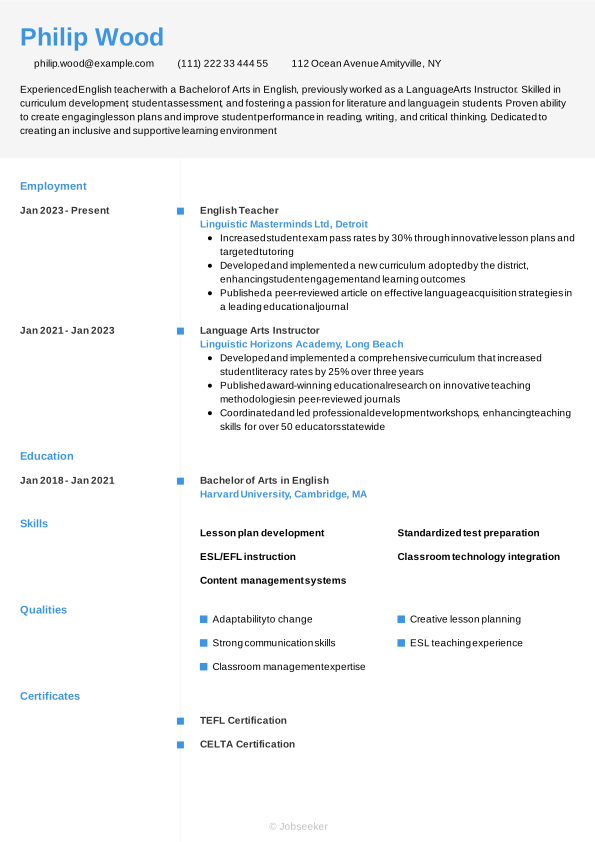
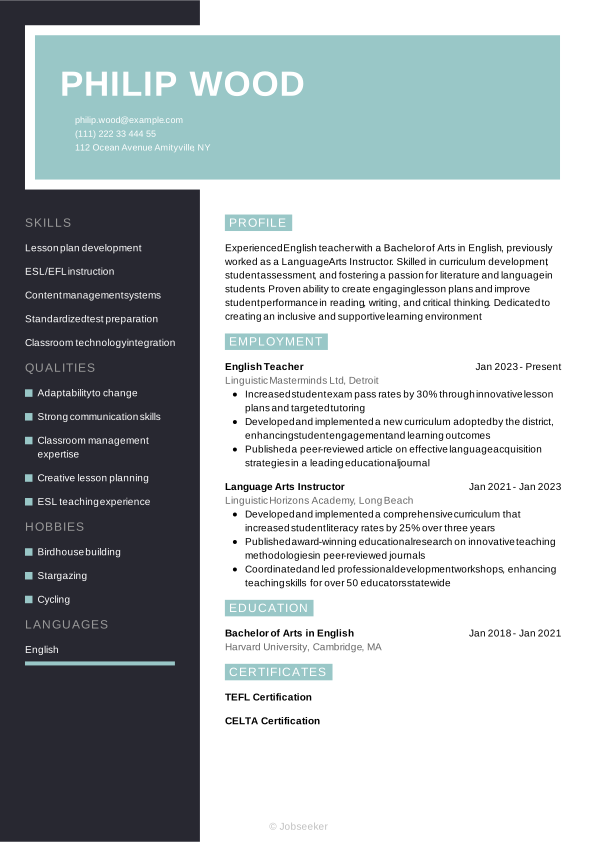
Next up, let’s take a closer look at the main five sections of your resume, and how to get the most out of each of them.
Header: Personal details
The first section you’ll need to perfect is your resume header. This is where your personal details go. It needs to be neat, clear, and well-formatted so the recruiter can quickly scan it.
You have limited space to play with, and you don’t want to waste it. Here’s a breakdown of what you must include, could include, and should absolutely not include:
Must Include |
|
Should Include |
|
Always Leave Out |
|
Share only the details that make sense for your professional resume. Your full name is a must. You can also include a job title and, in some cases, a resume headline to highlight your achievements. You can also include formal acronyms, such as Ph.D., if it’s relevant to the role. Add in your professional email address, ideally one including your first and second name, and a phone number. Cell numbers are fine so long as the voicemail message is suitable for work.
There’s no need to include your full address on modern resumes. List your general location, i.e. your city and state. If you’re willing to relocate for work or in the process of moving, you can note that in your resume header, too.
Expert Tip
Most candidates don’t need to include a photo on their resume. That’s because it reveals sensitive information about you (such as your age, gender, and race) that could leave to unconscious bias in the hiring process. There are some exceptions to this rule. If you’re a model or actor, adding a headshot to your resume is standard since your looks are integral to the role.
You should only include your LinkedIn, portfolio, and/or website links if they strengthen your application and make sense for your profession. For example, if you are a photographer, including your portfolio is a smart move. However, if you’re a barista, it’s not relevant.
Here’s an example of a well-written resume header:
Chicago, IL
•
j.d.smith@example.com
•
00 000 0000 000
•
linkedIn.com/in/john–smith–cpa
Professional summary or objective
Next, it’s time to write your professional statement. This is a short paragraph that sits neatly at the top of your resume. You have two options: a resume summary or a resume objective. Which you choose depends on where you are in your career.
Resume summary
Resume summaries show off your biggest career feats and skills to date. These are like highlight reels covering the main value you’ll bring to the position. Candidates with experience should write a summary rather than an objective.
Let’s take a look at a good resume summary example below:
Results-driven project manager with 10+ years of experience leading teams in the tech sector. Delivered $2M in cost savings over three years by streamlining processes and reducing timelines by 22%. PMP-certified and knowledgeable in Agile and Scrum methodologies.
Getting the balance right is a must. Consider what your most impressive feats are to date and weave them into summary. You should also align your summary with the job description.
Data Insight
Understanding what to include in your summary is key. As part of our survey of more than 1,000 HR professionals:
- 53.5% said they expect your summary to reflect any relevant work experience
- 60.7% said they expect summaries to highlight skills and achievements
Resume objective
Resume objectives include your career goals and aspirations, rather than past experience. This personal statement works best for entry-level or graduate candidates. If you don’t have a ton of work experience to draw upon, you can gear your statement to look toward the future.
You should use this space to explain your career direction and how the role you’re applying for fits into that plan. Check out a summary objective example below for inspiration:
Marketing graduate seeking a junior content role to apply my SEO knowledge and social media skills. Previously completed a six-month internship at a digital agency, producing copy and growing organic traffic by 34% across three client accounts.
Whether you choose to write a summary or an objective, don’t make the mistake of writing too much. Anything longer than 2-3 lines is too long for the recruiter to read, and could work against you. Aim for short, punchy sentences that pack value with relevant metrics.
Work experience
Our study found that 82% of recruiters go straight to the work experience section when reviewing resumes. Perfecting this section is one of the quickest ways to impress them and make them want to read more. It includes any relevant positions you’ve held in your professional career.
You should list each job in reverse-chronological order. That means starting with the most recent at the top of the section, and working your way back in time. You can include everything from a part-time job, a summer job, or a permanent position.
For each role, include the following information:
- Job title
- Name of company or organization
- Place where the work was performed
- Time period you worked there
- Bulleted list showing skills, responsibilities, and achievements
Only include relevant roles to the vacancy. If the position has no overlap with the job you’re applying for, it will detract from your application, rather than adding to it. Additionally, older roles become less relevant with time. If you’re short on space, consider leaving them off.
Expert Tip
Strong bullet points are the secret to your success. Focus on the results you gained, rather than merely the tasks you completed. Whenever possible, add metrics to strengthen your points.
Here’s an example of a well-written work experience section:
Senior Marketing Manager
2020
-2026
Bright Cloud Inc, Chicago IL
- Grew organic website traffic by 47% in 12 months by overhauling the company's content strategy across six channels
- Managed a team of eight, reducing staff turnover by 30% through a restructured onboarding and mentorship program
- Cut paid advertising spend by $120,000 annually while maintaining lead generation targets through improved audience segmentation
- Launched a rebranding campaign that increased brand awareness by 62% among the 25–40 demographic, per post-campaign survey data
Marketing Executive
2026
-2026
Redhouse Media, Chicago, IL
- Oversaw a $500,000 annual marketing budget across digital, print, and event channels
- Increased email open rates from 18% to 31% by redesigning the company's newsletter format and segmentation strategy
- Coordinated a product launch campaign that generated 3,200 leads in the first 30 days, exceeding the target by 28%
- Collaborated with the sales team to develop a lead nurturing workflow that shortened the average sales cycle by three weeks
Tips for people with little work experience
New to the world of work? Most people think that ‘work experience’ has to mean full-time roles. However, that is not the case. Add in anything that demonstrates your work ethic.
For example, you may include the following:
- Part-time jobs and summer jobs
- Internship or work placements
- Relevant college or school projects
- Volunteer work
- Any tasks that demonstrate your skills
If you don’t have much work experience, you could consider using a functional resume. This format switches the focus from your prior roles to your skills and competencies. This makes it simple to showcase your talents without focusing on the fact that your experience is short.
Education
Your education section tells the recruiter what professional qualifications you have. For each point, be sure to include the following details:
- Degree or qualification name
- The institute, college, or school
- The location
- Completion date (or expected completion date)
- Honors or GPA, as long as it’s above 3.6
- Coursework, if it’s highly relevant to the role
Deciding what counts as education often trips people up. However, it doesn’t have to be difficult. If you don’t have a degree, simply include your high school education as standard and leave it there. If you do have one or more degrees, you can leave off your high school diploma.
When it comes to longer courses, they can either be included here or in a dedicated certification section, instead. The choice is yours. Consider whether the course needs its own space, or whether it can fold neatly into your education section.
Check out our example of an education section below:
Education Bachelor of Science in Computer Science
2021
-2024
Georgia Institute of Technology, Atlanta, GA
- GPA: 3.9/4.0
- Relevant coursework: Data Structures and Algorithms, Machine Learning, Cloud Computing, Cybersecurity Fundamentals
Educational sections for different career levels
The amount of space you dedicate to this resume section depends on how far along you are in your career.
If you’re a recent graduate, for instance, it makes sense to emphasize your education. In that case, you may give it more space or even place it above your employment history section if you don't have other experience to show. If you’re further on in your career, you still need to include your education, but it may take up just a few customary lines towards the end of your resume.
If you’re a senior level worker, you may have professional certifications that are directly relevant to your career. In that scenario, it’s logical to create a separate section for certificates, where you can show off your accolades. You can also list any endorsements and memberships.
Expert Tip
You don’t need to add extra details about your education, unless they are highly relevant for the role. For example, you can mention coursework or special projects so long as they align directly with the vacancy, or highlight a skill that will be vital should you land the role.
Skills
Your skills section is a quick way for the recruiter to see if you meet the job criteria. For that reason, you’re going to want to align it with the job you’re applying for. You don’t need to include every skill you have up your sleeve. Instead, pick out top skills that are relevant to the role.
There are three main types of skills you need to know about: hard skills, soft skills, and transferable skills. Here’s what you need to know about each of them:
Skill type | What is it? | Examples |
|---|---|---|
Hard or ‘technical skills’ | Hard skills are professional skills related to the tools and expertise you will use on the job. They can usually be learned, measured, and documented. |
|
Soft skills | Soft skills, on the other hand, are about how you work. They don’t directly apply to one role, but let the recruiter understand your work style. |
|
Transferable skills | Transferable skills, as the name suggests, span industries. If you’re a career changer, these become particularly important. |
|
Deciding which skills to highlight on your resume can be tough. Here are some other ways to figure out what to include:
- Think about your industry. Different fields have different expectations. Consider the skill sets that are vital in your chosen industry. For example, skills that are important in IT and computing may not have relevance anywhere else. Include skills that are expected in your sector, especially if not every candidate will have them.
- Consider your career level. Toward the start of your career, you’ll need to emphasize the skills you’ve actually used. However, when you’ve got some years of experience, it quickly becomes more important to focus on your responsibility and mastery of skills.
- Look back at the job posting. Job descriptions are a gold mine when it comes to what skills to include on your resume. Select skills from the criteria that you have, and be sure to mention them in this section. Not only will this boost your odds of the recruiter noticing you, but it will also help your resume to score well in the ATS software.
Don’t stress about which skills to include on your resume. Jobseeker’s dedicated resume builder tool has you covered. Our app offers AI-generated skill suggestions based on your profession, so you can take the guesswork out of the equation.
Bonus: Optional resume sections
Now that you’ve covered the main resume sections, it’s time to consider adding something extra. When thinking about how to write a resume, don’t skip over the following optional resume sections. Include them if they directly bolster your application.
Section | What is it? | Examples |
|---|---|---|
Certifications | If you have formal qualifications that you’ve gained outside of your education, add them in this dedicated section. | PRINCE2, Google Analytics, HSE courses, authorizations |
Projects or portfolios | This is any practical work that you’ve completed, which is relevant to the role. It makes sense for creative and technical careers most of the time. | Photography portfolio, an app that you’ve built, a magazine you worked on etc. |
Languages | Should you speak a second language, you can include a dedicated languages section. Be sure to include your proficiency level. | English (Native), German (B2- CEFR), Spanish (A2 - CEFR) |
Awards and achievements | You may have recognitions or professional awards that go beyond the norm. You can either include these in your work experience section or in a separate section. | Employee of the Year, Top Salesperson |
Volunteer work | Volunteer work can strengthen your application by showcasing diverse skills and work ethic. This follows the same structure as your work experience section. | Board position, volunteering work |
Publications or conferences | Academic contributions are a surefire way to impress recruiters, especially if you’re going for a scholarly role. Ensure that any mentions are relevant to the job. | Journal articles, talks, academic papers |
References | Most of the time, you only need to provide references on request. However, in some professions (such as academia), adding this section may be acceptable. | The contact details of the person acting as a reference. |
If you don’t know how these sections will look, Jobseeker’s selection of resume examples is a good place to start. We have a wide range of samples including various sections and in different formats. Take a look at a few different examples to see how each section looks on paper.
Red flags to avoid when writing a resume
By now you should feel pretty confident in how to write a resume. However, there are still some common mistakes you’ll need to avoid. Overlooking these could land your resume in the reject pile faster than you might expect.
Let’s take a look at some of the errors you need to avoid.
- Failing to tailor your resume. Recruiters can spot generic resumes more easily than you think. Tailoring your resume to the job at hand is not optional. It’s the smartest way to make sure you score well on the ATS software and impress the reader.
- Typos and grammar errors. Don’t give recruiters any reason to pass over your resume. Typos and grammatical problems show a lack of attention to detail. Always proofread your resume before submitting it. You can also have a friend check it.
- Including outdated information. Resume real estate is expensive. Make sure you don’t waste it by cramming it full of irrelevant information. As a rule of thumb, you should omit anything that doesn’t directly apply to the role for which you’re applying.
- Writing long paragraphs. Resumes should be skimmable, since recruiters don’t have a moment to spare. Avoid writing long blocks of texts, which could be off-putting to them. Instead, use bullet points to make sure they can get the information they need quickly.
- Sharing sensitive details. Personal details, such as your age, marital status, religion, and nationality, have no place on your resume. The recruiter should not know these things about you when making their hiring decision. Leave them out entirely.
Nailing your resume the first time around doesn’t have to be hard. Jobseeker’s resume builder tool does the heavy lifting for you. Simply choose a template that suits your professional style, and add in your details. Our AI-powered prompts help you know precisely what to write.
Final resume writing checklist
Knowing how to write a resume properly is the first step toward job success. When you’ve completed yours, make sure you’ve ticked the following boxes before sending it.
You’ve included all of the relevant sections in your resume | |
Your contact details are accurate and up-to-date | |
You’ve tailored your resume to meet the job criteria | |
The skills line up with the demands of the position | |
You have proofread it, checking for spelling and grammar errors | |
You’ve saved it as a PDF (unless the description says otherwise) | |
You’ve used a matching cover letter template to create a cohesive look for your application |
Avoid rushing to send your resume to the recruiter before properly checking it. It’s always smart to do one final read-through to make sure everything is perfect.
Key takeaways for writing a great resume
A great resume is clear, easy to skim, and well-formatted for the best results. Go through each section you plan to include, and be meticulous about the information you share there. Add in any optional sections that will add more weight to your application, and don’t forget to proofread when you’re done.
Once you've crafted the perfect resume, don't forget to add a convincing cover letter. You can find inspiration in our wide variety of cover letter examples. Take a look at our resume resources for even more expert tips and career advice.
FAQ on how to write a resume
Should I include references on my resume?
No. It’s not common practice to include references on resumes. However, if the recruiter asks you to supply references, you should be ready to share their contact details.
How far back should a resume go?
Your resume should go no further than 10 or 15 years back. Any experience that dates back further is no longer likely to be relevant to the modern world of work, and will take up unnecessary space. You should always make sure the experience you include holds value.
What do recruiters look for in a resume?
98.8% of recruiters value clean, consistent formatting throughout a resume. That makes it easy for them to quickly scan a resume and see whether you match the job criteria.
How should I send my resume?
When submitting a resume online, you will either need to send it via email or upload it to a website. In either case, it’s best to save your resume as a PDF file.
How do you make a resume for a first job?
If you don’t have much experience, we recommend using a functional format for your resume. Our full guide on how to write a resume for a first job offers more insights into what to do.
How long should by resume be?
Resumes should be between 1-2 pages long. Remember, you don’t have to include every job you’ve ever held on your application.
Worried about going over that resume length? Sacrifice positions that are not entirely relevant to the vacancy in order to save space.

Impress potential employers with your resume
Follow step-by-step professional guidance to create a polished resume in minutes.