Vet Nurse CV Example
If you're hoping to launch a career in the veterinary medicine industry, including vet nurse roles, it's essential to write a CV that shows your skills and achievements in the best light. You'll want to focus on key responsibilities that are essential for the role and match your experience, such as monitoring IV fluid therapy and assisting in surgical procedures. In this article, you'll discover all the advice you'll need for writing a vet nurse CV that sets you apart from the crowd and boosts your chances of success.
A stronger, more engaging vet nurse CV gives you the best chance of success. It can help you pass the ATS CV screening stage and impress the recruiter or hiring manager, increasing your prospects of reaching the interview stage. Now let’s explore the main sections of a CV and see how to structure each one for maximum impact.
Key sections of a vet nurse CV
Your vet nurse CV writing strategy may vary significantly according to numerous factors, such as your previous experience, your seniority and the requirements in the job description.
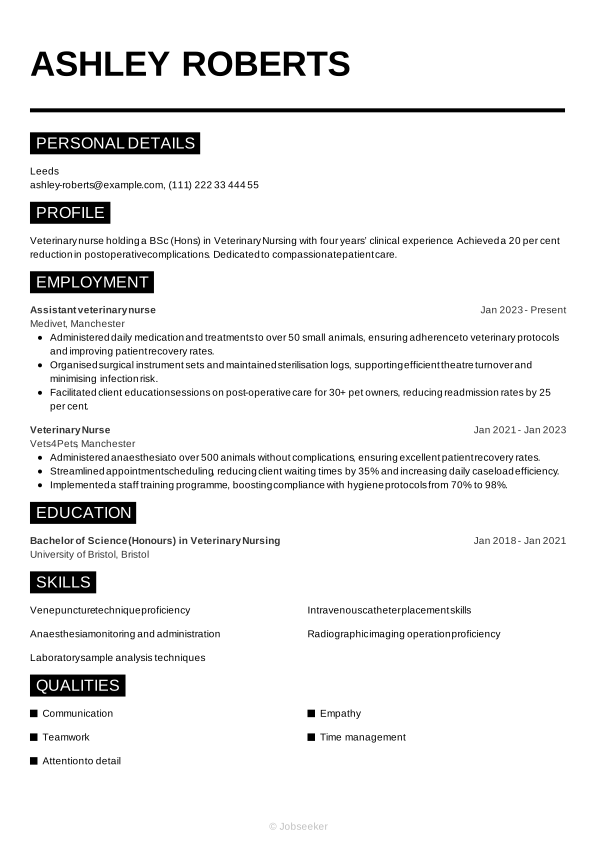
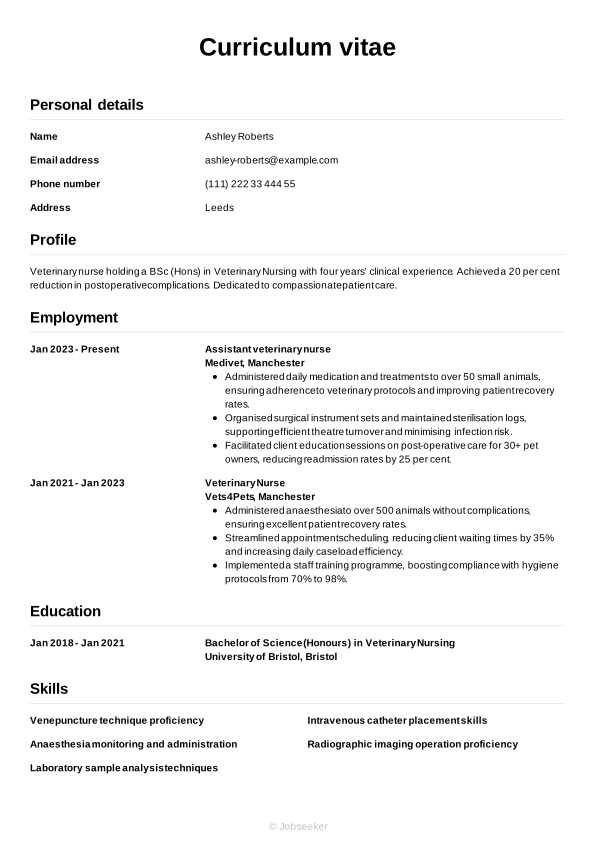
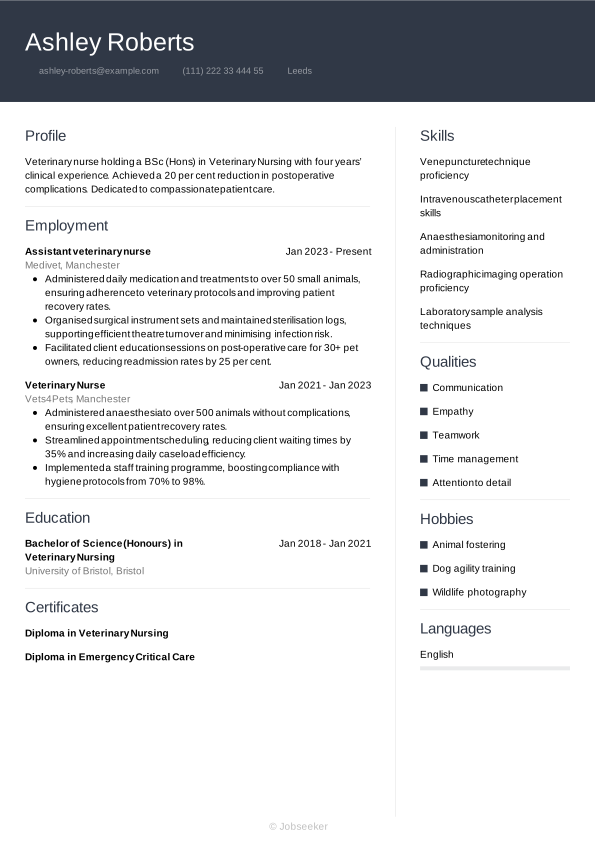
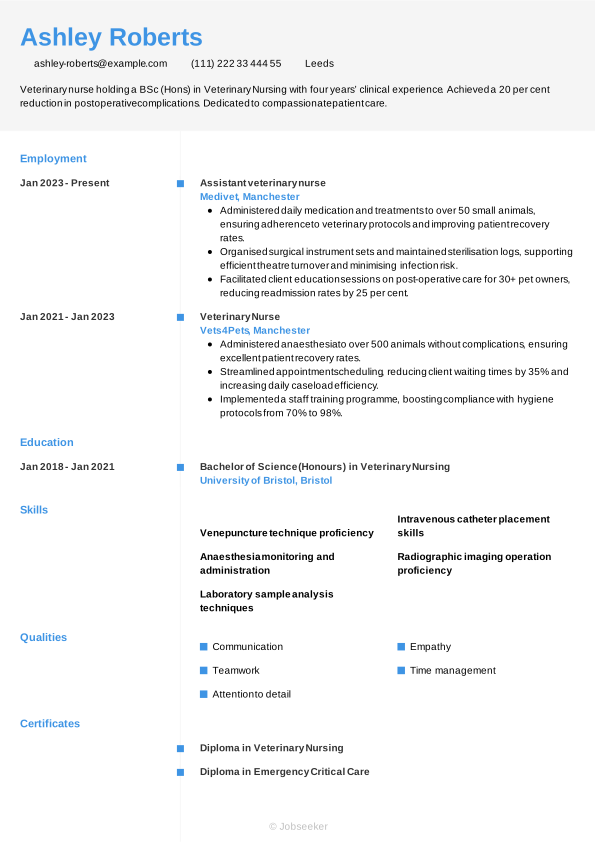
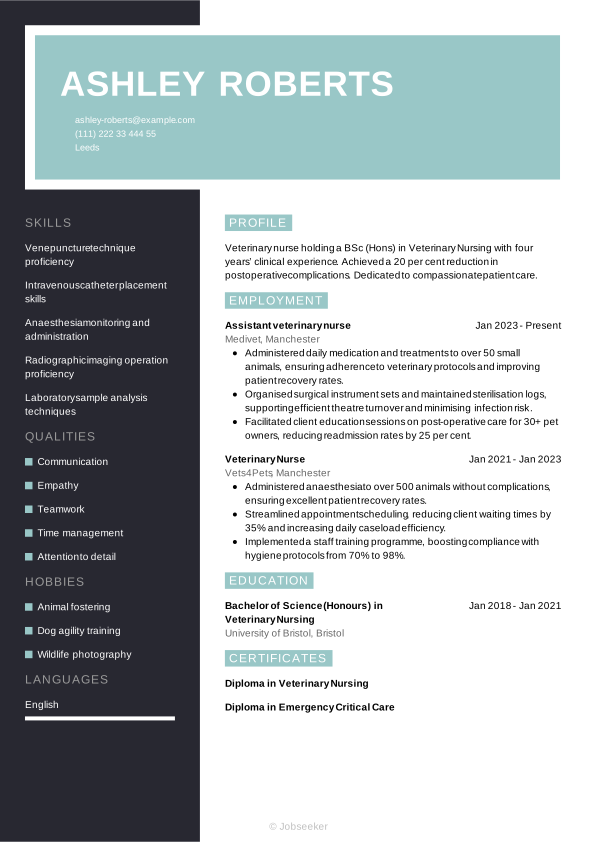
However, regardless of your years of experience, a vet nurse CV needs to connect the dots of your career into a cohesive story. In the following sections, we’ll dive into the specific chapters of your CV step-by-step, showing you how to refine everything from your initial introduction to your long-term achievements.
CV Header
At the top of your vet nurse CV, add a header that establishes the design language of the document. Include the necessary contact information: your full name, email address, phone number and location. It's not typically necessary to include your full address. Additionally, listing your LinkedIn profile in your CV header can be valuable. It serves to provide more detailed information about your career journey, your qualifications and your industry standing, in an easily accessible way.
For UK jobs, it's generally not a good idea to add a photo or any other personal details beyond your basic contact information. This means leaving off details such as your age, gender, ethnicity and nationality, as these can introduce bias to the selection process and complications related to the Equality Act 2010.
Ashley Roberts
ashley-roberts@example.com
(111) 222 33 444 55
Leeds
linkedin․com/in/ashley–roberts–123
CV Summary or Objective
Underneath your contact information, write a brief CV summary or CV objective to introduce yourself and highlight a few key skills and qualities. This can help the employer to quickly form a first impression on your suitability for the vet nurse role. While the CV summary focuses on your key skills and achievements, a CV objective highlights your career ambitions, making it more suitable for junior candidates.
Both a CV summary and objective should be concise, with an ideal length of two or three sentences. List your key skills, personal strengths and career achievements or ambitions, taking care to ensure the content reflects the requirements listed in the job description.
A good CV summary will highlight one or two key skills that match those listed in the job description, and show how you've put them to good use in your career to date. You'll want to set yourself apart from other candidates by focusing on unique qualities or particular areas of strength that have shaped your career to date. See below for an example of a strong vet nurse CV summary, featuring quantifiable evidence of your impact and concise, easy-to-read sentences.
Best example:
Compassionate veterinary nurse with five years’ small animal experience. BSc (Hons) in Veterinary Nursing graduate; boosted recovery rates by 20%. Skilled in client education, caring for 200+ patients weekly.
Unengaging example:
Compassionate veterinary nurse with broad small animal expertise, adept at supporting clinical activities and building positive relationships with pets and owners in busy environments while enhancing overall patient care quality.
See above for an example of an ineffective summary, with subtle differences leading to a reduction of impact. There are several factors that could make your summary less engaging. These include using long, poorly-structured sentences, failing to add evidence of your impact, being too generic with the skills you mention and not adapting your CV summary to specifically respond to the job description.
Work Experience
As with most CVs, your vet nurse CV work experience section tends to be the most vital part of your application. Employers tend to look to this section for evidence of how you've developed useful and relevant skills, and used them to add value for previous employers. Always take the time to tailor this section, including keywords and phrases that match the job description. This will help employers to judge how strong a fit you are for the role, and how you might apply your skills for the benefit of the organisation.
Add your most relevant previous jobs, including the job title, the name of the employer, its location and the dates you worked there. Below each entry, include several bullet points showcasing your skills and explaining how you used these to achieve positive results.
Standing out with your CV work experience section means using action verbs and measurable outcomes to show the impact you made. You'll want to outline a progression in your skills development, and list evidence of the value you added. See below for an example of a strong work experience section for a vet nurse CV.
Best example:
Veterinary Nurse, January 2023 - Present
Willowbrook Animal Care Centre, Bristol
- Developed and implemented a postoperative pain management protocol that reduced recovery times by 25% in small animal patients.
- Introduced a digital vaccination record system that improved appointment efficiency by 30% and enhanced client satisfaction scores.
- Trained and mentored a team of four trainee nurses, achieving a zero medication error rate over a twelve month period.
Unengaging example:
Veterinary Nurse, January 2023 - Present
Willowbrook Animal Care Centre, Bristol
- Provided general animal care and support during routine and emergency procedures.
- Assisted veterinary team with day-to-day patient monitoring and clinic administration tasks.
- Collaborated with colleagues to maintain hygiene standards and ensure smooth clinic operations.
Above is an example of what not to do with your vet nurse CV. The work experience section could fail to make an impression if it's too generic, focuses on older or irrelevant roles or lacks tailoring to the job description. It's also important to avoid focusing too much on responsibilities that don't tell the reader anything of the value you added to the role.
Education and Qualifications
Your education section should showcase your most recent and highest qualifications, paying particular attention to anything that's specifically required for the role.
Vet nurse roles typically require candidates to have a relevant university degree, and you'll want to showcase this in your CV to confirm your eligibility. Add your Bachelor of Science (Honours) in Veterinary Nursing or another related degree that makes you an eligible candidate for the position, in your CV. If you have any other degrees or qualifications that highlight radiographic imaging operation proficiency, laboratory sample analysis techniques or your most relevant skills, you could also add these.
Creating the education section of your CV means selecting the most relevant and highest qualifications, and listing them in reverse-chronological order, starting with your most recent achievements and working back from there. Add the name and level of the award, the institution, its location and your dates of study or graduation. If you have space or if you particularly want to emphasise your qualifications, you could add one or two bullet points under each entry, highlighting specialist areas of study, projects you worked on, awards you won or societies you were a member of.
Specialist licences or certifications can also be a valuable addition to your CV's education section. If these are essential for the job and are referenced in the job description, it's a good idea to include them here rather than further down your CV. Include any expiration or renewal dates for certifications, if applicable.
Bachelor of Science with Honours in Veterinary Nursing, 2018 - 2021
Harper Adams University, Newport
Key Skills
A CV's skills section is the place to show the reader, in an easily accessible format, that you have the necessary skills for the job. Read the job description to understand the most essential skills, and create a list of both hard and soft skills, ensuring you include some of your strongest, most unique characteristics and qualities to set you apart from the competition. In a vet nurse CV, focus on the most relevant and essential skills in your skills portfolio, such as communication and laboratory sample analysis techniques, to show you're qualified for the vet nurse position and to put you in a strong position to progress.
Hard Skills
Hard skills refer to the technical and specialist skills required for the everyday duties of the job. They might include specialist knowledge, or the use of certain software and equipment. You can gain these skills through study, training or industry experience, and they might require a licence or certification. For vet nurse jobs, essential hard skills from your career-to-date might include laboratory sample analysis techniques, and venepuncture technique proficiency. After checking the job description, include a list of four or five key hard skills in your CV to confirm that you have the necessary expertise for the role.
The best hard skills to include are typically listed as 'essential' or 'required' in the job description. Aim for a mix of the most desirable skills, together with those you have the highest proficiency in. For the best chance of success, you'll want your strongest skills to match closely with those most desired by the employer.
Below, you can find the types of skills typically featured in the hard skills section of a vet nurse CV:
- Venepuncture technique proficiency
- Intravenous catheter placement skills
- Anaesthesia monitoring and administration
Soft Skills
Your soft skills list should contain a list of your personal strengths that make you suitable for the role, and a good fit for the team and the organisation. In contrast to hard skills, these tend to be transferable and applicable to different roles and levels. As a result of rapid technological changes in the world of work, soft skills are becoming ever-more valued by employers. Soft skills can also be particularly valuable for junior or entry-level roles where candidates haven't necessarily had the time to develop hard skills and career achievements.
As with hard skills, review the job description to understand the best soft skills to mention in your vet nurse CV. The best CV soft skills section includes specific skills that you can evidence with examples throughout your CV. Create a list of four or five transferable skills, combining the most essential skills from the job description with the skills that help you to stand out as a unique and compelling candidate for the position.
The section below provides an overview of soft skills often highlighted in a vet nurse CV.
- Communication
- Empathy
- Teamwork
Language Skills
Including a section on language skills can be beneficial, if you speak at least one language to a reasonable level of competency, in addition to your mother tongue. This is true even if language skills aren't a requirement for the role, as foreign language abilities often correlate to other valuable soft skills. Within this section, list the foreign languages you speak to a reasonable degree of competence, together with an indicator of your skill levels.
The methods for indicating your foreign language skills on your CV include assigning a basic descriptive word, such as:
- English: Fluent
- Spanish: Intermediate
You might wish to use an internationally recognised standard for your language skills, such as the Common European Framework of Reference (CEFR). This divides your language skills into the following categories:
- A1: Beginner
- A2: Elementary
- B1: Intermediate
- B2: Upper intermediate
- C1: Advanced
- C2: Proficiency
Certifications and Training
If you've invested your time and resources into gaining extra qualifications beyond the minimum requirements for the role, you could highlight these in a certifications section. It can enhance your chances of success to show specific training and certifications. Not only do these prove you're qualified for the role, but they also indicate proactivity and a dedication to professional development. Furthermore, a certifications section is particularly valuable if you're applying for a role that sets out required certifications or licences in the job description. These might include technical roles that require the use of specialist software or equipment.
Here is a list of some key certifications and licences that can be particularly useful for vet nurse applications:
- Diploma in Veterinary Nursing, 2023
- Diploma in Emergency Critical Care, 2023
- Certificate in Veterinary Radiography, 2023
Specialist Insight:
With recruiters scanning CVs in less than nine seconds, Barnet Council highlights the importance of a short and compelling personal summary. (1)
Additional Information
Including optional sections in addition to the core sections of your vet nurse CV can help you to show employers you're a strong candidate for the job. Consider optional sections for your CV if you're looking for ways to show you're right for the job, beyond your work experience. Optional sections are particularly valuable if you haven't had the chance to build up relevant work experience, for example, if you're applying for entry-level roles or you're changing careers to a new industry or role.
You can find more detailed advice on tailoring your CV in our career resources, where we cover proven ways to highlight your skills effectively.
Hobbies and Interests
One valid way to show you have relevant skills for the job is by listing your hobbies and interests. In addition, you can use hobbies and interests to show elements of your personality that might not shine through otherwise, giving you a chance to offer something different to most candidates. However, a hobbies and interests section will only make an impact with the reader if the skills you showcase are relevant to the role. As such, only include this section if it helps you fulfil requirements of the role that you've been unable to show elsewhere.
Career Achievements
Listing your key career achievements in a distinct section can be an effective way of drawing attention to them. In your list, add any awards you've won, industry recognition or key career milestones that tell a story about your suitability for the role and place you ahead of other candidates.
Voluntary Roles
Listing any previous voluntary work is another useful way of showing you have the necessary skills and experience for the job. If you don't have much relevant work experience, either because you're a junior candidate or you're changing jobs from an unrelated field, volunteering can provide valuable examples of your skills in action. For this section, use a similar structure to your work experience section.
List your job title or a description of the role, the organisation name, its location and the dates you occupied the role. Use bullet points to show employers how you put your skills to use, and any positive achievements from your time in the role.
Evidence-Based Insight:
More than 3 out of every 4 recruiters use ATS software to check basic candidate details, including experience levels, hard skills and previous job titles. (2)
Most impactful action verbs for a vet nurse CV
Using strong action verbs in your work experience bullet points is a great way to focus this section and show the impact you've made in your career to date. Starting each bullet point with an action verb that reflects the skills required for the role will help the reader to easily cross-reference your skills to the job description. Remember to always back up the action verbs you use with quantifiable evidence that shows the impact you made. You can use past tense for any action verbs describing previous jobs, with present tense for action verbs to describe your current role and responsibilities.
- Assist
- Administer
- Monitor
- Sterilise
- Restrain
- Record
- Educate
- Prepare
- Support
- Maintain
Example of a vet nurse CV
Now we've shown you everything that needs to go into your vet nurse CV, we can take a look at how it comes together in its final form in the following example:
Leeds
•
ashley-roberts@example.com
•
(111) 222 33 444 55
•
linkedin․com/in/ashley–roberts–123
Veterinary nurse holding a BSc (Hons) in Veterinary Nursing with four years’ clinical experience. Achieved a 20 per cent reduction in postoperative complications. Dedicated to compassionate patient care.
Assistant veterinary nurse
2023
-2026
Medivet (Manchester)
- Administered daily medication and treatments to over 50 small animals, ensuring adherence to veterinary protocols and improving patient recovery rates.
- Organised surgical instrument sets and maintained sterilisation logs, supporting efficient theatre turnover and minimising infection risk.
- Facilitated client education sessions on post-operative care for 30+ pet owners, reducing readmission rates by 25 per cent.
Bachelor of Science (Honours) in Veterinary Nursing
2018
-2021
University of Bristol (Bristol)
Venepuncture technique proficiency
Intravenous catheter placement skills
Anaesthesia monitoring and administration
Communication
Empathy
Teamwork
Diploma in Veterinary Nursing
Diploma in Emergency Critical Care
English - Native
French - Advanced
If you want to get a feel for how your CV will look once you finalise its design and layout, check out our CV examples for inspiration.
Dos and don'ts for a winning vet nurse CV
Tips to follow
- Use strong action verbs that reflect the impact you've made for employers in your career to date.
- Add a dedicated skills section, including a summary of your key hard and soft skills that also reflect the job description.
- Proofread your CV in detail before sending it, to avoid unnecessary errors in spelling and grammar that could undermine your chances.
- Start your CV with a CV summary or objective that grabs the attention of the reader, clearly summarising your key skills and achievements.
- Use a reverse-chronological approach to listing your career timeline and education, starting with your most recent roles and courses, and working back from there.
Common mistakes to avoid
- Don't list your hobbies and interests unless they help you prove key, essential skills that you're unable to prove through work experience or another core CV section.
- Don't add personal information such as your age, gender, marital status or personal photo (unless necessary for the role).
- Don't overload your CV with industry jargon and acronyms that may alienate or confuse the reader, instead opt for simple, clear language whenever possible.
- Don't crowd your CV with too much information, but keep it as focused, concise and relevant as possible.
- Don't use complex formatting or confusing layouts that can make your CV less accessible for the reader or less scannable by ATS apps.
A courteous, professional cover letter can make all the difference to your job applications. Our cover letter templates have been designed by experts to help you make the best impression with hiring managers.
Tips for optimising your CV for ATS
Applicant tracking systems (ATS) are now commonly used by employers, to help them manage the recruitment process. One of the main functions of ATS software is the scanning and ranking of CVs according to their likely suitability for the role. By taking on this task, the hiring manager can reduce the time and resources they spend on the initial selection process, making recruitment more efficient and cost-effective.
The growing prevalence of ATS means candidates need to write and format their CV in a way that's compatible with the software, giving it the best chance of being accurately scanned and parsed, and ranking highly against other candidates. Here are some tips on how to optimise your CV for ATS screening:
- Include keywords and phrases that mirror the job description to maximise your chances of ranking highly in the ATS screening stage.
- Use standard CV headings that clearly identify each section, such as 'work experience', 'education' and 'skills'.
- Choose a simple, standard CV structure and omit any design elements that might make your CV less easy to read by automated systems, such as text boxes and columns.
- Select a font that increases the readability of your CV, such as popular serif and sans serif fonts, between the sizes of 10 and 12 for main text and 14 and 16 for headings.
- Use bullet points throughout your CV in place of full sentences. This serves a few purposes, reducing the overall length, helping keywords stand out and making it overall more scannable by ATS apps.
It might seem like there's a lot to remember when it comes to making an ATS-compatible CV, but taking care with this stage can really improve your chances of success. To make the process as easy as possible, use one of our expert-designed, ATS-optimised CV templates and boost your chances of success.
Jobseeker's CV templates can help your CV to make a strong first impression with recruiters. Each template is expertly designed and approved by HR specialists to help you craft a winning application.
Vet nurse CV FAQs
How do I write a vet nurse cover letter for my job application?
A cover letter that makes a positive impact with the reader can be just as important as your CV. For the best impact, choose a formal, professional letter layout and a cover letter template that reflects the look and feel of your CV, reinforcing your application's design language.
The standard cover letter format includes three main paragraphs of content. The first paragraph includes a brief introduction to yourself and the role you're applying for, and references your motivation for applying for the job. In the second paragraph, list some key skills and achievements, taking care to differentiate from the content in your CV. The closing paragraph typically contains a recap of your enthusiasm for the role, and adds a call to action that establishes dialogue with the employer.
Alternatively, if you're applying for the role via email, you may want to send a less formal cover note. This simply includes a brief introduction, confirming the role you're applying for and directing the reader to the relevant attached documents, rather than following the traditional professional letter conventions. Remember to include your contact details in your email, so the employer can follow up with you if necessary.
Jobseeker's cover letter examples for vet nurse jobs and key veterinary medicine industry roles offer valuable insights from HR experts on how to write a compelling cover letter.
How do I write a vet nurse CV without experience?
Even without relevant work experience, it's possible to write a vet nurse CV that impresses employers.
Choose a functional CV format, that gives greater emphasis to your skills than to your work experience. In this layout, the skills section comes immediately below your CV summary, followed by education, with work experience taking less priority.
For entry-level roles, employers tend to look more for candidates with the right soft skills to show they can learn and develop on the job. As such, place extra emphasis on your soft skills for an entry-level vet nurse CV.
How do I write a vet nurse CV headline?
A well-crafted CV headline can draw the reader in, providing a hint of your suitability for the role, while increasing the likelihood of passing the ATS screening stage.
Look to write a short, engaging sentence that encompasses your best qualities, including the job title to indicate your relevance and suitability for the role.
For the most effective CV headline, make sure it reflects the most critical keywords and phrases from the job description. This will also help your CV to pass the ATS screening stage of the recruitment process.
Below you'll find some examples of CV headlines for different experience levels:
- Compassionate Junior Veterinary Nurse Committed
- Compassionate Veterinary Nurse Delivering Care
- Compassionate Senior Veterinary Nurse
What's the best vet nurse CV format for 2026?
The best CV format for a vet nurse CV in 2026 depends on both your experience levels, and the role you're applying for, including its level, the company and industry norms.
Generally, the most effective CV format for candidates with some work experience is the traditional reverse-chronological structure. This layout prioritises your work experience section to show how you meet the job description, with examples of your key skills and achievements.
Alternatively, for entry-level candidates or career changers who don't have much relevant work experience, a functional CV format tends to work better. This layout places skills and qualifications above work experience.
Key takeaways for a successful vet nurse CV
To give you the best chance of success with your CV, tailor it for every specific application, including keywords that reflect the job description. Pick a CV format that matches your experience level, and focus on showing the reader how you've developed relevant skills and put them to good use to add value for previous employers.
Finally, creating your CV using one of Jobseeker's expert-designed CV templates can give your application the edge, placing you among the leading candidates and positioning you for success with your job applications.
Sources:
- Barnet Council (UK local government), Recruitment tips: How to write a supporting statement
- Jobseeker, HR Trends

Impress employers with your CV
Step-by-step guidance to create a professional CV in minutes.