Filmmaker CV Example
Achieving success with your film industry professional applications requires a strong, compelling CV that gives your skills and career achievements a chance to shine. You'll want to focus on key responsibilities that are essential for the role and match your experience, such as directing cast performances and overseeing SFX integration. In this comprehensive guide, you'll learn the steps to producing a film CV that puts you in pole position to progress to the interview stage.
A film CV that's well-written, engaging and showcases the most relevant skills and experience gives you the best chance of progressing to the next stage of the recruitment process. Let’s take a closer look at the key parts of a CV and how to shape them so they communicate your creative vision as clearly as your experience.
Main film CV sections
Your film CV writing strategy may vary significantly according to numerous factors, such as your previous experience, your seniority and the requirements in the job description.
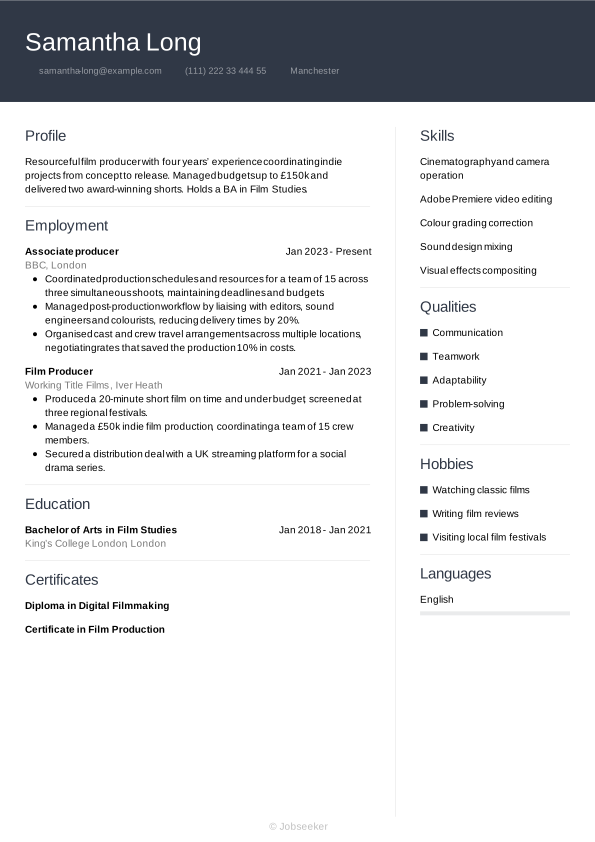
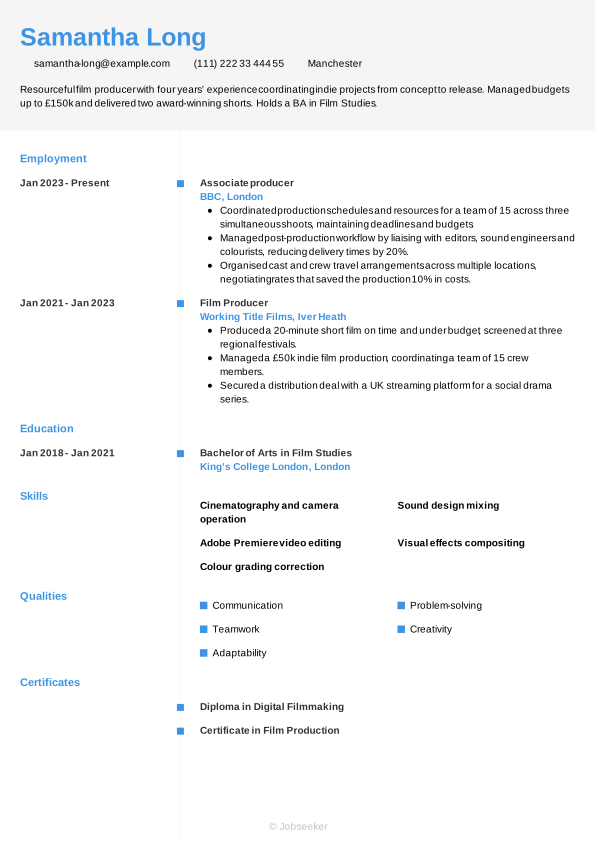
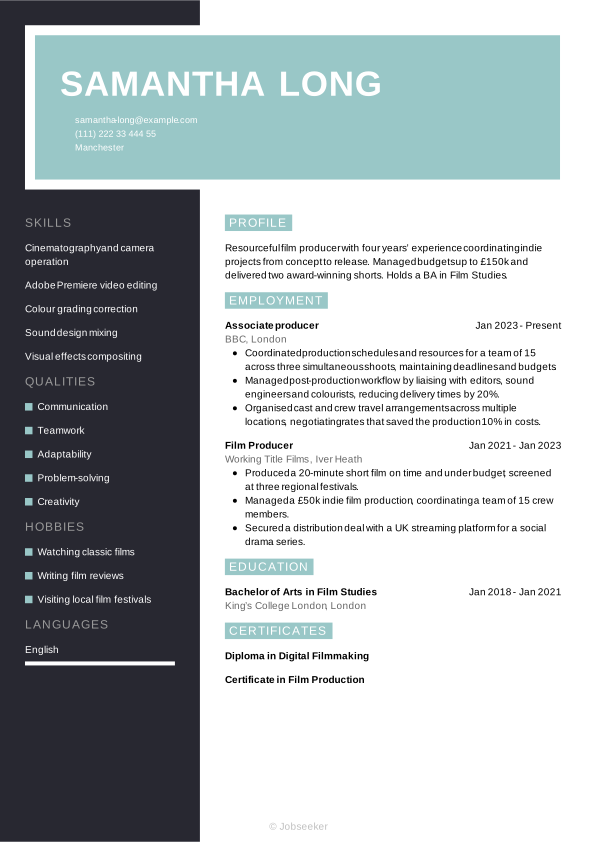
At the end of the day, though, a film CV is just a way to tell the story of how you’ve grown in your career. Regardless of your experience level, you want that progression to feel seamless and easy to follow for recruiters. To help you get there, we’re going to walk through each part of the CV step-by-step, starting with the basics in your header and working our way through to your professional achievements.
CV Header
At the top of your film CV, add a header that establishes the design language of the document. Include the necessary contact information: your full name, email address, phone number and location. It's not typically necessary to include your full address. Additionally, including your LinkedIn profile as a URL can be useful, as it will help the reader to quickly and easily access further information about your career and credentials.
For UK applications, it's not usually advisable to include a personal photo or any other personal details, such as your age, gender, nationality or ethnicity. These can risk introducing bias to the decision-making process and are discouraged under the terms of the Equality Act 2010.
Samantha Long
samantha-long@example.com
(111) 222 33 444 55
Manchester
linkedin․com/in/samantha–long–123
CV Objective
Under your header, write a brief CV summary or CV objective, outlining a few of your key skills, qualities and achievements. This short paragraph can help employers to quickly assess your suitability for the role, setting the tone for your film CV. While a CV summary showcases your key skills and achievements in the context of your career to date, a CV objective provides an alternative approach. It focuses instead on your ambitions for the future, making it ideal for junior candidates without much work experience.
In your summary or objective, write up to three sentences outlining your key skills, unique personal qualities and career achievements or ambitions, taking care to always reflect the requirements listed in the job description.
A good CV summary would typically focus on a couple of key skills that match the job description, demonstrating how you've used them to good effect in previous roles. It's important to focus on your unique qualities and provide a preview of how they've made an impact in your career to date, which you'll unpack later in the document. Find an example below of a positive film CV summary, characterised by evidence to support your claims and well-structured, easy-to-read sentences.
Best practice example:
Independent filmmaker with five years’ experience producing narrative and documentary projects. Directed a BAFTA-shortlisted short film that screened at over 15 international festivals. Holds a BA in Film Production.
Weak example:
Creative independent filmmaker with varied experience across narrative and documentary projects, highly passionate about storytelling and committed to delivering visually engaging content that resonates with audiences and supports innovative goals.
Above is an example of a less effective CV summary, with some subtle, yet notable differences. An ineffective summary might be vague or generic, failing to highlight specific personal qualities that help you stand out and failing to address the requirements specified in the job description. They might also lack firm evidence of your skills, and be structured with long, hard-to-read sentences.
Work History
A CV's work experience section is usually its most important element. Employers will want to see how you've developed relevant skills in previous roles, and how you've put them to good use in successful projects and career achievements. Always take the time to tailor this section, including keywords and phrases that match the job description. This will help employers to judge how strong a fit you are for the role, and how you might apply your skills for the benefit of the organisation.
Add your most relevant previous jobs, including the job title, the name of the employer, its location and the dates you worked there. Below each entry, include several bullet points showcasing your skills and explaining how you used these to achieve positive results.
Standing out with your CV work experience section means using action verbs and measurable outcomes to show the impact you made. You'll want to outline a progression in your skills development, and list evidence of the value you added. See below for an example of a strong work experience section for a film CV.
Best practice example:
Independent Filmmaker, January 2023 - Present
Silver Screen Productions, Manchester
- Directed and edited a ten-minute short film that secured official selection at the Bristol Film Festival.
- Managed all aspects of a £5,000 production budget while completing principal photography on schedule and under cost constraints.
- Collaborated with emerging cast and crew to produce a documentary screened on regional television with positive audience reviews.
Weak example:
Independent Filmmaker, January 2023 - Present
Silver Screen Productions, Manchester
- Directed and edited multiple short films for various events and showcases.
- Managed production processes and coordinated team efforts throughout diverse film projects.
- Collaborated with creative teams to produce compelling visual content for public screenings.
Take a look at a less strong film CV work experience section above. A poor work experience section might look more like a generic list of responsibilities rather than an account of how you've used your skills to positive effect in previous roles. It might also include old or irrelevant job entries and lack tailoring to the job description.
Portfolio and Work Samples
For some applications, including a link in your CV to a career portfolio or examples of your previous work can be advantageous.
Portfolios are most common for creative roles or positions with an emphasis on visual, aesthetic work, but you can actually include any type of work in a portfolio, as long as you can showcase it online. If you choose to add work samples to your CV, you could either add a link to a portfolio, or separate links to examples of completed projects. If adding a portfolio link, you could do so either in its own section, or in your CV header. If adding separate examples, you could include these are links to a company website, your LinkedIn profile or any other place where your work is hosted.
Education
Your education section is the chance to list your most recent and highest qualifications, and anything that's relevant or required for the role.
To be eligible for film industry professional positions, you typically need to have a relevant university degree, and include it in your CV. If you have a Bachelor of Arts in Film Studies or another related degree that qualifies you for the role, you should definitely mention it in your CV, along with any other degrees or qualifications that highlight your most relevant skills, such as cinematography and camera operation or Adobe Premiere video editing.
When listing your qualifications in your education section, select only the most suitable qualifications and list them in reverse-chronological order, starting with the most recent and working backwards. For each qualification, add its name and level, the awarding body or institution, its location (if necessary) and your dates of attendance or graduation. If you want to emphasise your education in your CV, include bullet points showing specialist areas of study, projects, awards, society memberships or anything else that helps show you've got the necessary skills for the job.
Specialist licences or certifications can also be a valuable addition to your CV's education section. If these are essential for the job and are referenced in the job description, it's a good idea to include them here rather than further down your CV. Include any expiration or renewal dates for certifications, if applicable.
Bachelor of Arts in Film Production, 2018 - 2021
Bournemouth University, Bournemouth
Key Skills
Your CV's skills section CV's skills section is a great place to showcase some of the key skills necessary for the role. Check the job description to understand which skills are most essential, and provide a combination of hard and soft skills, reserving space to include some unique qualities that can help you to stand out from the competition. For a film CV, you'll want to focus on the most relevant skills for the role that match your skill set, including adaptability and colour grading correction, to catch the reader's attention and show you're qualified for the film industry professional position.
Hard Skills
Hard skills and technical skills are specialist skills that are essential for carrying out the main responsibilities of the role. You might acquire hard skills through study, or through on-the-job training, and some hard skills may require a certification or licence. For film industry professional positions, hard skills that match your abilities, such as Adobe Premiere video editing, and colour grading correction tend to be valued by recruiters and hiring managers. Check the skills specified in the job description, and add four or five key hard skills to your CV that show employers you're capable of completing the key duties of the role.
You'll want to include a list of hard skills that closely matches the skills listed as 'essential' or 'desirable' in the job description, while also reflecting your own strongest technical skills.
Review the examples below to understand which skills are often added to the hard skills section of a film CV.
- Cinematography and camera operation
- Adobe Premiere video editing
- Colour grading correction
Soft Skills
Your soft skills list should contain a list of your personal strengths that make you suitable for the role, and a good fit for the team and the organisation. In contrast to hard skills, these tend to be transferable and applicable to different roles and levels. Transferable skills are among the most in-demand skills for employers, with rapidly changing and evolving ways of working requiring ever-more flexible and adaptable employees. Soft skills are also highly valuable for junior and entry-level positions, where candidates aren't expected to have a wealth of relevant work experience and career achievements.
Adopt the same approach as you did with your hard skills list, reviewing the job description to understand the requirements, before assessing which soft skills you can provide evidence for throughout your film CV. Aim to add up to five soft and transferable skills, including a mix of the most essential skills from the job description, together with some skills that make you stand out as a unique and compelling candidate.
Here are typical soft skills candidates include in a film CV.
- Communication
- Teamwork
- Adaptability
Expert Tip:
To increase your chances, the National Careers Service recommends fonts that are clean and professional, combined with structured formatting for clarity. (1)
Certifications and Training
Depending on the role you're applying for, and the type of qualifications you have, you might want to include a separate section for certifications, in addition to the education section. If you've been proactive in pursuing professional development opportunities throughout your career, it's worth showcasing them. Not only do they make you more qualified, they also show a proactive and motivated mindset. In addition, some roles require specific licences or training just to be eligible for the job, making the certifications section more important. This might include technical roles or positions which require the operation of specialist software, equipment or machinery.
Here are some key examples of certifications and licences that you could add to your CV for film industry professional positions:
- Diploma in Digital Filmmaking, 2023
- Certificate in Film Production, 2023
- Advanced Diploma in Screenwriting, 2023
Language Skills
Adding foreign language skills to your film CV can be a valuable addition that reflects well on you as a candidate. Even if language skills aren't listed as a requirement in the job description, if you speak a foreign language, it can be beneficial to add it to your CV. List any foreign languages you speak, together with an indication of your proficiency level.
There are several ways to cite your proficiency in foreign languages. Firstly, you could use a simple descriptive word to indicate your abilities, such as:
- English: Fluent
- Spanish: Intermediate
You might choose to adopt an international standard framework for languages, such as the Common European Framework of Reference (CEFR). This assigns a standardised level to your language skills, for example:
- A1: Beginner
- A2: Elementary
- B1: Intermediate
- B2: Upper intermediate
- C1: Advanced
- C2: Proficiency
Additional Information
Optional sections can be useful to add to your CV, to provide additional evidence that you have the skills for the film industry professional job. If you're unable to show you have all the necessary skills for the job through your work experience, optional sections can be a valid way of providing further evidence of your suitability, to give you the chance of gaining an interview. If you're an entry-level candidate or a career changer, optional sections can be particularly valuable.
Explore our career resources for practical strategies to make your CV stand out and move you closer to landing an interview.
Hobbies and Interests
One valid way to show you have relevant skills for the job is by listing your hobbies and interests. In addition, hobbies and interests can showcase your personality, helping to differentiate you from other candidates. However, only mention hobbies and interests that are relevant to the role, and that help you prove skills that you haven't been able to show in your work experience or other CV sections.
Achievements and Awards
Creating a list of your key career achievements can be an effective way of drawing attention to the things you're most proud of from your career. Add any awards you've won or career milestones you've reached, so employers can easily see the impact you've made in your career to date.
Voluntary Work
Listing any previous voluntary work is another useful way of showing you have the necessary skills and experience for the job. If you don't have much relevant work experience, either because you're a junior candidate or you're changing jobs from an unrelated field, volunteering can provide valuable examples of your skills in action. Structure your volunteering section the same as your work experience section.
Add your job title or the name of the volunteer role, the organisation, its location and the dates you volunteered. Also add some bullet points outlining your skills and experience in the role, as well as any key achievements.
References
For UK job applications, it's rare to include references on a CV and employers don't tend to request them until later in the recruitment process. However, it's worth checking the job advert just in case. If the employer requests references on your CV, choose two or three, and always approach them for permission before including them.
Add their name, their job title, the organisation and their contact details. As an alternative, you could add a brief line confirming you're able to supply references when necessary, such as 'references are available upon request'.
Analytical Insight:
If you're adding images or visuals to your CV, make sure they're relevant. While half of HR specialists accept appropriate images on CVs, almost as many (46%), prefer text-only CVs. (2)
Best action words for a film CV
Using strong action verbs in your work experience bullet points gives you the opportunity to show how you've applied skills to good effect in previous roles. Starting each bullet point with an action verb, such as 'delivered', 'collaborated' or 'developed' also allows you to show your key skills and qualities in a way that's easily identifiable for the reader. When adding action verbs to your work experience bullet points, just remember to always provide quantifiable evidence that shows the value you added for each employer. Use past tense for any action verbs that describe previous roles (for example, 'developed') and present tense for current roles (for example 'collaborating').
- Direct
- Produce
- Shoot
- Edit
- Cast
- Storyboard
- Photograph
- Mix
- Score
- Coordinate
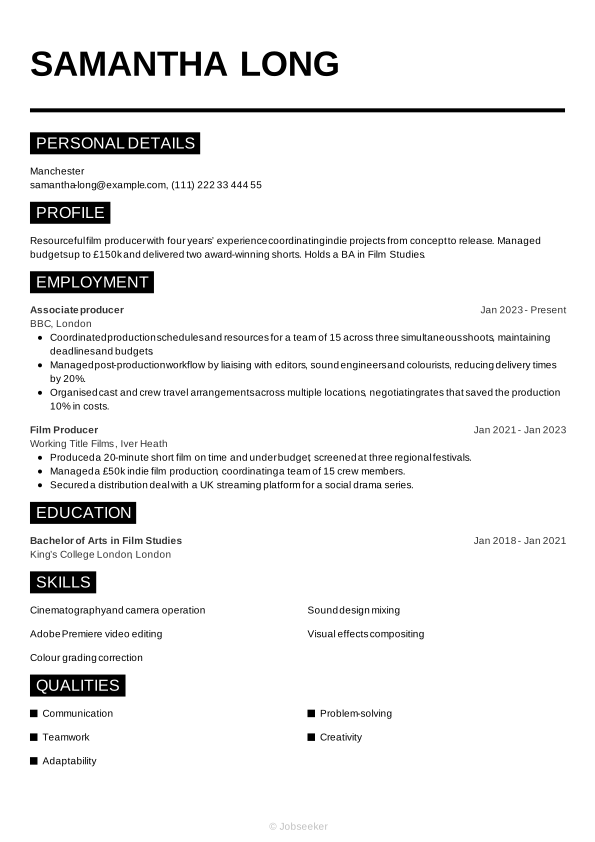
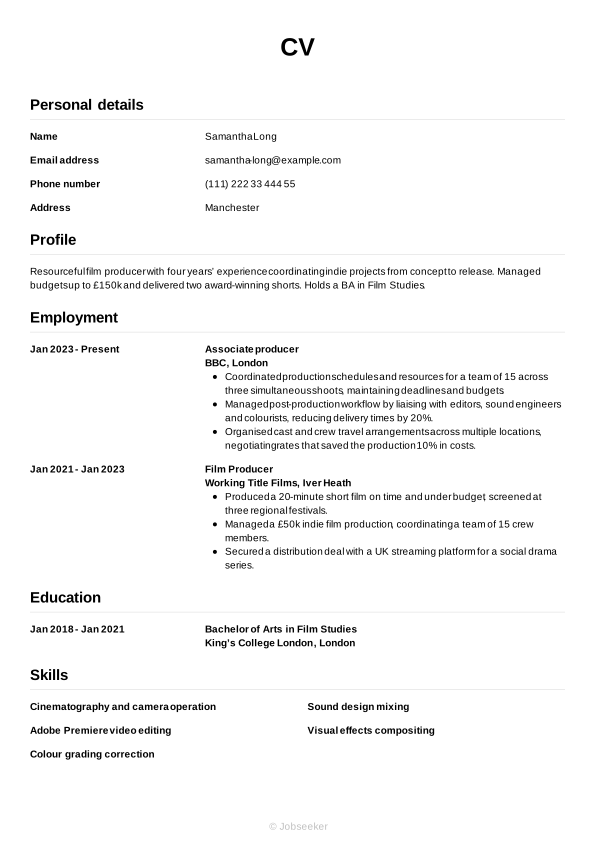
Full example of film CV
Now we've shown you everything that needs to go into your film CV, we can take a look at how it comes together in its final form in the following example:
Manchester
•
samantha-long@example.com
•
(111) 222 33 444 55
•
linkedin․com/in/samantha–long–123
Resourceful film producer with four years’ experience coordinating indie projects from concept to release. Managed budgets up to £150k and delivered two award-winning shorts. Holds a BA in Film Studies.
Associate producer
2023
-2026
BBC (London)
- Coordinated production schedules and resources for a team of 15 across three simultaneous shoots, maintaining deadlines and budgets.
- Managed post-production workflow by liaising with editors, sound engineers and colourists, reducing delivery times by 20%.
- Organised cast and crew travel arrangements across multiple locations, negotiating rates that saved the production 10% in costs.
Bachelor of Arts in Film Studies
2018
-2021
King’s College London (London)
Cinematography and camera operation
Adobe Premiere video editing
Colour grading correction
Communication
Teamwork
Adaptability
Diploma in Digital Filmmaking
Certificate in Film Production
English - Native
French - Advanced
To get an idea of how your completed, one-page CV will look once its been fully designed, see our selection of CV examples.
Dos and don'ts for a winning film CV
Tips to follow
- Use reverse-chronological order, starting with your most recent work experience or qualifications and working back from there.
- Quantify your achievements whenever possible, adding key figures and evidence to support your claims.
- Showcase your key skills with a dedicated skills section that includes both hard and soft skills listed in the job description.
- Start with a strong CV summary or objective, providing a snapshot of your best qualities and achievements to help employers form a positive first impression.
- List your relevant qualifications in a dedicated education section, adding any outstanding grades or awards you won, to help you stand out from the competition.
Common mistakes to avoid
- Don't fixate on irrelevant work experience that might take up valuable space and won't contribute significantly to your chances of success.
- Don't use an inappropriate email address with informal language or nicknames. If necessary, create a professional email address based on your name, initials and/or profession.
- Don't overload your CV with industry jargon and acronyms that may alienate or confuse the reader, instead opt for simple, clear language whenever possible.
- Don't forget to review your contact details to ensure everything is up-to-date, including regularly checking your LinkedIn profile and updating any relevant information.
- Don't add a hobbies and interests section unless they're directly related to the position or help you show skills that you can't prove through work experience.
Guide to CV ATS optimisation
Employers and recruiters now routinely use applicant tracking systems (ATS) to ease the burden of the selection process. One of the key functions of these systems is CV screening, which reviews CVs and ranks them based on their likely fit for the role. By taking on this task, the hiring manager can reduce the time and resources they spend on the initial selection process, making recruitment more efficient and cost-effective.
The increasing usage of ATS apps by recruiters and employers means it's critical to adapt and prepare your applications to successfully navigate this stage of the selection process. Following the tips below will give you everything you need for an ATS-compatible CV:
- Include keywords and phrases that mirror the job description to maximise your chances of ranking highly in the ATS screening stage.
- Use clear headings that reflect standard CV conventions, such as 'work experience', 'education' and 'skills'.
- Choose a standard CV layout, avoiding special design elements such as text boxes, columns or unlabelled graphics that can confound ATS scanning apps.
- Select a font that's widely used and maximises readability, including popular serif and sans serif fonts between size 10 and 12 for body text, and 14 and 16 for headings.
- Use bullet points throughout your CV in place of full sentences. This serves a few purposes, reducing the overall length, helping keywords stand out and making it overall more scannable by ATS apps.
It's easy to get overwhelmed by the steps to creating an ATS-compatible film CV, but a few small changes can make a big difference. To smooth the process, use one of our expert-designed, ATS-optimised CV templates to increase your chances of success at this stage of the screening process.
If you want to impress recruiters with your CV, use Jobseeker's ready-made CV templates, which are HR-approved for maximum chances of success.
Film CV FAQs
Is it a good idea to add a photo to my CV?
You might want to include a personal photo to your CV to enhance the overall design and help it stand out from more basic CVs.
On the contrary though, in the UK it's generally not a good idea to include a personal photo on your CV. This is because it could introduce bias into the recruitment process, whether conscious or unconscious.
Sometimes you may find employers request a personal photo on your CV in the job advert. This tends to be for roles where your appearance plays an important role, such as for acting or modelling jobs. If you're not sure, always check the job advert and unless mentioned, avoid adding a photo.
How do I create a film industry professional cover letter to go with my CV?
An engaging and gently persuasive cover letter can enhance your chances of success with your job applications. Opt for a formal, professional letter format and choose a cover letter template with a design consistent with your CV.
The standard cover letter format includes three main paragraphs of content. The first paragraph includes a brief introduction to yourself and the role you're applying for, and references your motivation for applying for the job. In the second paragraph, list some key skills and achievements, taking care to differentiate from the content in your CV. The closing paragraph typically contains a recap of your enthusiasm for the role, and adds a call to action that establishes dialogue with the employer.
Alternatively, if you're applying for the role via email, you may want to send a less formal cover note. This simply includes a brief introduction, confirming the role you're applying for and directing the reader to the relevant attached documents, rather than following the traditional professional letter conventions. Remember to include your contact details in your email, so the employer can follow up with you if necessary.
Jobseeker's cover letter examples for film industry professional roles and other key media industry positions provide useful HR-expert tips and guidance on how to write a compelling cover letter.
How do I write a film CV to impress without experience?
Even without work experience that fits the job description, there are ways to write a film CV that leaves a strong impression on employers.
Select a CV structure that makes the most of your relevant skills, rather than focusing on your work experience, such as a functional format. In this layout, the skills and education sections come before work experience.
For entry-level roles, employers tend to look more for candidates with the right soft skills to show they can learn and develop on the job. As such, place extra emphasis on your soft skills for an entry-level film CV.
How do I write a film CV headline for maximum impact?
A CV headline can be a way to grab the attention of the reader early in your CV, indicating that you're a good fit for the role and you offer something different to other candidates.
Aim for a short, snappy sentence that includes the job title and introduces one of your strongest, most relevant skills or qualities.
For the most effective CV headline, make sure it reflects the most critical keywords and phrases from the job description. This will also help your CV to pass the ATS screening stage of the recruitment process.
See below for some examples that you can use as inspiration for writing a CV headline for different experience levels:
- Junior Female Film Production Assistant
- Creative Female Film Industry Professional
- Senior Film Producer and Executive
A professional cover letter is a key element of any successful job application. Match your cover letter to your CV's style with our professionally-designed cover letter templates.
Key takeaways for a winning film CV
To make a strong first impression on hiring managers, tailor your CV for every application, adding keywords and phrases that match the job description. Pick a CV format that matches your experience level, and focus on showing the reader how you've developed relevant skills and put them to good use to add value for previous employers.
Finally, using an eye-catching, expert-designed CV template from Jobseeker can really give your CV an edge over those from rival candidates, helping you to achieve success in your job applications.
Citations:
- National Careers Service, How to write a CV
- Jobseeker, Hiring Trends

Impress employers with your CV
Step-by-step guidance to create a professional CV in minutes.