Starbucks CV Example
If you're applying for a job at Starbucks, you'll want to write a CV that demonstrates your experience in the food and beverage sector industry. Your CV is a summary of your relevant key professional skills that clearly demonstrates how you've used them to positive effect in food and beverage sector roles through your career to date.
Founded in 1971, Starbucks is a global coffeehouse chain now operating across the UK, renowned for its artisanal coffee, teas and food offerings. It operates in the food and beverage and hospitality industries.
After reading this article, you'll be equipped with all the tools to produce a winning CV that impresses Starbucks hiring managers, and identifies you as a suitable fit for the role. Putting these steps into action will enhance the likelihood of your CV passing the ATS screening stage, and improve the chances of your Starbucks application progressing to the interview stage. Let’s take a closer look at the key parts of a CV and how to develop them for maximum impact.
Key sections of a Starbucks CV
Your strategy for writing a Starbucks CV will depend heavily on your experience, your level of seniority and the requirements listed in the job description.
However, at any stage of your career, a Starbucks CV serves as a professional biography that must clearly illustrate your career trajectory. To help you tell that story effectively, we will now break down the document piece-by-piece, starting with your contact header and moving through the key pieces of your professional path.
CV Header
Start your Starbucks CV with a professional-looking header that includes all the relevant contact information. This usually includes your name, your email address, your phone number and your location, but not your full address. Additionally, including your LinkedIn profile as a URL can be useful, as it will help the reader to quickly and easily access further information about your career and credentials.
For UK applications, it's not usually advisable to include a personal photo or any other personal details, such as your age, gender, nationality or ethnicity. These can risk introducing bias to the decision-making process and are discouraged under the terms of the Equality Act 2010.
Nicholas Edwards
nicholas-edwards@example.com
(111) 222 33 444 55
Nottingham
linkedin․com/in/nicholas–edwards–123
CV Objective
Below your CV header, the next section tends to be a CV summary or CV objective. This paragraph briefly explains a few of your key skills and qualities, so employers can easily understand whether you're likely to be a suitable candidate for the Starbucks barista job. The CV objective provides an alternative to the standard CV summary. While the CV summary focuses on your skills and achievements through your work experience, a CV objective highlights your ambitions and plans for the future, including how the role fits with these. This makes it ideal for junior candidates.
In your summary or objective, write up to three sentences outlining your key skills, unique personal qualities and career achievements or ambitions, taking care to always reflect the requirements listed in the job description.
An effective CV summary will focus on a few of the key skills required for the role and show how you've put them to good use in your career to date. You'll want to give the reader a good impression of your unique qualities and briefly provide evidence of their impact in previous roles. See below for an example of a strong Starbucks CV summary, featuring quantifiable evidence of your impact and concise, easy-to-read sentences.
Best practice example:
Customer-focused retail sales associate with five years’ experience and a BA in Hospitality Management. Boosted sales by 15% through personalised upselling. Maintained a 95% customer satisfaction rating annually.
Unengaging example:
Enthusiastic Starbucks barista with strong hospitality background and customer service skills, adaptable team player who enjoys a fast-paced environment and strives to contribute through reliable work ethic and effective communication.
See above for an example of an ineffective summary, with subtle differences leading to a reduction of impact. Common mistakes that lead to an ineffective summary include a lack of quantifiable experience, vague statements or failing to tailor your summary to the job description. Long, rambling sentences that lack structure can also make your summary harder to read.
Work History
In your work experience section, it's essential to show any relevant previous employment in the food and beverage sector industry. Study the job description and include skills and achievements that reflect the key requirements listed, and that will resonate with Starbucks recruiters, showing how you can do a good job for their organisation. List previous jobs relevant to the food and beverage sector sector in reverse-chronological order, starting with your current or most recent role. Include your job title, the name of the employer, its location and the dates you worked there. Under each entry, add several bullet points outlining your key skills and achievements in the role.
A successful CV should emphasise relevant previous roles in the industry, providing evidence to show how your key skills related to the food and beverage sector sector have led to positive achievements in your career to date.
Best practice example:
Retail Sales Associate, January 2023 - Present
Costa Coffee, Manchester
- Exceeded monthly sales targets by 25% through effective product demonstrations and personalised customer recommendations.
- Implemented visual merchandising standards that boosted footfall by 15% and enhanced overall store appeal.
- Resolved customer enquiries efficiently, maintaining a 95% satisfaction rating and fostering repeat business.
Unengaging example:
Retail Sales Associate, January 2023 - Present
Costa Coffee, Manchester
- Prepared beverages and handled customer orders in a fast-paced environment with consistent quality standards.
- Maintained cleanliness of workstations and equipment while providing attentive service to patrons.
- Collaborated with team members to ensure smooth operations and fostered positive customer interactions.
Your work experience section may fail to make a positive impact on the reader if it includes jobs that aren't relevant to the food and beverage sector industry, or lacks evidence of key skills and qualities required for working in the sector.
Education
In your education section, list any formal qualifications you've gained, particularly those that are most recent or required for the role.
To work as a Starbucks barista, it's not necessary to have a specific degree. However, while a degree isn't usually requested in the job description, it can be useful to include other relevant qualifications in your CV's education section. These might include SCA Coffee Skills Diploma, or other courses that show your hard skills, such as espresso machine calibration expertise or latte art creation technique.
When creating your education section, think about which qualifications are most relevant to the role, and list them in reverse-chronological order, starting with the most recent and working back from there. For each entry into your education section, add the qualification name and level, the institution or awarding body, its location and your dates of study or graduation. For extra emphasis on your education section, include bullet points showcasing projects you worked on, modules you studied, awards you won or societies you participated in, if they help you to prove you're a suitable candidate.
If the job description requires any specialist certifications or licences, you may wish to add these in your education section. If you add these, it's also a good idea to include the expiration date of the licence or qualification, if it has one.
Bachelor of Arts in Hospitality Management, 2018 - 2021
University of Birmingham, Birmingham
Key Skills
The skills section of a Starbucks CV provides space for showcasing the key skills and qualities that set you apart as a candidate. You'll want to only include the most relevant skills, so review the job description and list hard and soft skills that match the requirements, while reserving some space to mention your own unique characteristics. For a Starbucks CV, you'll want to focus on the most relevant skills for the role that match your skill set, including teamwork and inventory management system operation, to catch the reader's attention and show you're qualified for the Starbucks barista position.
Hard Skills
Hard skills and technical skills are the specialist skills required for completing the everyday duties of the role, such as the use of certain software or equipment, or specialist industry knowledge. You can develop these skills through study, training, on-the-job or through completing industry certifications. For Starbucks barista jobs, essential hard skills from your career-to-date might include quality control procedure adherence, and espresso machine calibration expertise. Review the job description, and include four or five key hard skills in your CV that show employers you're capable of completing the key duties of the role.
The ideal hard skills section will feature the most essential hard skills from the job description, while closely reflecting your own best technical abilities. The closer your strongest skills are to matching the job description, the higher your chances of success.
Take a look below to see the type of skills that are commonly listed in a Starbucks CV hard skills section:
- Espresso machine calibration expertise
- Latte art creation technique
- Inventory management system operation
Soft Skills
Soft skills are the personal strengths and qualities that show employers how well you'll fit into the role and complement other members of the team. Soft skills tend to be more transferable and applicable to different roles than hard and technical skills. Transferable skills are among the most in-demand skills for employers, with rapidly changing and evolving ways of working requiring ever-more flexible and adaptable employees. Soft skills are also highly valuable for junior and entry-level positions, where candidates aren't expected to have a wealth of relevant work experience and career achievements.
Adopt the same approach as you did with your hard skills list, reviewing the job description to understand the requirements, before assessing which soft skills you can provide evidence for throughout your Starbucks CV. Your soft skills list should reflect the job description as closely as possible, while also reflecting your strongest, unique talents and personal qualities. Aim for a list of around five key skills.
Explore the examples below to identify soft skills commonly presented in a Starbucks CV.
- Customer service
- Communication
- Teamwork
Expert Tip:
Transport for London highlights that the most effective CVs are concise, focused on the job description and supported by clear evidence of relevant skills and experience. (1)
Language Skills
If you speak any languages in addition to your mother tongue, you might want to include them in your Starbucks CV as a languages section. These can be valuable for your application, whether languages are specified as a requirement in the job description or not. Within this section, list the foreign languages you speak to a reasonable degree of competence, together with an indicator of your skill levels.
There are a few acceptable ways of citing your foreign language proficiency levels. The simplest way is to assign a basic descriptive word to indicate your skills, such as:
- English: Fluent
- Spanish: Intermediate
You could adopt the Common European Framework of Reference (CEFR), as this provides standardised levels to describe your competence, as follows:
- A1: Beginner
- A2: Elementary
- B1: Intermediate
- B2: Upper intermediate
- C1: Advanced
- C2: Proficiency
Certifications and Licences
To showcase additional qualifications and training beyond the basic requirements for the role, consider adding a certifications section to your CV. It's often beneficial to include it as it can illustrate a positive attitude towards self-improvement and professional development, as well as a proactive mindset. All these qualities will appeal to most employers and decision-makers. In addition, the certifications section can be a valuable addition to your Starbucks CV if you're applying for a role that cites certain certifications or licences as a necessity in the job description. These might include roles where the use of specialist software or equipment forms part of your everyday duties.
Here is a list of some key certifications and licences that can be particularly useful for Starbucks barista applications:
- SCA Coffee Skills Diploma, 2023
- Level 2 Food Hygiene Certificate, 2023
- Level 2 Food Allergen Awareness, 2023
Optional Sections
Including optional sections in addition to the core sections of your Starbucks CV can help you to show employers you're a strong candidate for the job. Consider optional sections for your CV if you're looking for ways to show you're right for the job, beyond your work experience. Optional sections are particularly valuable if you haven't had the chance to build up relevant work experience, for example, if you're applying for entry-level roles or you're changing careers to a new industry or role.
You can find more detailed advice on tailoring your CV in our career resources, where we cover proven ways to highlight your skills effectively.
Hobbies and Interests
One valid way to show you have relevant skills for the job is by listing your hobbies and interests. In addition, hobbies and interests can showcase your personality, helping to differentiate you from other candidates. However, a hobbies and interests section will only make an impact with the reader if the skills you showcase are relevant to the role. As such, only include this section if it helps you fulfil requirements of the role that you've been unable to show elsewhere.
Achievements and Awards
Listing your key career achievements in a distinct section can be an effective way of drawing attention to them. If you've won any awards or achieved any key milestones in your career to date, you might want to mention them here.
Volunteer Roles
Listing volunteer roles is another effective way of showing employers your skills and experience. If you're lacking work experience, either as a junior candidate or a career changer, adding volunteering activities gives you a chance to show how you've put your skills into action. For this section, use a similar structure to your work experience section.
List your job title or a description of the role, the organisation name, its location and the dates you occupied the role. Use bullet points to show employers how you put your skills to use, and any positive achievements from your time in the role.
References
References aren't usually required on a UK CV, so leave them out in most cases. However, it's always worth checking the job advert and being ready to include them if requested. If you need to include references in your CV, aim for two or three and list their name, their contact details, their job title and the organisation they work for.
Always seek permission before you add them to your CV. Alternatively, it can be neater to simply add a line to your CV confirming you can provide references at the appropriate juncture, such as 'references are available upon request'.
Data-Driven Finding:
When writing a cover letter, always tailor it for Starbucks. Almost all recruiters (95%) want to see a cover letter that's tailored to the position you're applying for. (2)
Most impactful action verbs for a Starbucks CV
Using strong action verbs in your work experience bullet points is a great way to focus this section and show the impact you've made in your career to date. Starting each bullet point with an action verb that reflects the skills required for the role will help the reader to easily cross-reference your skills to the job description. Remember, it's essential to evidence any action verbs you add to your work experience. This will help show your achievements and the impact you made in previous roles. Use past tense for action verbs that describe previous roles, and present tense for your current position.
- Prepare
- Serve
- Operate
- Maintain
- Engage
- Recommend
- Sanitise
- Restock
- Handle
- Multitask
Starbucks CV sample
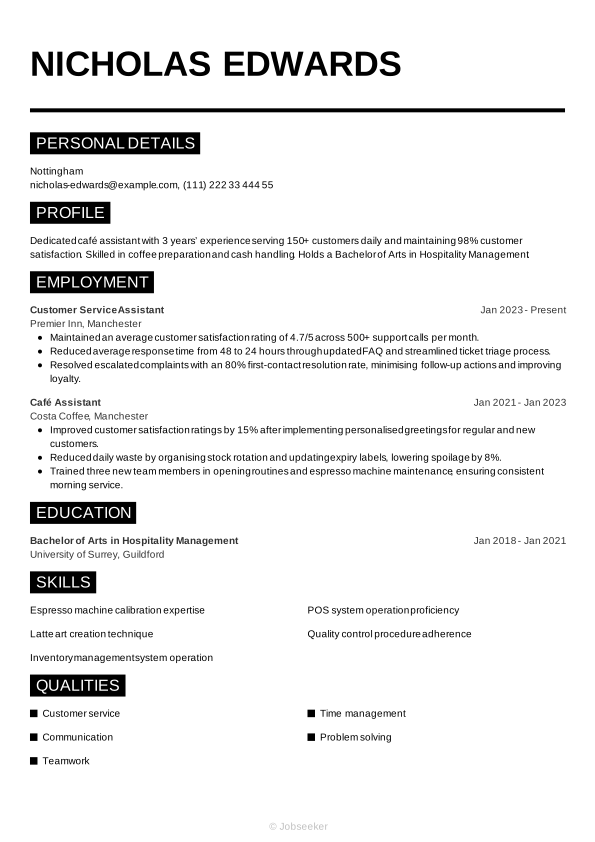
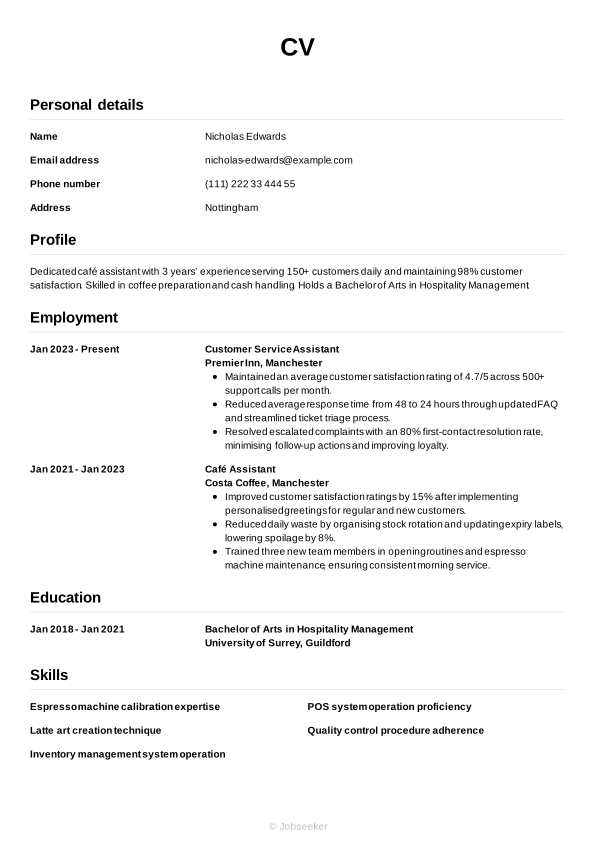
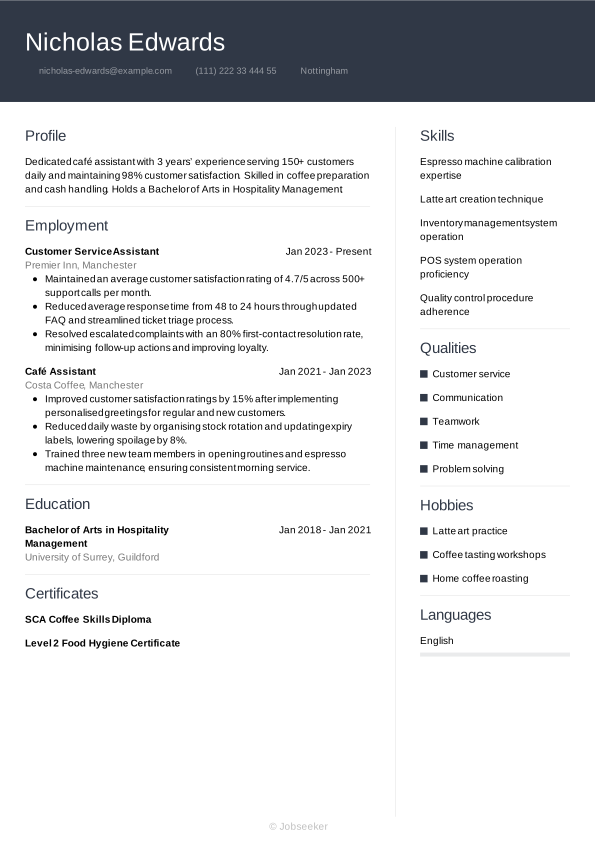
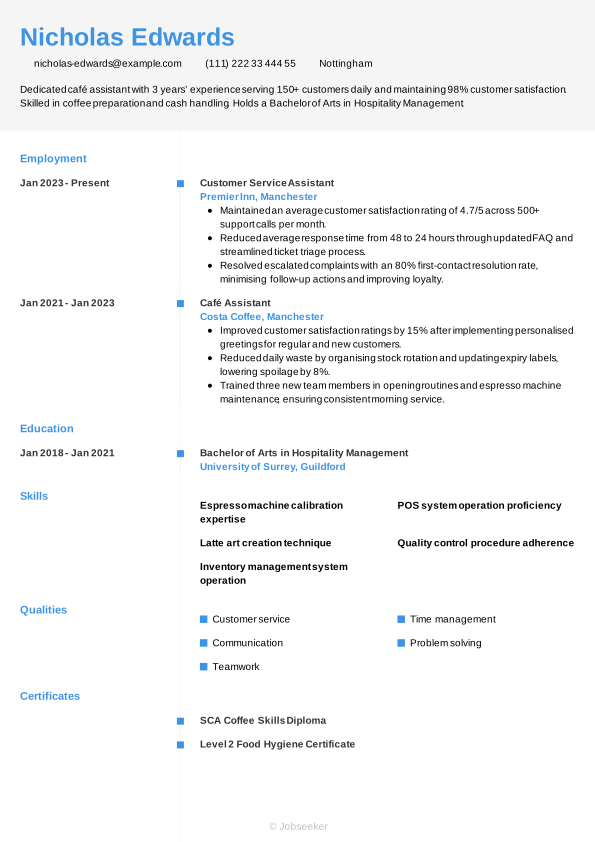
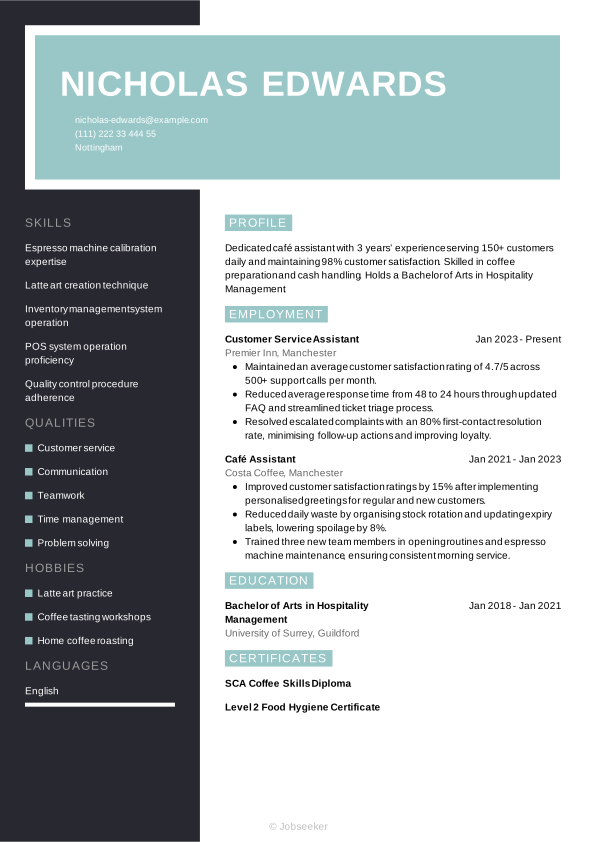
Now we've shown you everything that needs to go into your Starbucks CV, we can take a look at how it comes together in its final form in the following example:
Nottingham
•
nicholas-edwards@example.com
•
(111) 222 33 444 55
•
linkedin․com/in/nicholas–edwards–123
Dedicated café assistant with 3 years’ experience serving 150+ customers daily and maintaining 98% customer satisfaction. Skilled in coffee preparation and cash handling. Holds a Bachelor of Arts in Hospitality Management.
Customer Service Assistant
2023
-2026
Premier Inn (Manchester)
- Maintained an average customer satisfaction rating of 4.7/5 across 500+ support calls per month.
- Reduced average response time from 48 to 24 hours through updated FAQ and streamlined ticket triage process.
- Resolved escalated complaints with an 80% first-contact resolution rate, minimising follow-up actions and improving loyalty.
Bachelor of Arts in Hospitality Management
2018
-2021
University of Surrey (Guildford)
Espresso machine calibration expertise
Latte art creation technique
Inventory management system operation
Customer service
Communication
Teamwork
SCA Coffee Skills Diploma
Level 2 Food Hygiene Certificate
English - Native
French - Advanced
To see how your CV might look after finalising its design and layout, take a look at our CV examples.
Dos and don'ts for a winning Starbucks CV
Tips to follow
- Open your CV with a strong CV summary or objective, providing a brief account of your career achievements and skills.
- Proofread your CV thoroughly before sending, to avoid any spelling and grammar errors that could harm your chances of success.
- Use reverse-chronological order, starting with your most recent work experience or qualifications and working back from there.
- Select a clear, professional CV format that makes your document as readable as possible, utilising standard fonts, consistent line spacing and clear headings throughout.
- Keep your CV concise, with a target length of one side of A4 for junior roles, two for more experienced candidates and longer only for high-level, executive or academic positions.
Common mistakes to avoid
- Don't use passive voice, such as 'financial statements were prepared', but opt instead for powerful action verbs that showcase the impact you made.
- Don't use an unsuitable email address with informal language or nicknames, but instead opt for a professional email address combining elements of your name, initials or profession.
- Don't use overly elaborate CV formatting and designs that make your document harder to read and more confusing for ATS software.
- Don't use unnecessary industry jargon or acronyms that may alienate the reader, when simple, straightforward language will do the job.
- Don't forget to check your contact details to make sure they're current, and update your LinkedIn profile to ensure it doesn't contradict your CV.
Guide to CV ATS optimisation
Employers and recruiters now routinely use applicant tracking systems (ATS) to ease the burden of the selection process. One of the key functions of these systems is CV screening, which reviews CVs and ranks them based on their likely fit for the role. This task can relieve some of the strain on hiring managers through the recruitment process, which can become very resource-intensive, with roles often eliciting hundreds of applications.
The growing prevalence of ATS apps requires a shift in approach by jobseekers, to prepare a CV with the best chance of passing the ATS screening stage. That's why we've put together a list of key ATS CV tips, to maximise your chances of success:
- Include keywords and phrases that match the job description, making it easy for ATS apps to identify a strong fit for the role.
- Use standard CV headings that clearly identify each section, such as 'work experience', 'education' and 'skills'.
- Choose a standard CV layout, avoiding special design elements such as text boxes, columns or unlabelled graphics that can confound ATS scanning apps.
- Select a font that enhances the readability of your CV, including recognised serif and sans serif fonts between sizes 10 and 12 for body text, and 14 and 16 for headings.
- Use bullet points rather than writing long, full sentences, as this will make your CV easier to scan and parse, and help your keywords and phrases to stand out.
There are lots of things to think about when crafting an effective, engaging Starbucks CV, but ATS compatibility is something that's easy to overcome. Use one of our expert-designed, ATS-compatible CV templates and remove the stress from creating a CV that puts you in the frame for the role.
To make a splash with your CV, use one of Jobseeker's professional-looking CV templates. They come approved by HR specialists to maximise your chances of success.
Starbucks CV FAQs
How do I write a Starbucks barista cover letter for my job application?
A cover letter that makes a positive impact with the reader can be just as important as your CV. For the best impact, choose a formal, professional letter layout and a cover letter template that reflects the look and feel of your CV, reinforcing your application's design language.
Most cover letters include three standard paragraphs of information. The letter opens with a brief personal introduction and confirmation of the role you're applying for, and your motivations for applying. In the next paragraph, list some key skills and career achievements related to the role, taking care not to repeat your CV. Finally, end your cover letter with an expression of gratitude for considering your application, and a call to action that puts the ball in the court of the employer to arrange an interview or establish dialogue with you.
As an alternative to the traditional cover letter, you may wish to send your application via email with a simple cover note. This includes a short introduction to yourself, confirms the role you're applying for and directs the reader towards the attached CV. With email cover notes, you don't need to follow full letter-writing conventions and can be less formal in your tone. Always include your contact details in your sign-off or email footer.
Jobseeker's cover letter examples for food and beverage sector industry job titles can help you gain valuable insights from HR specialists on how to craft the most engaging, professional cover letter.
How do I write a Starbucks CV without experience?
Even if you don't have much work experience, you can still write a Starbucks CV that impresses employers.
Choose a CV format that places greater emphasis on your skills over your work experience, such as the functional format. In this CV layout, your skills section and education typically come before your work experience.
If you're applying for your first job, focusing on your soft and transferable skills can help you to create a strong Starbucks CV. Employers will likely be looking for candidates who can show they have well-developed soft skills for learning and adapting to a new role and environment.
How do you write an impactful Starbucks CV headline?
A CV headline can help you add relevant keywords into your CV, aiding ATS compatibility while catching the attention of the reader from the outset.
Look to craft a short. eye-catching sentence that demonstrates your greatest skills and natural strengths, and includes the job title.
To give your CV the best shot at success, write a CV headline that focuses on the most essential keywords and phrases from the job description. This will strike a chord with the hiring manager and help your CV to pass the ATS screening stage.
See below for some examples that you can use as inspiration for writing a CV headline for different experience levels:
- Junior Coffee Assistant Elevating Sales
- Experienced Café Assistant with Degree
- Experienced Coffee Leader Boosting Sales
What's the best Starbucks CV format for 2026?
The most suitable format for your Starbucks CV in 2026 will depend heavily on numerous factors, such as your career stage and experience levels, the type and level of the role, the organisation and established industry norms.
In most cases, the traditional reverse-chronological CV format is most effective, as it showcases your work experience, providing examples of relevant skills and how you've used them to contribute towards key achievements in your career to date.
Conversely, for less experienced candidates such as graduates and career changers, a functional CV format may work better, as this highlights your key skills and qualifications over your work experience.
A professional cover letter is a key element of any successful job application. Match your cover letter to your CV's style with our professionally-designed cover letter templates.
Key takeaways for a successful Starbucks CV
To give you the best chance of success with your CV, tailor it for every specific application, including keywords that reflect the job description. Pick a CV format that matches your experience level, and focus on showing the reader how you've developed relevant skills and put them to good use to add value for previous employers.
Finally, using an eye-catching, expert-designed CV template from Jobseeker can really give your CV an edge over those from rival candidates, helping you to achieve success in your job applications.
Sources:
- Transport for London (TfL), Writing a CV and cover letter
- Jobseeker, Hiring Trends

Impress employers with your CV
Step-by-step guidance to create a professional CV in minutes.