Regional Manager CV Example
If you're hoping to launch a career in the management industry, including regional manager roles, it's essential to write a CV that shows your skills and achievements in the best light. You'll want to focus on key responsibilities that are essential for the role and match your experience, such as managing P&L reports and driving sales growth. In this guide, we'll equip you with all the key tips and advice you'll need to craft a regional manager CV that sets you up for success in your job applications.
A meticulously crafted, tailored regional manager CV gives your application the best chance of passing the ATS screening stage, impressing the hiring manager and progressing to the interview stage. We’ll now go through the key sections of a CV and explain how to write them strategically.
Key sections of a regional manager CV
Your strategy for writing a regional manager CV will depend heavily on your experience, your level of seniority and the requirements listed in the job description.
If you're just starting out in your career, it's likely you won't have much work experience to showcase on your CV. As such, you'll want to flesh out your skills and achievements through other sections of your CV. As a junior candidate, therefore, you might prefer to use a functional, or skills-based, CV format. This layout brings your skills and education sections to the fore, de-prioritising your work experience section. Use optional sections such as hobbies and interests, volunteering and certifications and training to help you prove you have the necessary skills for the job.
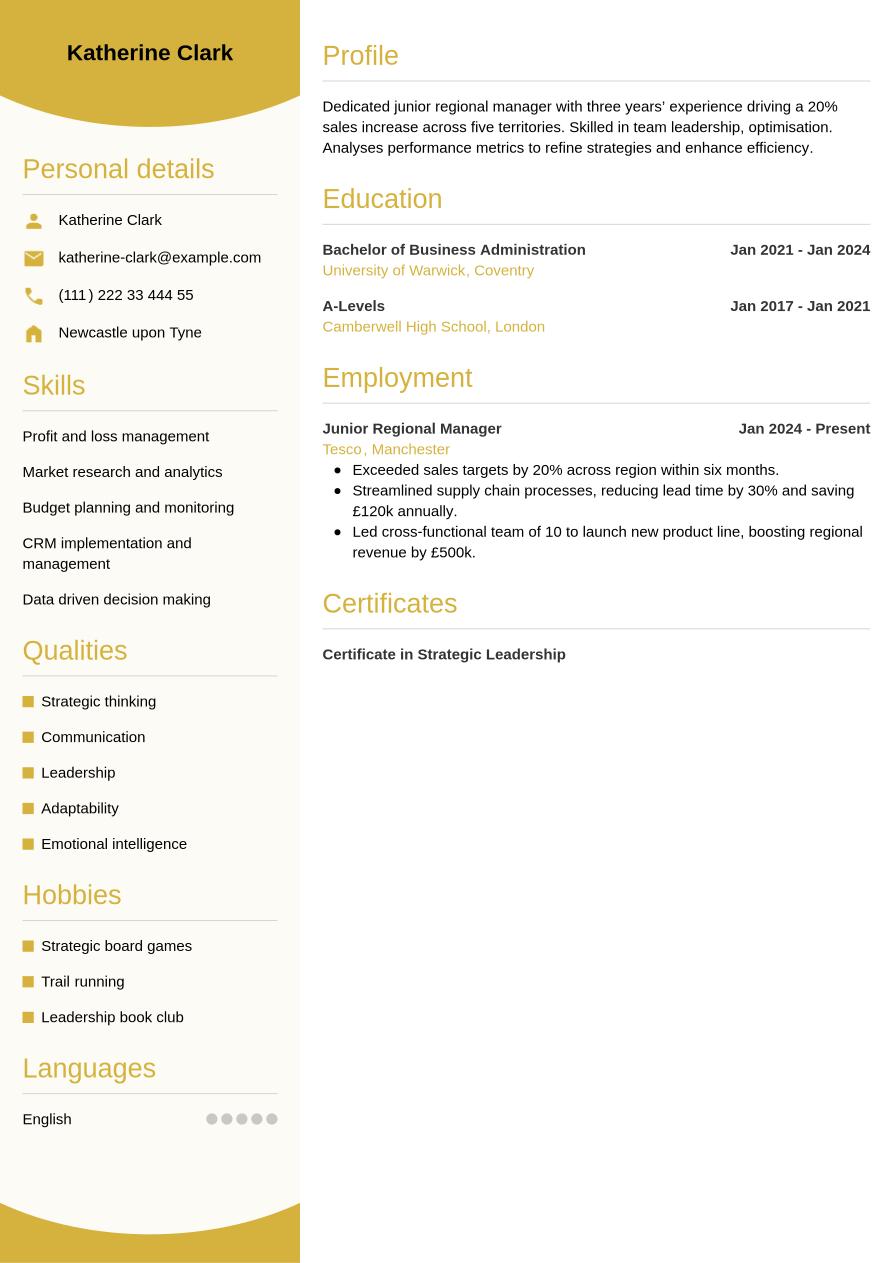
Once you've got some relevant work experience under your belt, you'll want your CV to focus on this as much as possible, and show how you've developed your skills and put them to good use in the workplace. Employers will be keen to see the impact you've had in other roles, and for other organisations. In this scenario, a reverse-chronological CV format is usually the most effective choice. Focus on your most recent and relevant previous roles and use bullet points to show your key skills and achievements, offering evidence that showcases your impact.
As a senior candidate with a wealth of relevant experience, it's important that your CV showcases your reputation within your industry. Employers will be looking for candidates with the expertise, industry standing and track record to lead a team or organisation. As such, opt for a detailed reverse-chronological CV structure that can adequately showcase the quality and depth of your work experience. You could also add awards, publications, achievements and professional memberships to provide an indication of your standing and reputation.
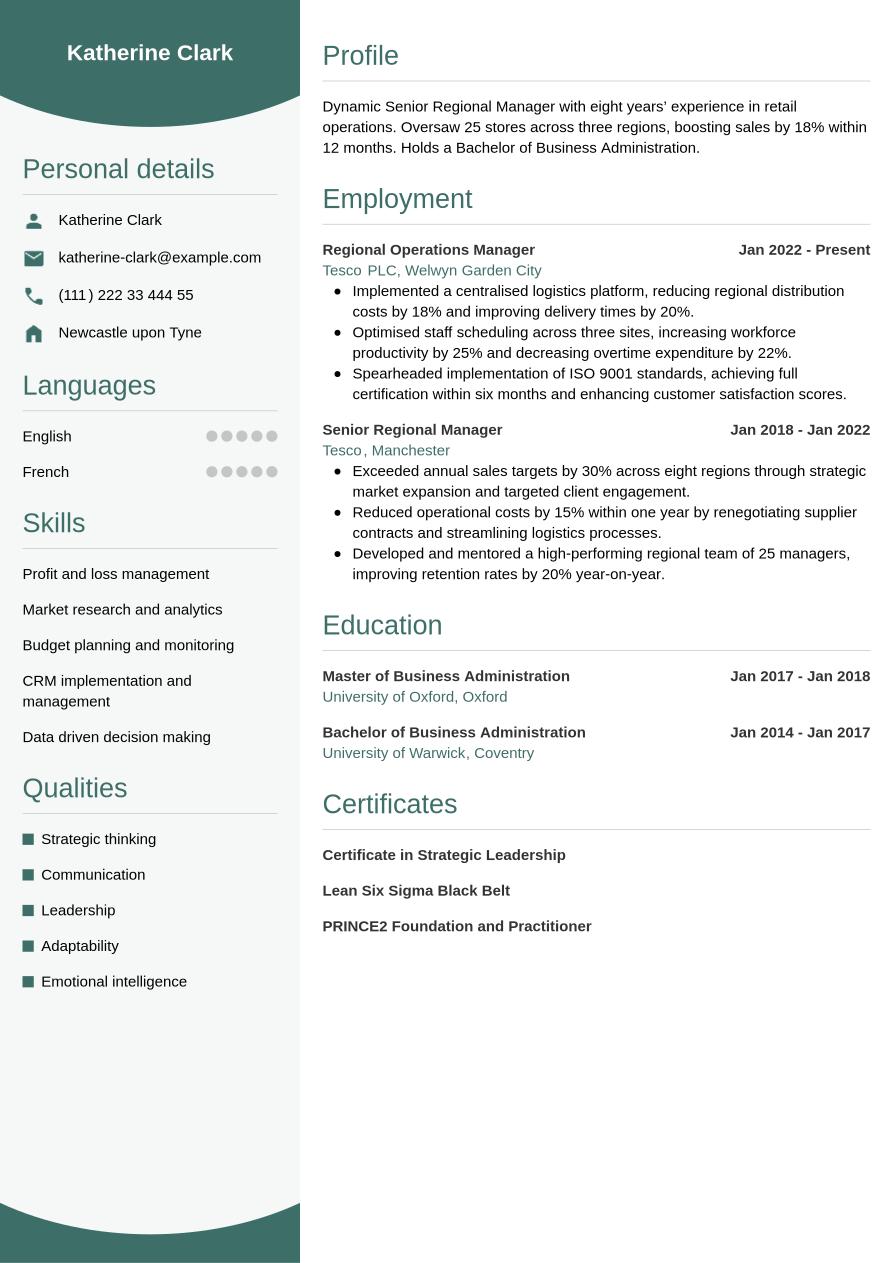
At the end of the day, though, a regional manager CV is just a way to tell the story of how you’ve grown in your career. Regardless of your experience level, you want that progression to feel seamless and easy to follow for recruiters. To help you get there, we’re going to walk through each part of the CV step-by-step, starting with the basics in your header and working our way through to your professional achievements.
CV Header
Start your regional manager CV by adding a professional-looking header that contains all your relevant contact information. Include your name, email address, phone number and location (your full address isn't typically necessary for UK job applications). Additionally, including your LinkedIn profile as a URL can be useful, as it will help the reader to quickly and easily access further information about your career and credentials.
For UK applications, it's not usually a good idea to add a personal photo or any other personal details, such as your age, gender, nationality or ethnicity. These can risk introducing bias to the selection process and, as such, are often discouraged in job adverts under the terms of the Equality Act 2010.
Katherine Clark
katherine-clark@example.com
(111) 222 33 444 55
Newcastle upon Tyne
linkedin․com/in/katherine–clark–123
CV Summary
Under your header, write a brief CV summary or CV objective, outlining a few of your key skills, qualities and achievements. This short paragraph can help employers to quickly assess your suitability for the role, setting the tone for your regional manager CV. While the CV summary focuses on your key skills and achievements, a CV objective highlights your career ambitions, making it more suitable for junior candidates.
For either a CV summary or an objective, aim for a length of two or three sentences. Showcase a few key skills, personal qualities and career achievements or ambitions, always reviewing the job description as you write, to show how you fulfil the requirements of the role.
An effective CV summary will focus on a few of the key skills required for the role and show how you've put them to good use in your career to date. You'll want to give the reader a good impression of your unique qualities and briefly provide evidence of their impact in previous roles. Find an example below of a positive regional manager CV summary, characterised by evidence to support your claims and well-structured, easy-to-read sentences.
Engaging example:
Experienced Regional Manager with 5 years’ tenure and a Bachelor of Business Administration. Former Area Sales Manager, driving 25% sales growth across three regions in 12 months. Adept at exceeding targets.
Weak example:
Versatile regional manager with substantial leadership experience who holds a Bachelor of Business Administration and seeks to enhance operational performance, foster productive relationships and support strategic initiatives through teamwork.
The regional manager CV summary above gives you an idea of what to avoid. The differences are subtle, yet significant. There are several factors that could make your summary less engaging. These include using long, poorly-structured sentences, failing to add evidence of your impact, being too generic with the skills you mention and not adapting your CV summary to specifically respond to the job description.
Professional Experience
Work experience is usually the most important section of any CV. Employers will be looking for evidence of how you've developed relevant skills in your career to date, and how you've used them to positive effect in previous roles. Always tailor this section of your CV, focusing on keywords and phrases that match the job description, so employers can assess how you might put the same skills and qualities to good use in the future.
Add your most relevant previous jobs, including the job title, the name of the employer, its location and the dates you worked there. Below each entry, include several bullet points showcasing your skills and explaining how you used these to achieve positive results.
The difference between an average CV work experience section and an outstanding one is the use of action verbs and quantifiable evidence. You'll want to show how your actions led to measurable positive outcomes for employers, and indicate a progression in your skills throughout your career. Take a look at this regional manager CV example work experience section for inspiration:
Engaging example:
Area Sales Manager, January 2023 - Present
Crescent Supply Chain Solutions Ltd, Manchester
- Exceeded annual sales quota by 30% across five counties through strategic client engagement and targeted promotional campaigns.
- Expanded market share by securing 15 new key accounts worth £2m annual revenue through tailored proposals and relationship building.
- Reduced sales cycle duration by 20% by implementing CRM enhancements and training team on efficient pipeline management.
Weak example:
Area Sales Manager, January 2023 - Present
Crescent Supply Chain Solutions Ltd, Manchester
- Managed regional teams to deliver strategic objectives and maintain stakeholder relationships across diverse operational areas.
- Coordinated cross-functional projects to optimise service delivery and drive continuous improvements in regional performance.
- Oversaw implementation of key initiatives to streamline processes and enhance team productivity across multiple locations.
Take a look at a less strong regional manager CV work experience section above. A less-engaging work experience section might include irrelevant roles or jobs from a long time ago, and generic information that fails to address the requirements of the job description. It could also lack evidence to support the claims made in the bullet points.
Education and Qualifications
Your education section is the chance to list your most recent and highest qualifications, and anything that's relevant or required for the role.
For careers as a regional manager, you don't generally need a specific degree. However, it can still be useful to include relevant certifications, training or formal qualifications in your CV's education section, even if these aren't requested by the employer. These could include PRINCE2 Foundation and Practitioner, or any training that shows your skills development in data driven decision making or profit and loss management.
Your education section should contain only the qualifications that you consider most relevant to the role. List them in reverse-chronological order, starting with the most recent and working back from there. For each qualification, add its name and level, the awarding body or institution, its location (if necessary) and your dates of attendance or graduation. If you want to emphasise your education in your CV, include bullet points showing specialist areas of study, projects, awards, society memberships or anything else that helps show you've got the necessary skills for the job.
Specialist licences or certifications can also be a valuable addition to your CV's education section. If these are essential for the job and are referenced in the job description, it's a good idea to include them here rather than further down your CV. Include any expiration or renewal dates for certifications, if applicable.
Bachelor of Business Administration, 2018 - 2021
University of Warwick, Coventry
Skills
The skills section of a regional manager CV provides space for showcasing the key skills and qualities that set you apart as a candidate. You'll want to only include the most relevant skills, so review the job description and list hard and soft skills that match the requirements, while reserving some space to mention your own unique characteristics. For a regional manager CV, you'll want to focus on the most relevant skills for the role that match your skill set, including leadership and budget planning and monitoring, to catch the reader's attention and show you're qualified for the regional manager position.
Hard Skills
Hard and technical skills are the essential skills required for carrying out the everyday duties of the role. They might include specialist operation of certain software or equipment, or knowledge of certain industry standards and regulations. You could gain these skills via training, certifications or industry experience. For regional manager roles, key hard skills you've gained, such as profit and loss management, and budget planning and monitoring, are typically among the most critical for the job. Firstly, check the job description, then add four or five key hard skills in your CV that help the employer to decide if you're a good fit for the role.
The best hard skills section would be based around skills listed as 'essential' or 'required' in the job description. To give yourself the best chance of success, you'll want your strongest skills to match closely with those most desired by the employer, and your hard skills list should reflect this.
The following section highlights skills that are commonly listed under hard skills in a regional manager CV:
- Profit and loss management
- Market research and analytics
- Budget planning and monitoring
Soft Skills
In your soft skills list, add any personal qualities and transferable skills that show you'll be a good fit for the role, you'll settle in well with the organisation and you'll complement other team members. Soft skills are typically more transferable and applicable to different roles than hard and technical skills. As a result of rapid technological changes in the world of work, soft skills are becoming ever-more valued by employers. Soft skills can also be particularly valuable for junior or entry-level roles where candidates haven't necessarily had the time to develop hard skills and career achievements.
Adopt the same approach as you did with your hard skills list, reviewing the job description to understand the requirements, before assessing which soft skills you can provide evidence for throughout your regional manager CV. Create a list of four or five transferable skills, combining the most essential skills from the job description with the skills that help you to stand out as a unique and compelling candidate for the position.
Consider the following soft skills that frequently appear in a regional manager CV.
- Strategic thinking
- Communication
- Leadership
Language Skills
Including a section on language skills can be beneficial, if you speak at least one language to a reasonable level of competency, in addition to your mother tongue. This is true even if language skills aren't a requirement for the role, as foreign language abilities often correlate to other valuable soft skills. Within this section, list the foreign languages you speak to a reasonable degree of competence, together with an indicator of your skill levels.
There are a few acceptable ways of citing your foreign language proficiency levels. The simplest way is to assign a basic descriptive word to indicate your skills, such as:
- English: Fluent
- Spanish: Intermediate
You could otherwise use an internationally recognised language standard, such as the Common European Framework of Reference (CEFR). This assigns your language skills a standardised level of competence, as follows:
- A1: Beginner
- A2: Elementary
- B1: Intermediate
- B2: Upper intermediate
- C1: Advanced
- C2: Proficiency
Certifications and Training
To showcase additional qualifications and training beyond the basic requirements for the role, consider adding a certifications section to your CV. It's often beneficial to include it as it can illustrate a positive attitude towards self-improvement and professional development, as well as a proactive mindset. All these qualities will appeal to most employers and decision-makers. Furthermore, if there are any necessary certifications or licences for the job, this CV section takes on even more importance. If you're applying for a technical role or a position that involves the use of specialist software or equipment, these might make it more necessary to include a section showcasing your training.
Here are some key examples of certifications and licences that you could add to your CV for regional manager positions:
- Certificate in Strategic Leadership, 2023
- Lean Six Sigma Black Belt, 2023
- PRINCE2 Foundation and Practitioner, 2023
Expert Tip:
According to Barnet Council, a concise CV and a well-crafted personal statement can make all the difference in that crucial 8.8-second scan. (1)
Optional Sections
Optional sections can be useful to add to your CV, to provide additional evidence that you have the skills for the regional manager job. If you're unable to show you have all the necessary skills for the job through your work experience, optional sections can be a valid way of providing further evidence of your suitability, to give you the chance of gaining an interview. If you're an entry-level candidate or a career changer, optional sections can be particularly valuable.
Explore our career resources for practical strategies to make your CV stand out and move you closer to landing an interview.
Hobbies and Interests
Your hobbies and interests can be a useful way of showcasing additional skills that are relevant to the job description, but that you haven't been able to prove via your work experience. In addition, this section is the ideal way to show aspects of your personality that might not otherwise shine through in your CV, helping to offer a point of difference compared to other candidates. However, a hobbies and interests section is only valuable if it helps you to show relevant skills you've been unable to evidence in other parts of your CV. If your hobbies and interests are unrelated to the job, it's best to leave them off your CV.
Awards and Achievements
Creating a section for your achievements and awards can help you draw attention to the things you're most proud of in your career to date. In your list, add any awards you've won, industry recognition or key career milestones that tell a story about your suitability for the role and place you ahead of other candidates.
Volunteering
Listing volunteer roles is another effective way of showing employers your skills and experience. If you're lacking work experience, either as a junior candidate or a career changer, adding volunteering activities gives you a chance to show how you've put your skills into action. Approach your volunteering section in much the same way as your work experience section.
For each entry, include a job title or description of your role, the organisation, its location and the dates you volunteered. Adding bullet points can also help you to show how you developed relevant skills, and used them to good effect.
Data Insight:
More than 3 out of every 4 recruiters use ATS software to check basic candidate details, including experience levels, hard skills and previous job titles. (2)
Best action verbs for an engaging regional manager CV
Using strong action verbs in your work experience bullet points is a great way to focus this section and show the impact you've made in your career to date. Starting each bullet point with an action verb that reflects the skills required for the role will help the reader to easily cross-reference your skills to the job description. When adding action verbs to your work experience bullet points, just remember to always provide quantifiable evidence that shows the value you added for each employer. Use past tense for any action verbs that describe previous roles (for example, 'developed') and present tense for current roles (for example 'collaborating').
- Manage
- Coordinate
- Oversee
- Develop
- Implement
- Strategise
- Analyse
- Negotiate
- Mentor
- Forecast
Example of a regional manager CV
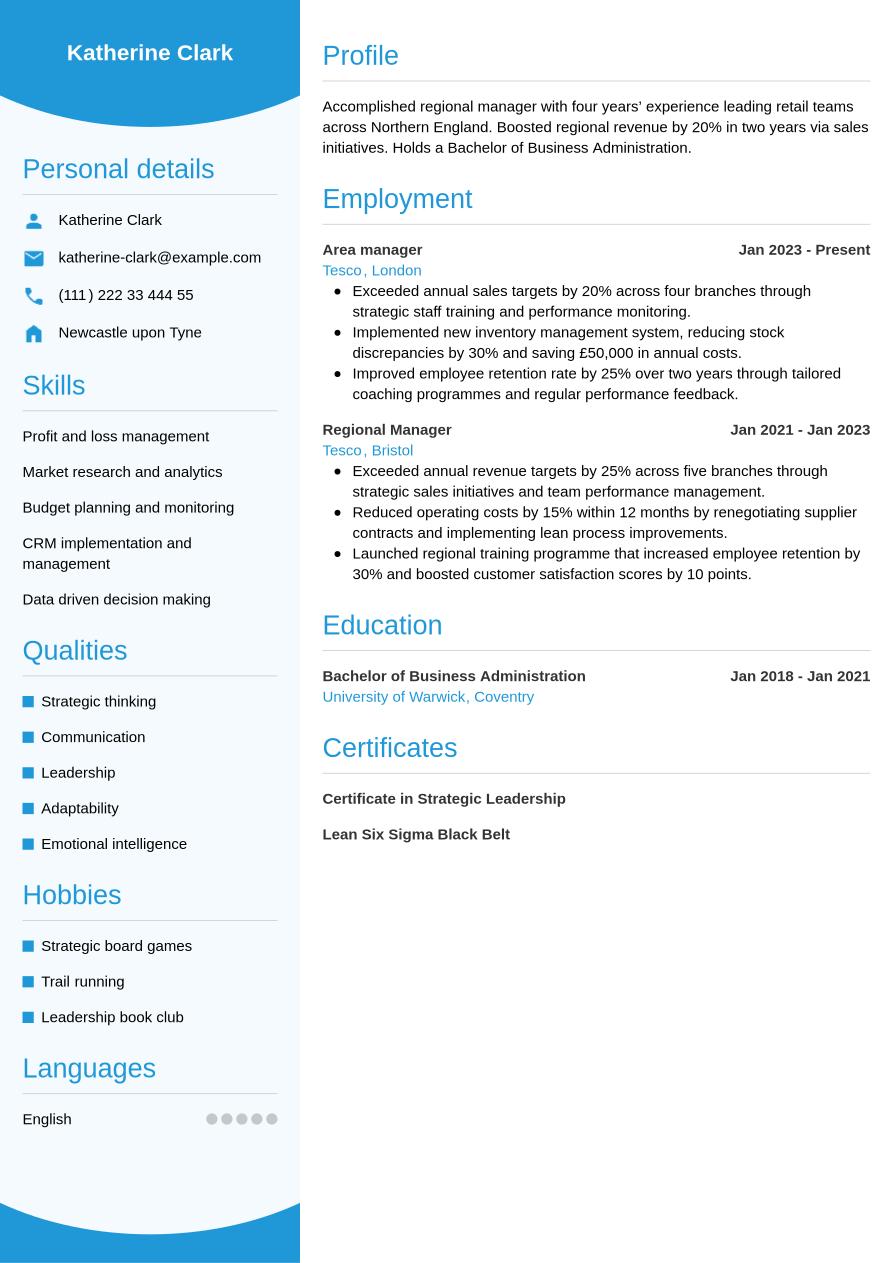
Now we've shown you everything that needs to go into your regional manager CV, we can take a look at how it comes together in its final form in the following example:
Newcastle upon Tyne
•
katherine-clark@example.com
•
(111) 222 33 444 55
•
linkedin․com/in/katherine–clark–123
Accomplished regional manager with four years’ experience leading retail teams across Northern England. Boosted regional revenue by 20% in two years via sales initiatives. Holds a Bachelor of Business Administration.
Area manager
2023
-2026
Tesco (London)
- Exceeded annual sales targets by 20% across four branches through strategic staff training and performance monitoring.
- Implemented new inventory management system, reducing stock discrepancies by 30% and saving £50,000 in annual costs.
- Improved employee retention rate by 25% over two years through tailored coaching programmes and regular performance feedback.
Bachelor of Business Administration
2018
-2021
University of Warwick (Coventry)
Profit and loss management
Market research and analytics
Budget planning and monitoring
Strategic thinking
Communication
Leadership
Certificate in Strategic Leadership
Lean Six Sigma Black Belt
English - Native
French - Advanced
If you want to get a feel for how your CV will look once you finalise its design and layout, check out our CV examples for inspiration.
Best practice and common mistakes for your regional manager CV
Tips to follow
- Use a reverse-chronological approach to listing your career timeline and education, starting with your most recent roles and courses, and working back from there.
- Use a clear, professional CV format, choosing a readable font, consistent line spacing and clear headings, to make your CV as accessible as possible.
- Keep your CV concise, aiming to limit it to one side of A4 for junior applications, two for more senior roles or more than two for any high-level, executive or academic applications.
- Tailor your CV to reflect the key skills and experience listed in the job description, while highlighting your best career achievements.
- Showcase your key skills with a dedicated skills section that includes both hard and soft skills listed in the job description.
Common mistakes to avoid
- Don't forget to check your contact details before sending your CV, ensuring they're current and updating your LinkedIn profile with your latest career information.
- Don't overburden the reader with too much information but stick to the most relevant, concise and focused content possible.
- Don't try to impress with industry jargon or acronyms that can make your CV less readable, when simple, clear language will do the same job.
- Don't add too much irrelevant or unrelated information to your CV regarding work or other experience – it takes up valuable space and doesn't help your chances of success.
- Don't add an inappropriate email address to your CV comrosing of nicknames or informal language. If needed, create a dedicated professional email address combining elements of your name, initials and/or profession.
A compelling cover letter is an essential part of a successful job application. Ensure your cover letter matches the style and design of your CV with our professional cover letter templates.
Guide to making your CV ATS compatible
Applicant tracking systems (ATS) are a valuable tool for many recruiters and employers, helping them manage the recruitment process by scanning and assessing CVs based on their likely fit to the job description. By taking on this task, the systems can save hiring managers the time and effort of reviewing every CV in detail. With vacancies regularly receiving hundreds of applications, this can increase the efficiency of the recruitment process.
The growing prevalence of ATS apps requires a shift in approach by jobseekers, to prepare a CV with the best chance of passing the ATS screening stage. That's why we've put together a list of key ATS CV tips, to maximise your chances of success:
- Include keywords and phrases that mirror the job description to maximise your chances of ranking highly in the ATS screening stage.
- Use clear, conventional CV headings to make your CV easier to navigate, including 'work experience', 'education' and 'skills'.
- Choose a standard CV layout, avoiding special design elements such as text boxes, columns or unlabelled graphics that can confound ATS scanning apps.
- Select a font that's widely used and maximises readability, including popular serif and sans serif fonts between size 10 and 12 for body text, and 14 and 16 for headings.
- Use bullet points instead of writing full sentences, to reduce the overall length of your CV, make it more keyword-dense and help ATS apps to scan it more easily.
It might seem like there's a lot to remember when it comes to making an ATS-compatible CV, but taking care with this stage can really improve your chances of success. To make the process as easy as possible, use one of our expert-designed, ATS-optimised CV templates and boost your chances of success.
If you're looking to make a strong first impression on hiring managers with your CV, use Jobseeker's eye-catching CV templates, which are approved by HR experts.
Regional manager CV FAQs
How do I write a regional manager cover letter to accompany my CV?
A cover letter that makes a positive impact with the reader can be just as important as your CV. For the best impact, choose a formal, professional letter layout and a cover letter template that reflects the look and feel of your CV, reinforcing your application's design language.
The standard cover letter format includes three main paragraphs of content. The first paragraph includes a brief introduction to yourself and the role you're applying for, and references your motivation for applying for the job. In the second paragraph, list some key skills and achievements, taking care to differentiate from the content in your CV. The closing paragraph typically contains a recap of your enthusiasm for the role, and adds a call to action that establishes dialogue with the employer.
Alternatively, if applying via email, you may wish to write a shorter, more simple cover note. You can use traditional email conventions for this, which are less formal than standard letter conventions. Simply introduce yourself and confirm the role you're applying for, direct the reader to the attached documents and add your contact details in your email footer/sign-off.
Jobseeker's cover letter examples for regional manager and management industry roles provide useful tips and guidance from HR experts on how to write a compelling cover letter.
How do I write a persuasive regional manager CV without experience?
Even without a history of relevant work experience, you can still write a regional manager CV that makes its mark with employers.
Choose a functional CV format, that gives greater emphasis to your skills than to your work experience. In this layout, the skills section comes immediately below your CV summary, followed by education, with work experience taking less priority.
For junior or entry-level roles, employers may be more keen to know whether you have the right soft and transferable skills to adapt to the requirements of the role. In this case, place greater emphasis on soft skills for a junior regional manager CV.
How do you write an attention-grabbing regional manager CV headline?
A CV headline can be a way to grab the attention of the reader early in your CV, indicating that you're a good fit for the role and you offer something different to other candidates.
Look to write a short, engaging sentence that encompasses your best qualities, including the job title to indicate your relevance and suitability for the role.
For the most attention-grabbing CV headline, match your sentence to the most critical keywords and phrases from the job description. This will catch the eye of the reader as well as giving you the best chance of passing the ATS screening stage.
See these examples to understand best practice for writing a CV headline for different experience levels:
- Junior Regional Manager Driving Results
- Proven Regional Manager Driving Growth
- Results Driven Senior Regional Manager
What's the best regional manager CV format for 2026?
The best regional manager CV format for success in your 2026 job hunt might vary according to your experience levels, the type and level of the role, the company and standard industry practices.
Typically, the reverse-chronological CV is most effective if you have some work experience under your belt. This is because the layout showcases your work experience, providing evidence of how you've used relevant skills to achieve success in previous roles.
Alternatively, for entry-level candidates or career changers who don't have much relevant work experience, a functional CV format tends to work better. This layout places skills and qualifications above work experience.
Key takeaways for your regional manager CV
To make a strong first impression on hiring managers, tailor your CV for every application, adding keywords and phrases that match the job description. Choose the most fitting CV format for your experience level, and focus on showcasing how you've developed the necessary skills for the role, and used them to positive effect in previous roles.
Finally, creating your CV using one of Jobseeker's expert-designed CV templates can give your application the edge, placing you among the leading candidates and positioning you for success with your job applications.
References:
- Barnet Council (UK local government), Recruitment tips: How to write a supporting statement
- Jobseeker, Recruitment Statistics

Impress employers with your CV
Step-by-step guidance to create a professional CV in minutes.