Interior Designer CV Example
If you're considering applying for interior designer positions, you'll want to draft a CV that gives your skills and career achievements a chance to shine. It's the mention of key responsibilities from your career, such as developing design concepts and managing project budgets that will show employers you're a good fit for the role. In this guide, we'll equip you with all the key tips and advice you'll need to craft an interior designer CV that sets you up for success in your job applications.
A meticulously crafted, tailored interior designer CV gives your application the best chance of passing the ATS screening stage, impressing the hiring manager and progressing to the interview stage. Now let’s explore the main sections of a CV and see how to structure each one to showcase both your skills and your creative voice.
Main sections of an interior designer CV
Your approach to creating your winning interior designer CV will differ depending on your experience, your seniority and the details listed in the job description.
As a junior candidate, you might lack a wealth of work experience, so you'll want to show the employer you have the skills necessary for the job through other sections. As such, adopt a functional (or skills-based) CV format that places skills and education above the work experience section in the order of the document. Use sections like volunteer work, internships and hobbies and interests to showcase your skills, as long as they're relevant to the job description.
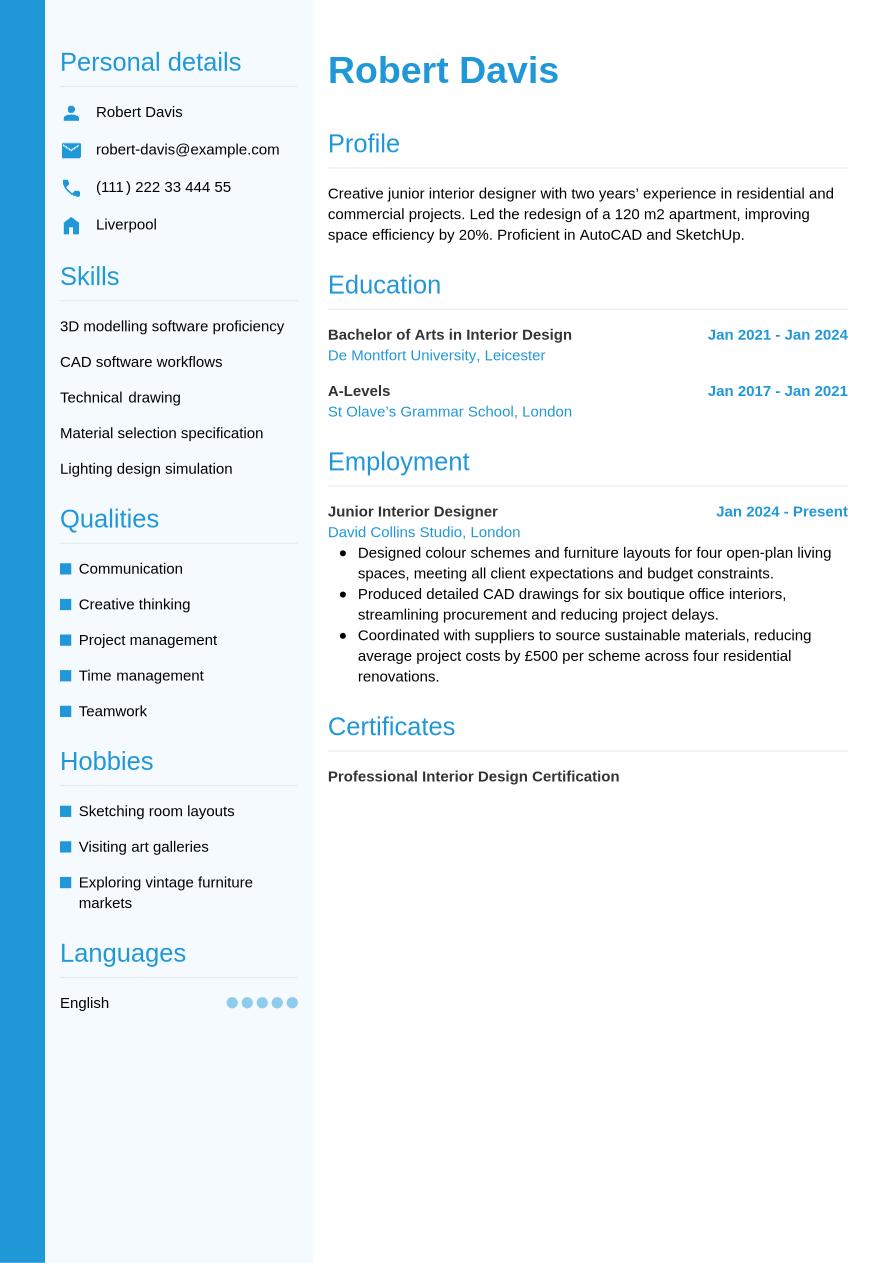
If you've built up some work experience in relevant roles or industry sectors, you'll want to choose a CV format that showcases your career trajectory. Hiring managers will be keen to see how you've used your skills to create positive results for employers in previous roles. In this scenario, a reverse-chronological CV format is usually the most effective choice. Focus on your most recent and relevant previous roles and use bullet points to show your key skills and achievements, offering evidence that showcases your impact.
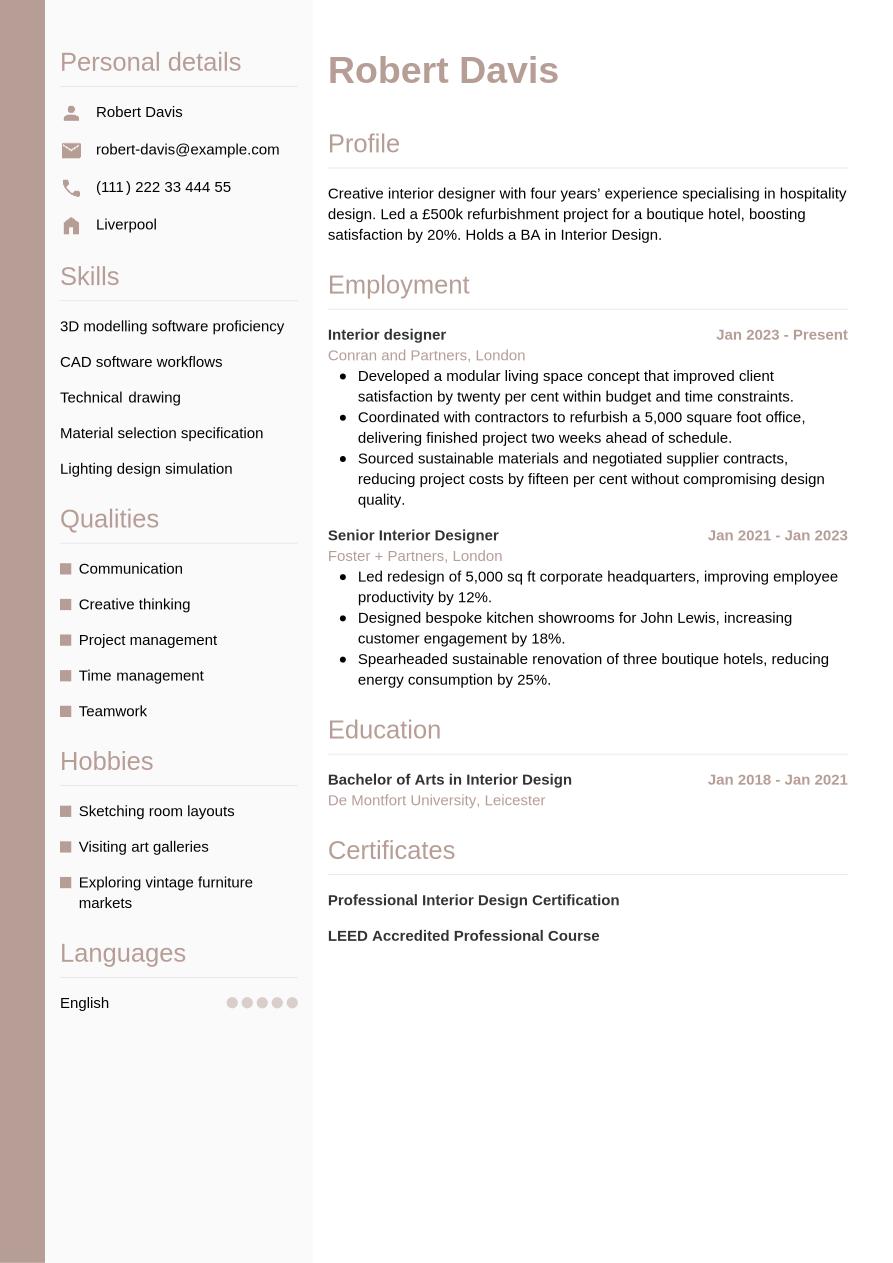
For the most experienced, senior candidates, it's important for the CV to showcase the most relevant and impactful work experience examples. Employers will want to see evidence of your value to organisations, and how you've reached a high standing in your field. As such, opt for a detailed reverse-chronological CV structure that can adequately showcase the quality and depth of your work experience. You could also add awards, publications, achievements and professional memberships to provide an indication of your standing and reputation.
However, regardless of your years of experience, an interior designer CV needs to connect the dots of your career into a cohesive story. In the following sections, we’ll dive into the specific chapters of your CV step-by-step, showing you how to refine everything from your initial introduction to your long-term achievements.
CV Header
Start your interior designer CV with a professional-looking header that includes all the relevant contact information. This usually includes your name, your email address, your phone number and your location, but not your full address. Additionally, add your LinkedIn profile, if this is in use and up-to-date. A well-utilised LinkedIn profile can give further information to the reader about your skills, experience, industry knowledge and career achievements.
For UK applications, it's not usually advisable to include a personal photo or any other personal details, such as your age, gender, nationality or ethnicity. These can risk introducing bias to the decision-making process and are discouraged under the terms of the Equality Act 2010.
Robert Davis
robert-davis@example.com
(111) 222 33 444 55
Liverpool
linkedin․com/in/robert–davis–123
CV Summary or Objective
Below your contact information, a short, concise CV summary or CV objective can set the tone for your application and provide brief, basic information on your key skills and qualities that gives a strong indication to the reader about your suitability for the interior designer role. While the CV summary focuses on your key skills and achievements, a CV objective highlights your career ambitions, making it more suitable for junior candidates.
Whether you choose to write a summary or an objective, aim for a length of two or three sentences, introducing your key skills, unique qualities and key achievements or ambitions, making sure they reflect what's included in the job description.
An effective summary will include brief reference to one or two of your strongest skills, ensuring they reflect the skills listed in the job description. It's important to make your skills and qualities feel unique to you, and show how you've used them to positive effect in your career to date. Below you'll find an example of a strong interior designer CV summary.
Engaging example:
Innovative interior designer with 5 years’ experience creating residential and commercial spaces. Delivered a 15% cost saving while revamping a corporate office layout. Holds a BA (Hons) in Interior Design.
Worst practice example:
Creative interior designer with several years’ experience designing various projects, skilled in project collaboration, client communication and concept development to deliver aesthetically pleasing environments that meet broad requirements and budget expectations.
The CV summary above contains various red flags and things to avoid. While the differences are subtle, they can make all the difference. Common mistakes that lead to an ineffective summary include a lack of quantifiable experience, vague statements or failing to tailor your summary to the job description. Long, rambling sentences that lack structure can also make your summary harder to read.
Work Experience
A CV's work experience section is usually its most important element. Employers tend to value the work experience section, as it shows evidence of how you've put your relevant skills to good use in your career to date. Always take the time to tailor this section, including keywords and phrases that match the job description. This will help employers to judge how strong a fit you are for the role, and how you might apply your skills for the benefit of the organisation.
List only relevant previous jobs, and add your job title, the name of the employer, its location and your dates of employment. Under this, write several bullet points showing employers how your skills and key qualities contributed to positive outcomes.
To differentiate your work experience section from other candidates, include action verbs and quantifiable evidence that showcases the impact you made. Show your career progression through the skills you developed and used in each role. See below for an example of how to put the work experience section best practice into action:
Engaging example:
Interior Designer, January 2023 - Present
Harbridge Design Studio, Brighton
- Designed and implemented a sustainable showroom layout that improved product visibility and reduced customer dwell time by 15%.
- Managed refurbishment of a listed Georgian townhouse, coordinating trades and meeting budget and heritage compliance deadlines.
- Coordinated fit-out of 10 open-plan workstations, selecting materials and furnishings to align with brand guidelines and cost constraints.
Worst practice example:
Interior Designer, January 2023 - Present
Harbridge Design Studio, Brighton
- Delivered innovative design solutions across multiple projects to enhance space functionality and aesthetics.
- Oversaw project coordination and resource planning to achieve client satisfaction and maintain quality standards.
- Managed interior schemes from concept through completion, ensuring adherence to brand guidelines and project timelines.
Take a look at a less strong interior designer CV work experience section above. A less-engaging work experience section might include irrelevant roles or jobs from a long time ago, and generic information that fails to address the requirements of the job description. It could also lack evidence to support the claims made in the bullet points.
Portfolio and Work Samples
For some applications, a link to a portfolio or some examples of your previous work can be a valuable addition to your CV.
While this is most common for creative roles or positions where the appearance and presentation is particularly important, you could include any type of work in a portfolio, as long as it can be showcased online. You could add your work examples as a link to a dedicated external portfolio, either in its own section or in your CV header. Alternatively, you could add separate work samples as links in your CV, either linking to a company website (for example, a case studies page), or to your LinkedIn profile.
Education
Your education section is the chance to list your most recent and highest qualifications, and anything that's relevant or required for the role.
Interior designer roles typically require candidates to have a relevant university degree, and you'll want to showcase this in your CV to confirm your eligibility. Add your Bachelor of Arts in Interior Design or another related degree that makes you an eligible candidate for the position, in your CV. If you have any other degrees or qualifications that highlight material selection specification, lighting design simulation or your most relevant skills, you could also add these.
When adding your qualifications to your education section, choose the highest relevant qualifications, and list them in reverse-chronological order, starting with your most recent. Add the name and level of the award, the institution, its location and your dates of study or graduation. If you have space or if you particularly want to emphasise your qualifications, you could add one or two bullet points under each entry, highlighting specialist areas of study, projects you worked on, awards you won or societies you were a member of.
If the job description requires any specialist certifications or licences, you may wish to add these in your education section. If you add these, it's also a good idea to include the expiration date of the licence or qualification, if it has one.
BA (Hons) in Interior Design, 2018 - 2021
University of the Arts London, London
Skills
In your CV's skills section, you'll want to draw attention to some of your strongest skills that make you suitable for the role. Review the job description to get an idea of the most essential skills, and create a list of hard and soft skills, including some of your strongest, most unique qualities that set you apart from other candidates. In an interior designer CV, focus on the most relevant and essential skills in your skills portfolio, such as communication and lighting design simulation, to show you're qualified for the interior designer position and to put you in a strong position to progress.
Hard Skills
Hard skills refer to the technical and specialist skills required for the everyday duties of the job. They might include specialist knowledge, or the use of certain software and equipment. You can gain these skills through study, training or industry experience, and they might require a licence or certification. For interior designer jobs, essential hard skills from your career-to-date might include lighting design simulation, and 3D modelling software proficiency. Check the skills specified in the job description, and add four or five key hard skills to your CV that show employers you're capable of completing the key duties of the role.
The best hard skills to include are typically listed as 'essential' or 'required' in the job description. Aim for a mix of the most desirable skills, together with those you have the highest proficiency in. For the best chance of success, you'll want your strongest skills to match closely with those most desired by the employer.
See below for examples of skills that are frequently included in the hard skills section of an interior designer CV:
- 3D modelling software proficiency
- CAD software workflows
- Technical drawing
Soft Skills
Soft skills differ from hard skills because they tend to be more transferable and applicable to different roles. Soft skills are the personal strengths and qualities that define your style of working and determine how well you're likely to fit in with the team and wider organisation. Owing to the rapidly evolving nature of the work landscape, soft skills are growing in importance for a number of roles and industry sectors where technology is replacing hard skills. Additionally, soft skills are particularly valuable for junior and entry-level candidates, who might not have much work experience but have the right building blocks for a successful career.
Adopt the same approach as you did with your hard skills list, reviewing the job description to understand the requirements, before assessing which soft skills you can provide evidence for throughout your interior designer CV. Aim to add up to five soft and transferable skills, including a mix of the most essential skills from the job description, together with some skills that make you stand out as a unique and compelling candidate.
Below is a selection of soft skills regularly featured in an interior designer CV.
- Communication
- Creative thinking
- Project management
Expert Tip:
The UK’s National Careers Service advises keeping a CV easy to read with clear fonts such as Arial or Calibri, supported by headings and bullet points. (1)
Certifications and Training
If you have extra qualifications beyond the basics of what's expected or required for the role, you might want to include a separate certifications section in your CV. If you've been proactive in pursuing professional development opportunities throughout your career, it's worth showcasing them. Not only do they make you more qualified, they also show a proactive and motivated mindset. Furthermore, the CV certifications and training section is a great showcase for official licences and certifications when applying for roles where these are a key requirement listed in the job description. These could include positions where the use of specialist software and equipment is a routine part of your everyday responsibilities.
Here is a list of some key certifications and licences that can be particularly useful for interior designer applications:
- Professional Interior Design Certification, 2023
- LEED Accredited Professional Course, 2023
- Autodesk Revit Certification Programme, 2023
Languages
If you speak any languages in addition to your mother tongue, you might want to include them in your interior designer CV as a languages section. These can be valuable for your application, whether languages are specified as a requirement in the job description or not. List any foreign languages you speak, together with an indication of your proficiency level.
There are several methods of confirming your foreign language skills on your CV. The simplest way is by assigning a basic descriptive word, such as:
- English: Fluent
- Spanish: Intermediate
Alternatively, use an internationally recognised framework for languages, such as the Common European Framework of Reference (CEFR). This gives your language skills a standardised competence indicator, as follows:
- A1: Beginner
- A2: Elementary
- B1: Intermediate
- B2: Upper intermediate
- C1: Advanced
- C2: Proficiency
Additional Sections
Including optional sections in addition to the core sections of your interior designer CV can help you to show employers you're a strong candidate for the job. Consider including a few optional sections to your CV if you think you need to provide extra information to prove your credentials. These sections can be particularly valuable if you lack relevant work experience, such as for entry-level roles, or if you're changing careers to a completely new field or specialism.
And if you'd like more tips on making your CV stand out, explore our career resources. They’re designed to help you showcase your strengths and boost your chances of landing the job.
Hobbies and Interests
If you participate in hobbies and activities that are related to the role, or use some of the same skill set, you could include them in a hobbies and interests section. In addition, hobbies and interests can showcase your personality, helping to differentiate you from other candidates. However, a hobbies and interests section is only valuable if it helps you to show relevant skills you've been unable to evidence in other parts of your CV. If your hobbies and interests are unrelated to the job, it's best to leave them off your CV.
Awards and Achievements
Including an achievements and awards section is an effective way of showing the reader the value you've added for employers in your career to date. Add any awards you've won or career milestones you've reached, so employers can easily see the impact you've made in your career to date.
Voluntary Roles
Another valuable optional section for your CV is volunteering. This section can offer a great alternative showcase for your skills and experience, if you don't have much relevant work experience. Consider adding this section if you have any relevant unpaid experience, either as a junior candidate or a career changer. In your volunteering section, use a similar structure to your work experience section.
Add your job title or a description of the volunteer role, the organisation name, its location and the dates you volunteered (start and end date). Under this, add bullet points to show the skills you used, and evidence of how they contributed to positive achievements for the organisation.
References
For UK job applications, it's rare to include references on a CV. However, it's a good idea to check the job advert and have some references ready to go in case the employer wants you to include them on your CV. If references are needed, opt for two or three, and always make sure you approach them for permission before including them.
Add their name, their job title, the organisation they work for and their contact details. Alternatively, if references aren't required you could simply add a line to your CV confirming you can provide them when needed, such as 'references are available upon request'.
Analytical Insight:
More than 80% of HR executives say the design of a CV has an impact on the way they assess an application. (2)
Most impactful action verbs for an interior designer CV
Adding strong action verbs to the bullet points in your CV's work experience section is a great way to focus on the key skills required for the job, while showing the impact you've made. Start each bullet point with an action word that reflects the job description, so the reader can easily identify your best qualities. Always remember to back up any action verbs you use with evidence that shows the impact it made and the achievements that it led to. Use past tense for action verbs that describe previous roles, and present tense for your current position.
- Design
- Conceptualise
- Plan
- Customise
- Source
- Coordinate
- Visualise
- Draft
- Present
- Optimise
Example of an interior designer CV
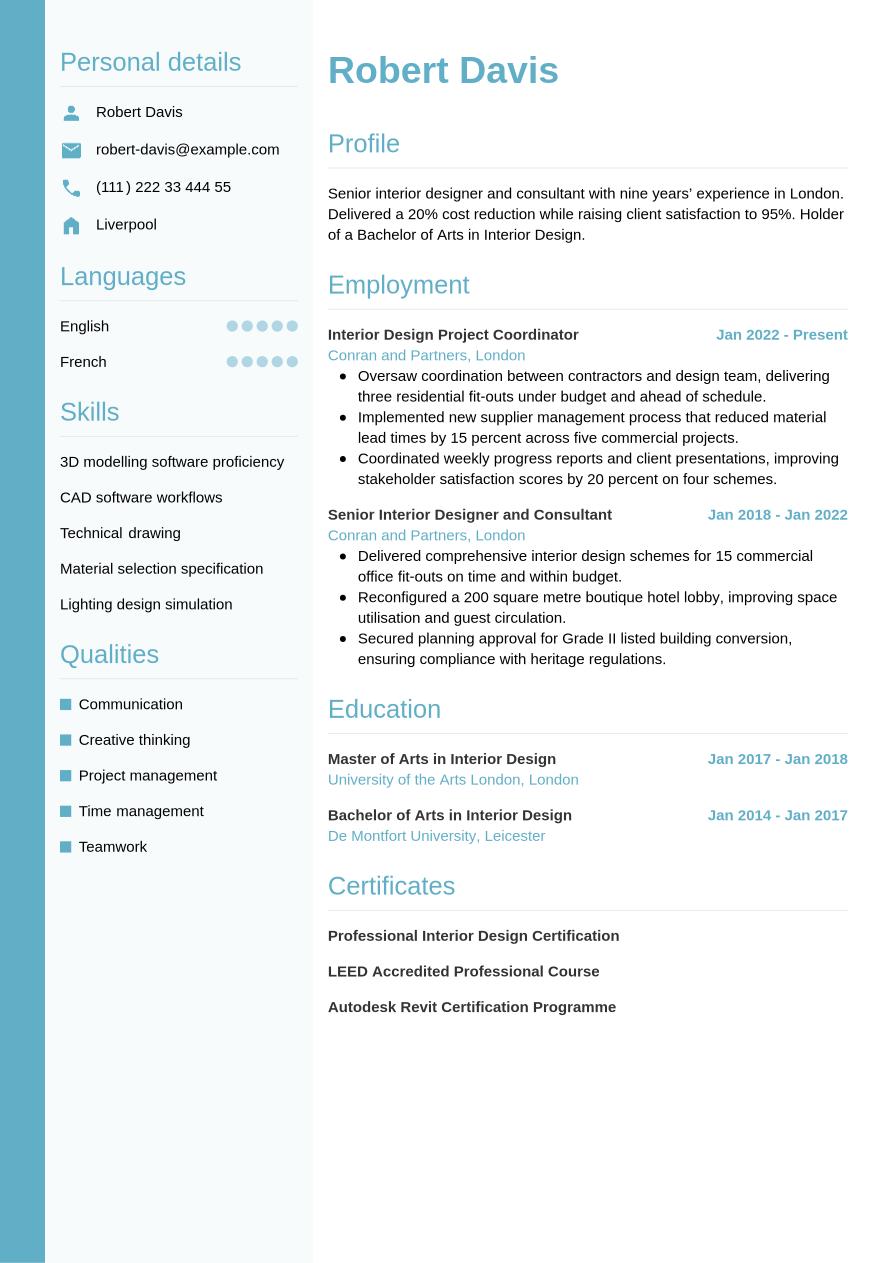
Now that you know exactly what to include in your interior designer CV, we can take a look at a final, finished example below:
Liverpool
•
robert-davis@example.com
•
(111) 222 33 444 55
•
linkedin․com/in/robert–davis–123
Creative interior designer with four years’ experience specialising in hospitality design. Led a £500k refurbishment project for a boutique hotel, boosting satisfaction by 20%. Holds a BA in Interior Design.
Interior designer
2023
-2026
Conran and Partners (London)
- Developed a modular living space concept that improved client satisfaction by twenty per cent within budget and time constraints.
- Coordinated with contractors to refurbish a 5,000 square foot office, delivering finished project two weeks ahead of schedule.
- Sourced sustainable materials and negotiated supplier contracts, reducing project costs by fifteen per cent without compromising design quality.
Bachelor of Arts in Interior Design
2018
-2021
De Montfort University (Leicester)
3D modelling software proficiency
CAD software workflows
Technical drawing
Communication
Creative thinking
Project management
Professional Interior Design Certification
LEED Accredited Professional Course
English - Native
French - Advanced
If you want a sneak preview of what your one-page, fully designed and finalised CV might look like, see our completed examples.
Key tips and mistakes to avoid for your interior designer CV
Tips to follow
- Tailor your CV to match the job description of the role you're applying for, highlighting your strongest skills and career achievements.
- Use a clear, professional CV format with a standard font, consistent line spacing and headings that stand out, for maximum readability.
- Highlight your key skills with a dedicated skills section that matches both the hard and soft skills listed in the job description.
- Proofread your CV carefully before sending, as any spelling or grammatical errors could seriously undermine your chances of success.
- Open your CV with a strong CV summary or objective, providing a brief account of your career achievements and skills.
Common mistakes to avoid
- Don't add any unnecessary personal information, such as your age, gender, marital status, or a personal photo, unless it's required for the role.
- Don't use an unsuitable email address with informal language or nicknames, but instead opt for a professional email address combining elements of your name, initials or profession.
- Don't overload your CV with industry jargon and acronyms that may alienate or confuse the reader, instead opt for simple, clear language whenever possible.
- Don't crowd your CV with unnecessary extra details, but stick to the key facts and present them in a clear, readable fashion.
- Don't fill your CV with irrelevant work experience that takes up precious CV space and won't persuade the reader of your suitability for the role.
Tips for optimising your CV for ATS
Applicant tracking systems (ATS) are becoming more and more integral to the recruitment process for many employers. These systems ease the burden of the recruitment process by performing various tasks, including scanning and ranking CVs based on their likely fit to the job description. This saves recruiters and hiring managers the time and effort of reading every CV in detail. With many vacancies often receiving hundreds of applications, ATS software can really relieve the burden on hiring teams and free them up to focus only on the most suitable candidates.
Because ATS software is becoming more common in the recruitment process, it's important to make some concessions in your CV to give yourself the best chance of progressing beyond the initial screening. With that in mind, here are some tips on preparing your CV for ATS screening:
- Include keywords and phrases that match the job description, giving you the best chance of appearing as a strong fit for the role.
- Use clear headings that reflect standard CV conventions, such as 'work experience', 'education' and 'skills'.
- Choose a simple, standard CV structure and omit any design elements that might make your CV less easy to read by automated systems, such as text boxes and columns.
- Select a font that enhances the readability of your CV, including recognised serif and sans serif fonts between sizes 10 and 12 for body text, and 14 and 16 for headings.
- Use bullet points rather than writing long, full sentences, as this will make your CV easier to scan and parse, and help your keywords and phrases to stand out.
There are lots of things to think about when crafting an effective, engaging interior designer CV, but ATS compatibility is something that's easy to overcome. Use one of our expert-designed, ATS-compatible CV templates and remove the stress from creating a CV that puts you in the frame for the role.
If you're looking to make a strong first impression on hiring managers with your CV, use Jobseeker's eye-catching CV templates, which are approved by HR experts.
Interior designer CV FAQs
Should I include a personal photo on my CV?
You might wonder whether it's a good idea to add a personal photo to your CV to enhances its appearance and help it stand out from the crowd.
On the contrary though, in the UK it's generally not a good idea to include a personal photo on your CV. This is because it could introduce bias into the recruitment process, whether conscious or unconscious.
Nevertheless, some employers may request a personal photo, depending on the role they're hiring for. Acting and modelling jobs, or anything where your appearance and presentation is a factor, may require a photo on your CV. If you're unsure, check the job advert and if in doubt, leave the photo off your CV.
How do I write an interior designer cover letter for my job application?
A well-crafted cover letter can be just as vital to your chances of success as your CV. To write a cover letter that makes a positive impression on the reader, adopt a formal, professional layout and use a cover letter template that matches the design of your CV.
Most cover letters include three standard paragraphs of information. The letter opens with a brief personal introduction and confirmation of the role you're applying for, and your motivations for applying. In the next paragraph, list some key skills and career achievements related to the role, taking care not to repeat your CV. Finally, end your cover letter with an expression of gratitude for considering your application, and a call to action that puts the ball in the court of the employer to arrange an interview or establish dialogue with you.
Alternatively, if you're applying for the role via email, you may want to send a less formal cover note. This simply includes a brief introduction, confirming the role you're applying for and directing the reader to the relevant attached documents, rather than following the traditional professional letter conventions. Remember to include your contact details in your email, so the employer can follow up with you if necessary.
Jobseeker's cover letter examples for design industry job titles can help you gain valuable insights from HR specialists on how to craft the most engaging, professional cover letter.
How do I write an interior designer CV without experience?
Even if you're lacking relevant work experience, you can still write an interior designer CV that impresses employers.
Consider a structure that emphasises your skills rather than your work experience, such as a functional, or skills-based, CV format. In this CV layout, the skills and education sections are placed above the work experience section.
For entry-level roles, employers tend to look more for candidates with the right soft skills to show they can learn and develop on the job. As such, place extra emphasis on your soft skills for an entry-level interior designer CV.
How do I write a headline for an interior designer CV?
A well-crafted CV headline can draw the reader in, providing a hint of your suitability for the role, while increasing the likelihood of passing the ATS screening stage.
Look to write a short, engaging sentence that encompasses your best qualities, including the job title to indicate your relevance and suitability for the role.
For the most attention-grabbing CV headline, match your sentence to the most critical keywords and phrases from the job description. This will catch the eye of the reader as well as giving you the best chance of passing the ATS screening stage.
See these examples to understand best practice for writing a CV headline for different experience levels:
- Junior Interior Designer with Vision
- Experienced Creative Male Interior Designer
- Experienced Senior Interior Design Specialist
A professional cover letter is a key element of any successful job application. Match your cover letter to your CV's style with our professionally-designed cover letter templates.
Key takeaways for a successful interior designer CV
To grab the attention of the reader with your CV, tailor it to the exact specifications of the job description, incorporating keywords and phrases that match the employer's requirements. Use a CV format that reflects your experience levels, and emphasise your skills and achievements throughout your CV, to show employers you've got the required skills and experience for the job.
Finally, building your CV using Jobseeker's HR-approved CV templates can help to catch the eye of recruiters and hiring managers, making your application stand out and giving you the best chance of gaining your dream job.
Sources:
- National Careers Service, How to write a CV
- Jobseeker, Hiring Trends

Impress employers with your CV
Step-by-step guidance to create a professional CV in minutes.