Founder CV Example
Successfully pursuing a career as a founder requires a CV that gives you the edge over other candidates and shows your skills and achievements in context. Mentioning responsibilities from your previous experience, such as defining company vision and securing initial investment will indicate to the employer that you're a good fit for the role. In this guide, you'll find comprehensive tips and advice on creating a founder CV that makes a strong impression and puts you in the top bracket of applicants.
A comprehensive, strategically tailored a founder CV that reflects the full scope of your leadership responsibilities and conveys executive presence and a great fit to hiring committees and board-level stakeholders. By approaching each opportunity with a defined leadership narrative and clear strategic focus, you can develop a CV that aligns with organizational priorities and demonstrates the senior-level expertise, governance experience, and results required for the role. We’ll now review the essential sections of a CV and outline how to present each in a way that communicates executive impact and long-term value.
Key sections for a founder CV
How you approach writing your founder CV will vary according to your experience, your level and the details outlined in the job description.
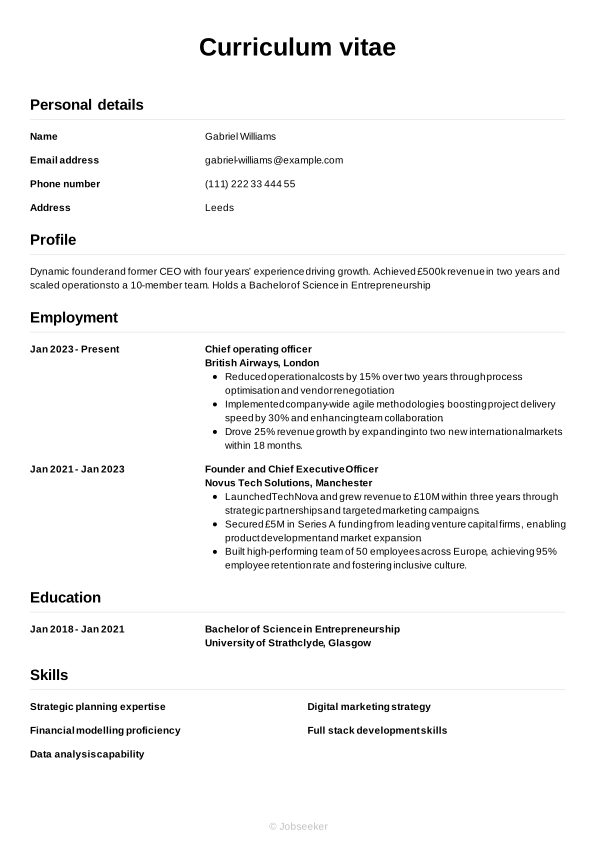
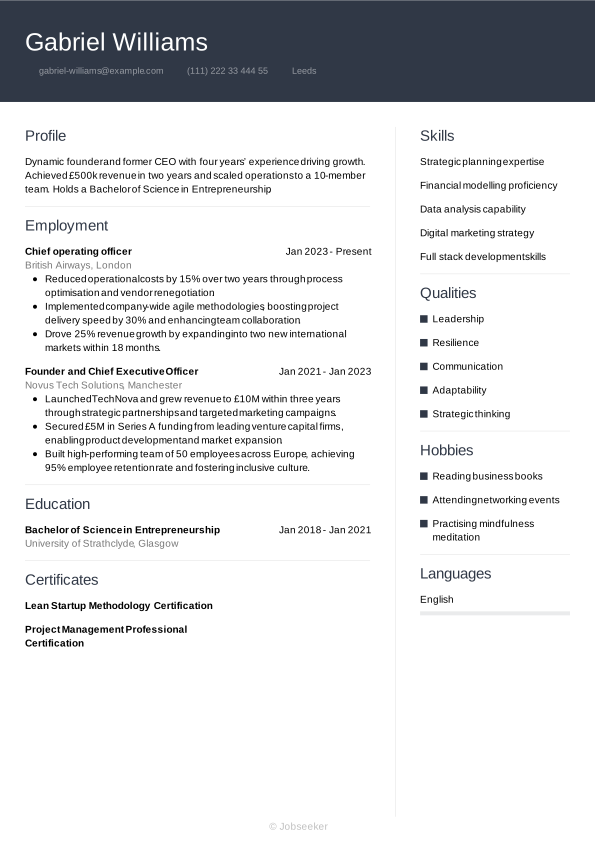
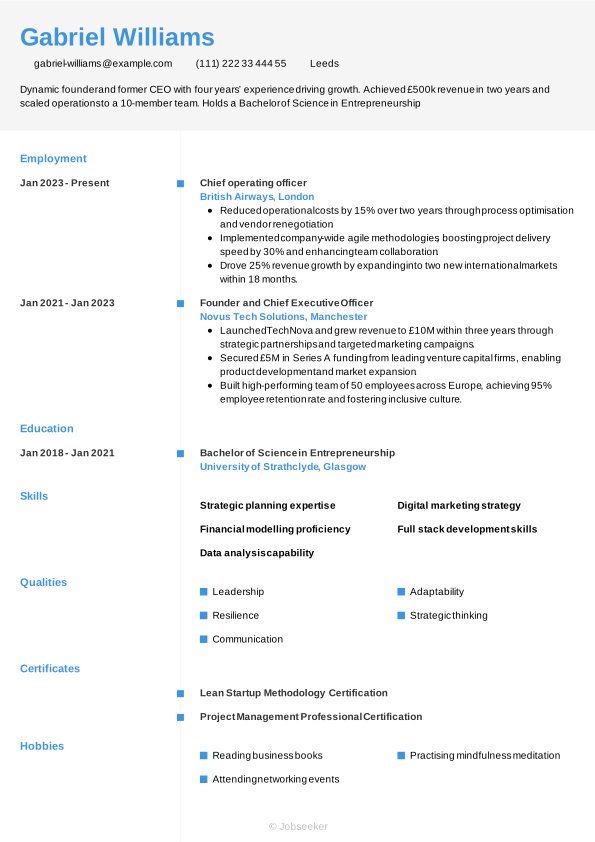
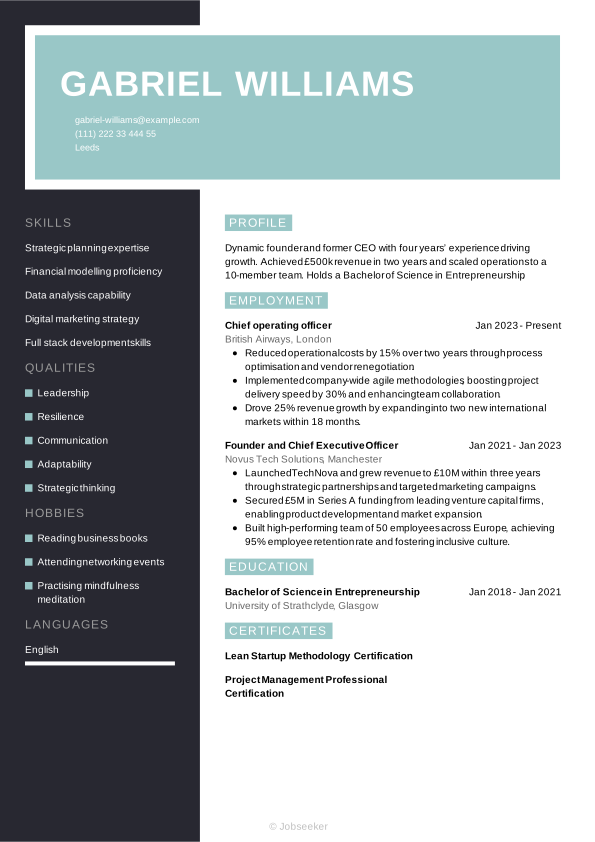
However, no matter where you are in your career, a founder CV must present a clear, compelling narrative of your professional journey. To help you build that story, we’ll now break down the document piece-by-piece—from the initial contact header to your most significant career milestones.
CV Header
Start your founder CV by adding a professional-looking header that contains all your relevant contact information. Include your name, email address, phone number and location (your full address isn't typically necessary for UK job applications). Additionally, listing your LinkedIn profile in your CV header can be valuable. It serves to provide more detailed information about your career journey, your qualifications and your industry standing, in an easily accessible way.
For jobs in the UK, a personal photo is usually not required on your CV. That, along with any other personal details such as age, gender, ethnicity and nationality, are generally discouraged under the terms of the Equality Act 2010, which aims to reduce and eliminate discriminatory practices, such as recruitment bias.
Gabriel Williams
gabriel-williams@example.com
(111) 222 33 444 55
Leeds
linkedin․com/in/gabriel–williams–123
CV Summary
Underneath your contact information, write a brief CV summary or CV objective to introduce yourself and highlight a few key skills and qualities. This can help the employer to quickly form a first impression on your suitability for the founder role. The CV objective provides an alternative to the standard CV summary. While the CV summary focuses on your skills and achievements through your work experience, a CV objective highlights your ambitions and plans for the future, including how the role fits with these. This makes it ideal for junior candidates.
Both a CV summary and objective should be concise, with an ideal length of two or three sentences. List your key skills, personal strengths and career achievements or ambitions, taking care to ensure the content reflects the requirements listed in the job description.
An effective summary will include brief reference to one or two of your strongest skills, ensuring they reflect the skills listed in the job description. It's important to make your skills and qualities feel unique to you, and show how you've used them to positive effect in your career to date. Find an example below of a positive founder CV summary, characterised by evidence to support your claims and well-structured, easy-to-read sentences.
Strong example:
Dynamic founder with a Bachelor of Science in Entrepreneurship and strategic vision. Led a SaaS platform to £1.5 million annual recurring revenue. Expert in financial management and team leadership, driving growth.
Worst practice example:
Experienced entrepreneur with a strong academic background, adept at efficiently overseeing operations, guiding teams and shaping strategies, focused on achieving objectives and fostering innovation across diverse, fast-paced business environments.
The founder CV summary above gives you an idea of what to avoid. The differences are subtle, yet significant. Common mistakes that lead to an ineffective summary include a lack of quantifiable experience, vague statements or failing to tailor your summary to the job description. Long, rambling sentences that lack structure can also make your summary harder to read.
Work Experience
A CV's work experience section is usually its most important element. Employers will want to see how you've developed relevant skills in previous roles, and how you've put them to good use in successful projects and career achievements. Remember, it's essential to tailor this section to match the job description, including keywords and phrases to help employers see how you'll fit the role, and how you might put the required skills to good use in the future.
Create a list of all your most relevant roles, going back up to 10 or 15 years if necessary. Include your job title, the name of the employer, its location and the dates you worked there. Include bullet points that explain how you put your skills to good use in each previous role.
Your CV for senior founder applications can include a work experience section longer than mid-level or junior CVs. This gives you more space to show the reader the full extent of your relevant experience in the sector, either with greater detail about previous roles, or by listing a more comprehensive career timeline.
The difference between an average CV work experience section and an outstanding one is the use of action verbs and quantifiable evidence. You'll want to show how your actions led to measurable positive outcomes for employers, and indicate a progression in your skills throughout your career. Here's an example of best practice in a founder CV work experience section:
Strong example:
Founder and Chief Executive Officer, January 2023 - Present
Brightfield Innovations Ltd, Cambridge
- Launched and scaled a software-as-a-service platform to over 10,000 paying customers across three continents within two years.
- Secured £5 million in seed and Series A funding from leading venture capital firms to accelerate product development.
- Built and led a cross-functional team of 50 professionals achieving annual revenue growth of 300% within three fiscal years.
Worst practice example:
Founder and Chief Executive Officer, January 2023 - Present
Brightfield Innovations Ltd, Cambridge
- Oversaw daily operations and coordinated cross-functional activities to drive business objectives.
- Managed stakeholder engagement and facilitated collaborative partnerships across diverse organisational functions.
- Developed strategic frameworks and guided company direction to support long-term growth initiatives.
Above you can see an example of what not to do with your founder CV work experience section. A less-effective work experience section could focus too much on irrelevant or out-of-date roles, or include generic information about your responsibilities that fails to show the impact you made. It might lack tailoring to the job description or fail to provide evidence to support the claims made in the bullet points.
Education
With your education section, you'll draw attention to your most recent and highest qualifications, particularly emphasising any qualifications listed as a requirement in the job description.
A degree is typically a strict requirement for founder jobs, and as such, you'll want to showcase yours in your CV. If you have a Bachelor of Science in Entrepreneurship or another similar, relevant degree that confirms your eligibility for the position, include it in your CV. You might also wish to add other degrees or qualifications that highlight your strongest skills, such as digital marketing strategy or data analysis capability.
When listing your qualifications in your education section, select only the most suitable qualifications and list them in reverse-chronological order, starting with the most recent and working backwards. When adding each qualification, include the name and level of the award, the institution, its location (if necessary), and the dates you attended or graduated. It can also be valuable to add bullet points outlining your key achievements and activities, such as projects you worked on, modules you completed, awards you won or societies you participated in while studying.
Specialist licences or certifications can also be a valuable addition to your CV's education section. If these are essential for the job and are referenced in the job description, it's a good idea to include them here rather than further down your CV. Include any expiration or renewal dates for certifications, if applicable.
Bachelor of Science in Business Management, 2018 - 2021
University of Cambridge, Cambridge
Skills
In your CV's skills section, you'll want to draw attention to some of your strongest skills that make you suitable for the role. Review the job description to get an idea of the most essential skills, and create a list of hard and soft skills, including some of your strongest, most unique qualities that set you apart from other candidates. In a founder CV, only list the most relevant and essential skills you possess, such as resilience and digital marketing strategy, to make a positive first impression and show you're qualified for the founder position.
Hard Skills
Hard and technical skills are the essential skills required for carrying out the everyday duties of the role. They might include specialist operation of certain software or equipment, or knowledge of certain industry standards and regulations. You could gain these skills via training, certifications or industry experience. For founder roles, hard skills from your career experience, such as digital marketing strategy, and full stack development skills tend to be prioritised by employers and recruiters. Check the skills specified in the job description, and add four or five key hard skills to your CV that show employers you're capable of completing the key duties of the role.
You'll want to include a list of hard skills that closely matches the skills listed as 'essential' or 'desirable' in the job description, while also reflecting your own strongest technical skills.
See below for examples of skills that are frequently included in the hard skills section of a founder CV:
- Strategic planning expertise
- Financial modelling proficiency
- Data analysis capability
Soft Skills
Soft skills are distinct from hard skills and tend to reflect your inherent personal qualities and strengths. These are often more transferable to different roles, and help the reader understand your working style, and your likely fit to the team and the organisational culture. The world of work is evolving at a rapid pace, changing the types of hard skills required for many roles, and therefore rendering soft and transferable skills more valuable than ever. Soft skills are also extremely valuable for junior and entry-level roles, where candidates aren't necessarily expected to have a wealth of relevant work experience.
Similar to your hard skills section, it's best to first review the job description to know which soft skills to focus on in your founder CV. You'll want to include a combination of soft skills that you can provide evidence for throughout your CV. Your soft skills list should reflect the job description as closely as possible, while also reflecting your strongest, unique talents and personal qualities. Aim for a list of around five key skills.
For senior, executive and director level roles, you'll want your CV's soft skills section to showcase your leadership and management skills. Aim to include soft skills that highlight your ability to lead a team and represent an organisation, such as decision-making, strategic thinking, change management and communication.
Explore the examples below to identify soft skills commonly presented in a founder CV.
- Leadership
- Resilience
- Communication
Pro Tip:
Public Appointments emphasizes structuring CVs in reverse chronological order and using clear sections such as professional summary, skills and work experience. (1)
Certifications, Training and Licences
Depending on the role you're applying for, and the type of qualifications you have, you might want to include a separate section for certifications, in addition to the education section. It's often beneficial to include it as it can illustrate a positive attitude towards self-improvement and professional development, as well as a proactive mindset. All these qualities will appeal to most employers and decision-makers. Furthermore, a certifications section is particularly valuable if you're applying for a role that sets out required certifications or licences in the job description. These might include technical roles that require the use of specialist software or equipment.
Here are some key examples of certifications and licences that you could add to your CV for founder positions:
- Lean Startup Methodology Certification, 2023
- Project Management Professional Certification, 2023
- Digital Marketing Strategy Certification, 2023
Projects and Publications
For roles in academia or scientific disciplines, or for senior or executive appointments, it can be valuable to include a section listing relevant publications and projects. Include any publications or projects that showcase your expertise and contribute to the academic discourse, such as journal articles, book chapters, research papers or funded projects that have achieved recognition or received awards.
When listing publications, be aware of the standard citation styles, and which one is most suitable for the business sector. The most popular citation style for UK CVs tends to be the Harvard style, but you may also wish to consider using the APA (American Psychological Association), MHRA (Modern Humanities Research Association) or OSCOLA (Oxford University Standard for Citation of Legal Authorities). Below you can find an example citation for a publication in a founder CV, listed using a suitable CV citation format:
Gabriel Williams. Harnessing customer feedback for product-market fit. Journal of Startup Ecosystems. 3 (1234) 45. 2009
Key Achievements
Compiling your key career achievements into a single list is an effective way of making your CV more readable at a glance. If you've been awarded any prizes or accolades, or reached any key career milestones, these can all help to show you have the required status and experience for the role.
Furthermore, as a candidate for senior founder roles, you can use your achievements section to give an indication of your expertise and standing in your industry, as well as showing how you've progressed to a senior status.
Languages
If you speak any additional languages, you might want to consider adding a languages section to your CV. Even if languages aren't a requirement of the job description, speaking a foreign language can reflect well on you as a candidate, and correlate with other soft skills that can increase your employability. Within this section, list the foreign languages you speak to a reasonable degree of competence, together with an indicator of your skill levels.
The ways to indicate your foreign language skills depend on the level of detail you want to provide. They include assigning a basic descriptive word, such as:
- English: Fluent
- Spanish: Intermediate
You could adopt the Common European Framework of Reference (CEFR), as this provides standardised levels to describe your competence, as follows:
- A1: Beginner
- A2: Elementary
- B1: Intermediate
- B2: Upper intermediate
- C1: Advanced
- C2: Proficiency
Evidence-Based Insight:
A professional cover letter can make the difference with your application. 82% of recruiters read them, and it can help form a coherent narrative about your professional journey, especially regarding motivation, achievements, or career transitions. (2)
Best action verbs for an engaging founder CV
Using strong action verbs in your work experience bullet points gives you the opportunity to show how you've applied skills to good effect in previous roles. Starting each bullet point with an action verb, such as 'delivered', 'collaborated' or 'developed' also allows you to show your key skills and qualities in a way that's easily identifiable for the reader. Remember, it's essential to evidence any action verbs you add to your work experience. This will help show your achievements and the impact you made in previous roles. Use past tense for action verbs that describe previous roles, and present tense for your current position.
- Establish
- Launch
- Innovate
- Scale
- Fundraise
- Strategise
- Lead
- Build
- Network
- Drive
Founder CV sample
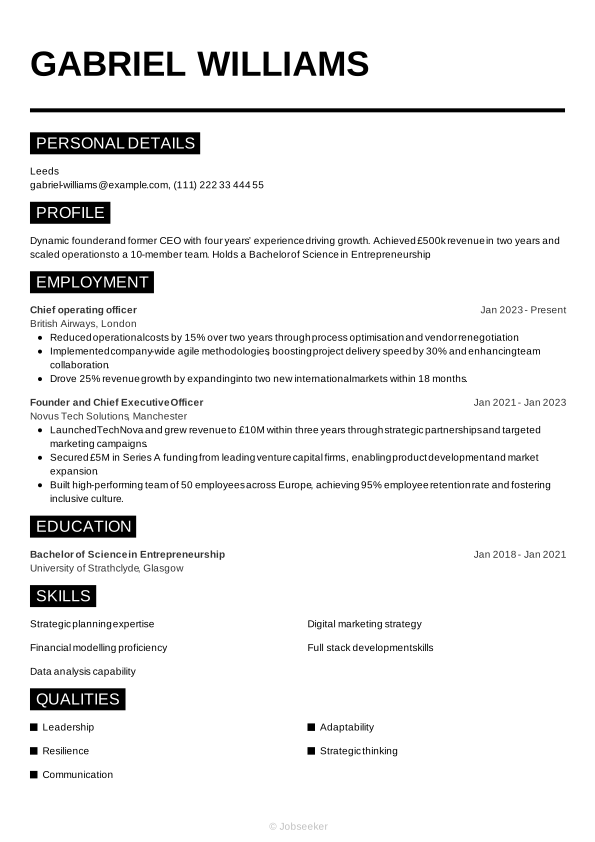
Now we've shown you everything that needs to go into your founder CV, we can take a look at how it comes together in its final form in the following example:
Leeds
•
gabriel-williams@example.com
•
(111) 222 33 444 55
•
linkedin․com/in/gabriel–williams–123
Resourceful senior founder with eight years’ experience as Senior Founder and Managing Director delivering 150% revenue growth. Experience in investor relations and team leadership. Bachelor of Science in Entrepreneurship.
Chief Executive Officer and Founder
2022
-2026
Bright Horizon Ventures (Birmingham)
- Secured £4 million seed funding, enabling rapid market expansion and growing team from 3 to 45 within 18 months.
- Launched flagship SaaS platform that attracted 10,000+ subscribers and generated £1 million recurring annual revenue in first year.
- Established global presence by opening offices in London, Berlin and Singapore, boosting international sales by 180% year-on-year.
Master of Business Administration
2017
-2018
University of Warwick (Coventry)
Bachelor of Science in Entrepreneurship
2014
-2017
University of Strathclyde (Glasgow)
Strategic planning expertise
Financial modelling proficiency
Data analysis capability
Leadership
Resilience
Communication
Lean Startup Methodology Certification
Project Management Professional Certification
English - Native
French - Advanced
Dos and don'ts for a winning founder CV
Tips to follow
- Start with an engaging CV summary or objective that provides a clear synopsis of your career and highlights your best qualities and achievements.
- Use a reverse-chronological approach to listing your work experience and education, starting with your most recent activities and working back from there.
- Showcase your strongest skills, both hard and soft, in a dedicated skills section that references the key skills listed in the job description.
- Proofread your CV in detail before sending it, to avoid unnecessary errors in spelling and grammar that could undermine your chances.
- Select a clear, professional CV format that makes your document as readable as possible, utilising standard fonts, consistent line spacing and clear headings throughout.
Common mistakes to avoid
- Don't include a section for hobbies and interests unless they're clearly relevant to the role and help you show skills you can't prove through other core CV sections.
- Don't use overly elaborate CV formatting and designs that make your document harder to read and more confusing for ATS software.
- Avoid adding personal information, for example your age, gender or marital status, or a personal photo, unless this is required for the role.
- Don't use passive voice, such as 'the target was achieved', but instead use strong action verbs to show the value you added to previous roles.
- Don't forget to update your contact information to ensure it's current, including keeping your LinkedIn profile updated with your latest career details.
While a standard CV length is between one and two pages of A4, for executive or senior roles, you might wish to make your founder CV longer. You'll want to showcase all your credentials and demonstrate your standing in the business sector by including additional sections such as awards, publications, professional memberships and conference appearances.
As such a CV length of longer than two pages tends to be most effective for senior applications. To see how your CV might look after finalising its design and layout, take a look at our CV examples.
Guide to CV ATS optimisation
Applicant tracking systems (ATS) are now commonly used by employers, to help them manage the recruitment process. One of the main functions of ATS software is the scanning and ranking of CVs according to their likely suitability for the role. This task can relieve some of the strain on hiring managers through the recruitment process, which can become very resource-intensive, with roles often eliciting hundreds of applications.
The growing prevalence of ATS apps requires a shift in approach by jobseekers, to prepare a CV with the best chance of passing the ATS screening stage. That's why we've put together a list of key ATS CV tips, to maximise your chances of success:
- Include keywords and phrases that mirror the job description to maximise your chances of ranking highly in the ATS screening stage.
- Use clear, standard CV headings that are easily recognisable, such as 'work experience', 'education' and 'skills'.
- Choose a simple, standard CV structure and omit any design elements that might make your CV less easy to read by automated systems, such as text boxes and columns.
- Select a font that can enhance the readability of your CV, such as popular serif and sans serif fonts, with size 10 to 12 for body text and 14 to 16 for headings.
- Use bullet points in place of full sentences and paragraphs, as these are easier for ATS apps to scan and parse, and help your keywords stand out.
It's easy to get overwhelmed by the steps to creating an ATS-compatible founder CV, but a few small changes can make a big difference. To smooth the process, use one of our expert-designed, ATS-optimised CV templates to increase your chances of success at this stage of the screening process.
If you're looking to make a strong first impression on hiring managers with your CV, use Jobseeker's eye-catching CV templates, which are approved by HR experts.
Founder CV FAQs
How do I produce an effective founder cover letter for my application?
Your cover letter can have just as strong an impact on your chances of success as your CV. When writing a cover letter, use a professional, formal letter structure and select a cover letter template to match the look and feel of your CV.
Most cover letters include three main paragraphs of written content. In the first paragraph, confirm the role you're applying for and reference your reasons for applying, including how it fits with your career journey and why you want to work for the organisation. Secondly, write a brief paragraph outlining your key skills and achievements, taking care not to simply repeat the details in your CV. Finally, express your gratitude and enthusiasm, and leave a call to action that encourages the reader to reach out to you to arrange an interview or establish a dialogue.
Alternatively, if you're applying for the role via email, you may want to send a less formal cover note. This simply includes a brief introduction, confirming the role you're applying for and directing the reader to the relevant attached documents, rather than following the traditional professional letter conventions. Remember to include your contact details in your email, so the employer can follow up with you if necessary.
Jobseeker's cover letter examples for founder roles and other key business industry positions provide useful HR-expert tips and guidance on how to write a compelling cover letter.
How many years should my founder CV cover?
In most situations, it's necessary to include only the last 10 to 15 years of your relevant career history and achievements in your CV.
However, as a senior candidate, you may have built up much more than 10 or 15 years of work experience, and you might want to show employers your progression from more junior roles to senior status, along with the progression in skills and achievement that go with that journey.
In this case, consider listing a more complete career history, extending beyond the typical 10 to 15 years and showcasing the depth and quality of your business industry experience and the impact you've made.
How do you write an impactful founder CV headline?
A CV headline can be an effective way of introducing yourself in your CV and setting the tone, so the reader can quickly identify whether you're likely to be a good fit for the role.
Aim to write a short, engaging sentence that includes the job title and shows you to be a good match for the job description.
For an impactful CV headline, focus on the most critical keywords and phrases from the job description, as this will mark you out as a strong fit for the role and give you a strong ranking in the ATS screening stage.
Below you can find some examples of best practice for CV headlines at different levels of experience:
- Visionary Startup Founder and CEO
- Experienced Founder and Growth Strategist
What founder CV format gives me the best chance of success in 2026?
For a senior founder application, employers will look for evidence in your CV of your extensive experience and industry expertise. If you're applying for an executive role or a position of leadership, you'll want your CV to assure employers that you've got what it takes.
In this case, a detailed, extended reverse-chronological CV of at least two sides of A4 is typically best, as it gives you the chance to showcase your work experience and career achievements.
A well-written cover letter is an essential element of any job application. Take a look at our HR-approved cover letter templates to find a design and layout that matches your CV.
Key takeaways for your founder CV
To make a strong first impression on hiring managers, tailor your CV for every application, adding keywords and phrases that match the job description. Pick a CV format that matches your experience level, and focus on showing the reader how you've developed relevant skills and put them to good use to add value for previous employers.
Finally, using an eye-catching, expert-designed CV template from Jobseeker can really give your CV an edge over those from rival candidates, helping you to achieve success in your job applications.
References:
- Public Appointments, Tips for a good CV
- Jobseeker, HR Trends

Impress employers with your CV
Step-by-step guidance to create a professional CV in minutes.