Vice President CV Example
Successfully pursuing a career as a vice president requires a CV that gives you the edge over other candidates and shows your skills and achievements in context. You'll want to showcase strong skills that are relevant to the role and reflect your experience, including driving organisational growth strategies and representing company at events. In this comprehensive guide, you'll learn the steps to producing a vice president CV that puts you in pole position to progress to the interview stage.
A well-crafted, strategically focused a vice president CV that highlights your most relevant leadership achievements and enterprise-level impact will significantly improve your chances of advancing in a competitive executive search process. Tailoring your CV for each leadership opportunity, with clear evidence of measurable business outcomes, transformation initiatives, and strategic influence, will reinforce your executive credibility from the first review. Let’s take a closer look at the key components of a CV and consider how to develop each to communicate authority, strategic judgment, and measurable business impact.
Key sections for a vice president CV
Your approach to creating your winning vice president CV will differ depending on your experience, your seniority and the details listed in the job description.
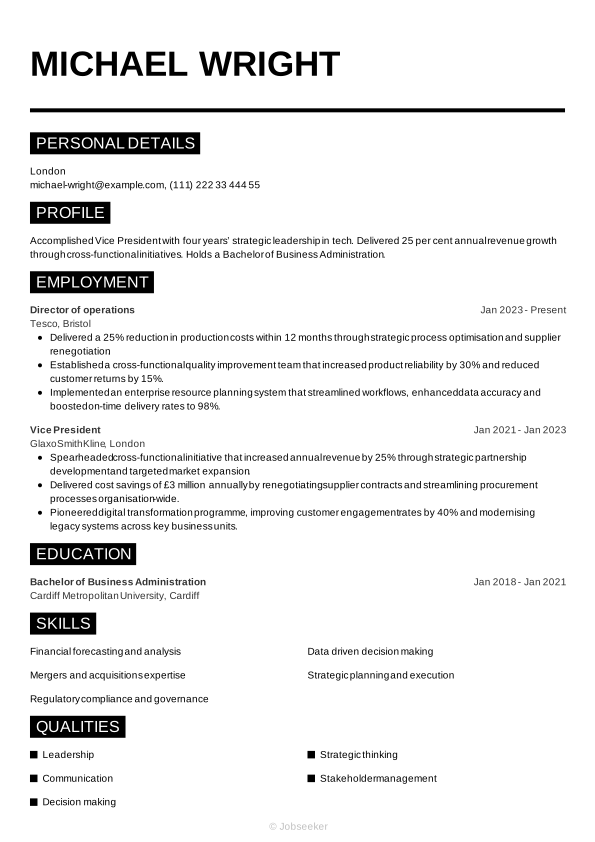
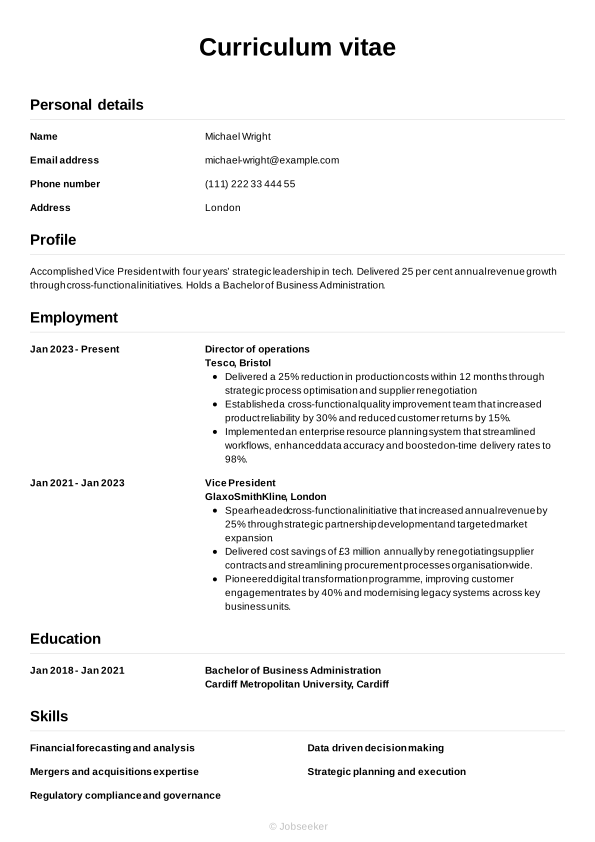
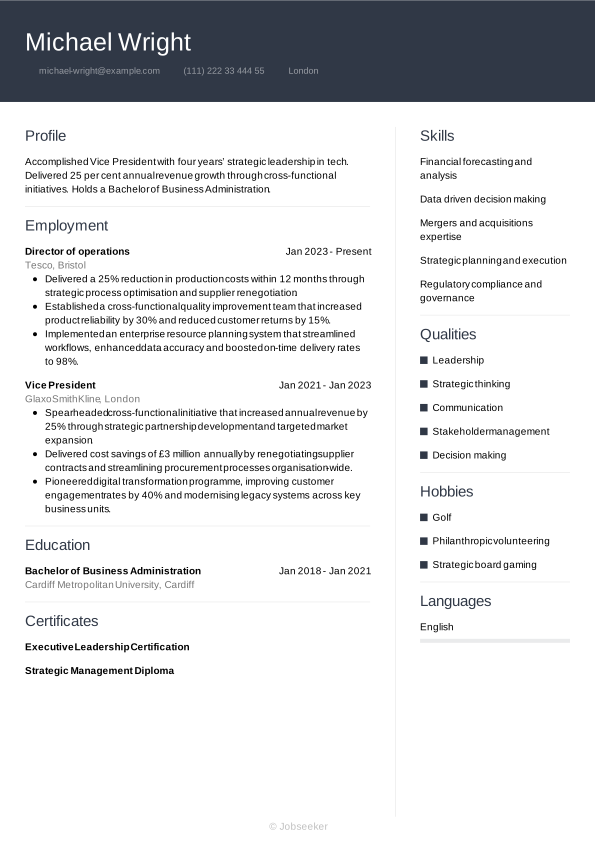
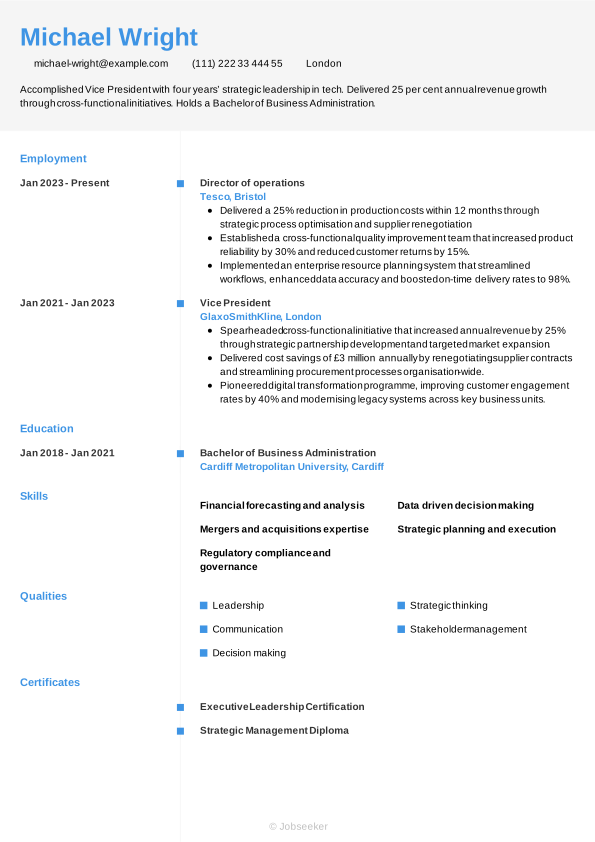
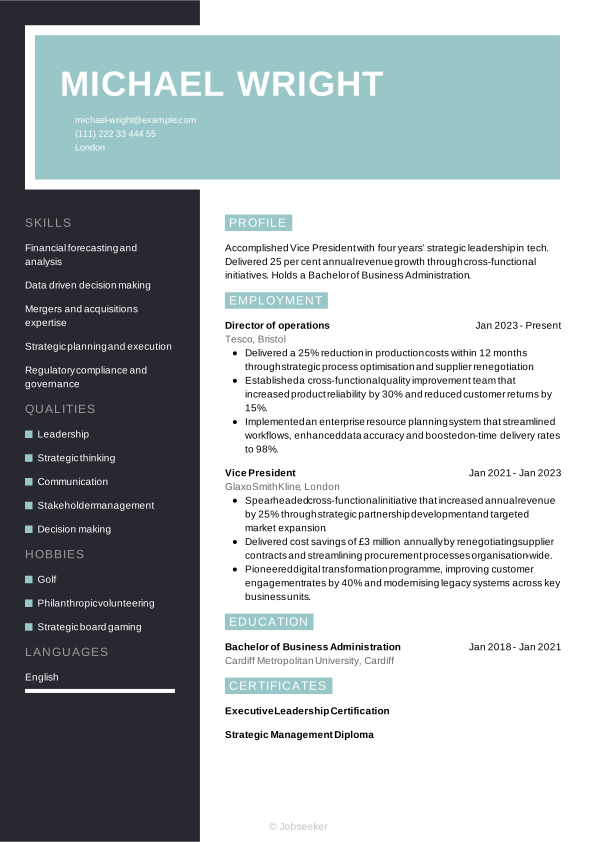
At the end of the day, though, a vice president CV is just a way to tell the story of how you’ve grown in your career. Regardless of your experience level, you want that progression to feel seamless and easy to follow for recruiters. To help you get there, we’re going to walk through each part of the CV step-by-step, starting with the basics in your header and working our way through to your professional achievements.
CV Header
Start your vice president CV with a header that features subtle, professional design elements and sets the tone for the document. Add your name, email address, phone number and location (your full address isn't normally needed). Additionally, listing your LinkedIn profile in your CV header can be valuable. It serves to provide more detailed information about your career journey, your qualifications and your industry standing, in an easily accessible way.
For jobs in the UK, a personal photo is usually not required on your CV. That, along with any other personal details such as age, gender, ethnicity and nationality, are generally discouraged under the terms of the Equality Act 2010, which aims to reduce and eliminate discriminatory practices, such as recruitment bias.
Michael Wright
michael-wright@example.com
(111) 222 33 444 55
London
linkedin․com/in/michael–wright–123
CV Objective
Under your header, write a brief CV summary or CV objective, outlining a few of your key skills, qualities and achievements. This short paragraph can help employers to quickly assess your suitability for the role, setting the tone for your vice president CV. A CV summary focuses on your key skills and achievements, while a CV objective provides an alternative approach, showcasing your career ambitions and how the role fits with these. This makes a CV objective ideal for entry-level candidates.
For either a CV summary or an objective, aim for a length of two or three sentences. Showcase a few key skills, personal qualities and career achievements or ambitions, always reviewing the job description as you write, to show how you fulfil the requirements of the role.
The most effective way to approach a CV summary is to focus on one or two key skills that reflect the requirements of the job description and show how you've used them to create positive outcomes for previous employers. You'll also want to showcase your unique personal strengths, and touch on how they've contributed to your career progression up to now. Find an example below of a positive vice president CV summary, characterised by evidence to support your claims and well-structured, easy-to-read sentences.
Good example:
Seasoned vice president with five years’ leadership experience, streamlining operations across multiple sites. Spearheaded a cost-saving initiative that reduced expenses by 15% annually. Holds an MBA in Operations Management.
Worst example:
Experienced vice president with a strong background in leadership and strategy, adept at managing teams and projects across various functions to drive results and support business objectives in dynamic environments.
Above is an example of CV summary that doesn't follow best practice, with some subtle shortcomings and failings. Common mistakes that lead to an ineffective summary include a lack of quantifiable experience, vague statements or failing to tailor your summary to the job description. Long, rambling sentences that lack structure can also make your summary harder to read.
Work Experience
Work experience is usually the most important section of any CV. Employers will be looking for evidence of how you've developed relevant skills in your career to date, and how you've used them to positive effect in previous roles. Ensure you tailor your work experience section to reflect the job description and show you meet all the essential requirements. This means picking out skills and qualities as keywords and reflecting them back in your work experience bullet points, so employers can assess your likely fit for the role.
This section should contain a list of your most relevant previous jobs in the last 10 or 15 years. Add the job title, the name of the employer, its location and your dates of employment. Include detail in bullet points, outlining the skills you used in the role and the impact they made.
When writing your work experience section for senior vice president applications, you may wish to make it longer and more detailed than the same section for a more junior CV. This will allow you to add more detail or go back further in your work history, to showcase the full extent of your experience in the sector.
The difference between an average CV work experience section and an outstanding one is the use of action verbs and quantifiable evidence. You'll want to show how your actions led to measurable positive outcomes for employers, and indicate a progression in your skills throughout your career. Take a look at an example of a strong vice president CV work experience section below.
Good example:
Vice President of Operations, January 2023 - Present
Parkminster Group, Manchester
- Optimised supply chain processes, reducing lead times by 30% and cutting operating costs by £2 million annually.
- Introduced Lean Six Sigma methodologies, improving production efficiency by 25% and boosting on-time delivery from 82% to 98%.
- Spearheaded integration of ERP system across five divisions, enhancing real-time data visibility and accelerating decision-making by 40%.
Worst example:
Vice President of Operations, January 2023 - Present
Parkminster Group, Manchester
- Directed cross-functional teams to implement corporate strategies across multiple departments.
- Managed ongoing business operations to drive growth and optimise performance throughout the organisation.
- Developed and executed high-level plans to enhance organisational effectiveness and stakeholder engagement.
Above is an example of what not to do with your vice president CV. A less-engaging work experience section might include irrelevant roles or jobs from a long time ago, and generic information that fails to address the requirements of the job description. It could also lack evidence to support the claims made in the bullet points.
Education
Your education section should showcase your most recent and highest qualifications, paying particular attention to anything that's specifically required for the role.
A degree is typically a strict requirement for vice president jobs, and as such, you'll want to showcase yours in your CV. If you have a Bachelor of Business Administration or another similar, relevant degree that confirms your eligibility for the position, include it in your CV. You might also wish to add other degrees or qualifications that highlight your strongest skills, such as strategic planning and execution or mergers and acquisitions expertise.
Your education section should contain only the qualifications that you consider most relevant to the role. List them in reverse-chronological order, starting with the most recent and working back from there. For each entry, include the name and level of the degree or certification, the institution, its location and your graduation date or dates of study. To emphasise your qualifications and achievements, you might wish to include one or two bullet points, which highlight things like specialist areas of study, projects, dissertations or society memberships.
Specialist licences or certifications can also be a valuable addition to your CV's education section. If these are essential for the job and are referenced in the job description, it's a good idea to include them here rather than further down your CV. Include any expiration or renewal dates for certifications, if applicable.
Bachelor of Business Administration, 2018 - 2021
University of Oxford, Oxford
Skills
A CV's skills section is the place to show the reader, in an easily accessible format, that you have the necessary skills for the job. Read the job description to understand the most essential skills, and create a list of both hard and soft skills, ensuring you include some of your strongest, most unique characteristics and qualities to set you apart from the competition. In a vice president CV, only list the most relevant and essential skills you possess, such as strategic thinking and strategic planning and execution, to make a positive first impression and show you're qualified for the vice president position.
Hard Skills
Hard skills and technical skills are the specialist skills required for completing the everyday duties of the role, such as the use of certain software or equipment, or specialist industry knowledge. You can develop these skills through study, training, on-the-job or through completing industry certifications. For vice president roles, hard skills from your career experience, such as strategic planning and execution, and regulatory compliance and governance tend to be prioritised by employers and recruiters. After reviewing the job description, compile a list of four or five key hard skills for your vice president CV to show you're capable of carrying out the duties required for the role.
You'll want to include a list of hard skills that closely matches the skills listed as 'essential' or 'desirable' in the job description, while also reflecting your own strongest technical skills.
Below, you can find the types of skills typically featured in the hard skills section of a vice president CV:
- Financial forecasting and analysis
- Data driven decision making
- Mergers and acquisitions expertise
Soft Skills
In your soft skills list, add any personal qualities and transferable skills that show you'll be a good fit for the role, you'll settle in well with the organisation and you'll complement other team members. Soft skills are typically more transferable and applicable to different roles than hard and technical skills. Transferable skills are among the most in-demand skills for employers, with rapidly changing and evolving ways of working requiring ever-more flexible and adaptable employees. Soft skills are also highly valuable for junior and entry-level positions, where candidates aren't expected to have a wealth of relevant work experience and career achievements.
As with hard skills, review the job description to understand the best soft skills to mention in your vice president CV. The best CV soft skills section includes specific skills that you can evidence with examples throughout your CV. Draft a list of up to five key soft and transferable skills, combining the most essential skills from the job description with your strongest personal qualities.
For applicants with plenty of experience, such as executive or director level candidates, it's essential for a CV soft skills section to include skills related to management and leadership. Highlight your decision-making, communication, problem-solving and strategic thinking skills.
Explore the examples below to identify soft skills commonly presented in a vice president CV.
- Leadership
- Strategic thinking
- Communication
Specialist Insight:
Public Appointments emphasizes structuring CVs in reverse chronological order and using clear sections such as professional summary, skills and work experience. (1)
Certifications and Licences
Depending on the role and your qualifications, it might be necessary to include a certifications section. Having a separate section can draw more attention to your training, and show employers your proactive, motivated mindset towards professional development, which could be a key asset. In addition, some roles require specific licences or training just to be eligible for the job, making the certifications section more important. This might include technical roles or positions which require the operation of specialist software, equipment or machinery.
See below for a list of example certifications and licences you might add to your CV for vice president roles:
- Executive Leadership Certification, 2023
- Strategic Management Diploma, 2023
- Corporate Governance Certification, 2023
Publications and Projects
For roles in academia or scientific disciplines, or for senior or executive appointments, it can be valuable to include a section listing relevant publications and projects. Include any publications or projects that showcase your expertise and contribute to the academic discourse, such as journal articles, book chapters, research papers or funded projects that have achieved recognition or received awards.
When listing publications, be aware of the standard citation styles, and which one is most suitable for the business sector. The most popular citation style for UK CVs tends to be the Harvard style, but you may also wish to consider using the APA (American Psychological Association), MHRA (Modern Humanities Research Association) or OSCOLA (Oxford University Standard for Citation of Legal Authorities). Take a look below at an example publication citation for a vice president CV, based on the most suitable citation style:
Michael Wright. Strategic Leadership in Multinational Corporations. International Journal of Business. 3 (1234) 45. 2009
Awards and Achievements
Compiling your key career achievements into a single list is an effective way of making your CV more readable at a glance. If you've won any awards or achieved any key milestones in your career to date, you might want to mention them here.
Furthermore, as a candidate for senior vice president positions, including some of your most impressive achievements in a summary section can help you show employers your reputation and standing in the industry, as well as your career progression.
Languages
Adding foreign language skills to your vice president CV can be a valuable addition that reflects well on you as a candidate. Even if language skills aren't listed as a requirement in the job description, if you speak a foreign language, it can be beneficial to add it to your CV. Within this section, list the foreign languages you speak to a reasonable degree of competence, together with an indicator of your skill levels.
The ways to indicate your foreign language skills depend on the level of detail you want to provide. They include assigning a basic descriptive word, such as:
- English: Fluent
- Spanish: Intermediate
You could adopt the Common European Framework of Reference (CEFR), as this provides standardised levels to describe your competence, as follows:
- A1: Beginner
- A2: Elementary
- B1: Intermediate
- B2: Upper intermediate
- C1: Advanced
- C2: Proficiency
Data-Driven Finding:
A professional cover letter can make the difference with your application. 82% of recruiters read them, and it can help form a coherent narrative about your professional journey, especially regarding motivation, achievements, or career transitions. (2)
Most effective action verbs for a vice president CV
Starting each of your work experience bullet points with strong action verbs is a great way to showcase your key skills and qualities, and demonstrate the impact they've had in your career to date. Start each bullet point with a verb linked to the skills required in the job description, to add focus to your work experience section and make it easy for the reader to identify your strengths. When adding action verbs to your work experience bullet points, just remember to always provide quantifiable evidence that shows the value you added for each employer. Use past tense for any action verbs that describe previous roles (for example, 'developed') and present tense for current roles (for example 'collaborating').
- Lead
- Strategise
- Oversee
- Drive
- Foster
- Cultivate
- Direct
- Negotiate
- Represent
- Influence
Vice president CV sample
Now that we've covered the main sections to include in your vice president CV, we can see how it would all come together in its final form in the example below:
London
•
michael-wright@example.com
•
(111) 222 33 444 55
•
linkedin․com/in/michael–wright–123
Seasoned Vice President with eight years’ experience leading operations and strategy. Delivered a 25% increase in efficiency through process optimisation. Holds a Bachelor of Business Administration, driving sustainable growth.
Vice President of Operations
2022
-2026
British Airways (London)
- Streamlined production processes to increase output by 25% while maintaining quality standards across six manufacturing plants.
- Negotiated strategic supplier contracts that reduced procurement expenses by £2 million annually and improved material delivery times.
- Implemented cross-functional ERP system integration project to enhance data visibility and cut decision-making cycle by 40%.
Master of Business Administration
2017
-2018
University of Warwick (Coventry)
Bachelor of Business Administration
2014
-2017
Cardiff Metropolitan University (Cardiff)
Financial forecasting and analysis
Data driven decision making
Mergers and acquisitions expertise
Leadership
Strategic thinking
Communication
Executive Leadership Certification
Strategic Management Diploma
English - Native
French - Advanced
Dos and don'ts for a winning vice president CV
Tips to follow
- Tailor your CV, matching it to the key skills and experience described in the job description, while telling a unique story about your best qualities and achievements.
- Use a clear, professional CV format that includes a standard font, regular, consistent line spacing and clear headings, to ensure it's easy to read.
- Use strong action verbs that show how you've used your skills to add value for employers in your career to date.
- Quantify your achievements as much as possible, offering evidence to support your claims, such as key performance metrics, other data or feedback you received.
- Open your CV with an engaging CV summary or objective that concisely summarises your key skills and career achievements to date.
Common mistakes to avoid
- Don't overload your CV with industry jargon and acronyms that may alienate or confuse the reader, instead opt for simple, clear language whenever possible.
- Don't lie or exaggerate about events in your career, such as previous jobs, qualification or key achievements – it can backfire and disqualify you from the running.
- Don't use passive voice, such as 'financial statements were prepared', but opt instead for powerful action verbs that showcase the impact you made.
- Don't forget to check your contact details to make sure they're current, and update your LinkedIn profile to ensure it doesn't contradict your CV.
- Don't crowd your CV with unnecessary extra details, but stick to the key facts and present them in a clear, readable fashion.
While a standard CV length is between one and two pages of A4, for executive or senior roles, you might wish to make your vice president CV longer. You'll want to showcase all your credentials and demonstrate your standing in the business sector by including additional sections such as awards, publications, professional memberships and conference appearances.
As such a CV length of longer than two pages tends to be most effective for senior applications. To see how your CV might look after finalising its design and layout, take a look at our CV examples.
How to make your CV ATS compatible
Applicant tracking systems (ATS) are becoming more and more integral to the recruitment process for many employers. These systems ease the burden of the recruitment process by performing various tasks, including scanning and ranking CVs based on their likely fit to the job description. By taking on this task, the systems can save hiring managers the time and effort of reviewing every CV in detail. With vacancies regularly receiving hundreds of applications, this can increase the efficiency of the recruitment process.
The increasing usage of ATS apps by recruiters and employers means it's critical to adapt and prepare your applications to successfully navigate this stage of the selection process. Following the tips below will give you everything you need for an ATS-compatible CV:
- Include keywords and phrases that mirror the job description to maximise your chances of ranking highly in the ATS screening stage.
- Use clear, standard CV headings that are easily recognisable, such as 'work experience', 'education' and 'skills'.
- Choose a simple, standard CV structure and omit any design elements that might make your CV less easy to read by automated systems, such as text boxes and columns.
- Select a font that can enhance the readability of your CV, such as popular serif and sans serif fonts, with size 10 to 12 for body text and 14 to 16 for headings.
- Use bullet points instead of writing full sentences, to reduce the overall length of your CV, make it more keyword-dense and help ATS apps to scan it more easily.
You might feel there are a lot of steps to creating an ATS-compatible vice president CV, but with just a few small changes, you can ensure your CV passes this stage. Use one of our ATS-compatible CV templates, which are designed by experts to give you the best chances of success.
If you're looking to make a strong first impression on hiring managers with your CV, use Jobseeker's eye-catching CV templates, which are approved by HR experts.
Vice president CV FAQs
How do I write a vice president cover letter for my job application?
A cover letter that makes a positive impact with the reader can be just as important as your CV. For the best impact, choose a formal, professional letter layout and a cover letter template that reflects the look and feel of your CV, reinforcing your application's design language.
Most cover letters include three standard paragraphs of information. The letter opens with a brief personal introduction and confirmation of the role you're applying for, and your motivations for applying. In the next paragraph, list some key skills and career achievements related to the role, taking care not to repeat your CV. Finally, end your cover letter with an expression of gratitude for considering your application, and a call to action that puts the ball in the court of the employer to arrange an interview or establish dialogue with you.
Alternatively, if you're applying for the role via email, you may want to send a less formal cover note. This simply includes a brief introduction, confirming the role you're applying for and directing the reader to the relevant attached documents, rather than following the traditional professional letter conventions. Remember to include your contact details in your email, so the employer can follow up with you if necessary.
Jobseeker's cover letter examples for vice president and business industry roles provide useful tips and guidance from HR experts on how to write a compelling cover letter.
How many years of career history is suitable for my vice president CV?
Under normal circumstances, a career history dating back 10 to 15 years is typically sufficient for showcasing the required skills and achievements for the role.
However, as a senior candidate, you'll have an extensive body of work experience that might be worth mentioning, to show how you've advanced to the upper echelons of your field, and how you've added key skills and achievements during your career progression.
In this case, you could provide a more comprehensive career history, going back beyond the standard 10 to 15 years to demonstrate your vast experience in the business industry.
How do I write a headline for a vice president CV?
A CV headline can be a way to grab the attention of the reader early in your CV, indicating that you're a good fit for the role and you offer something different to other candidates.
Aim for a short, snappy sentence that includes the job title and introduces one of your strongest, most relevant skills or qualities.
For the most attention-grabbing CV headline, match your sentence to the most critical keywords and phrases from the job description. This will catch the eye of the reader as well as giving you the best chance of passing the ATS screening stage.
See below for some examples that you can use as inspiration for writing a CV headline for different experience levels:
- Visionary Vice President of Operations
- Integrity Focused Senior Vice President
What is the best format for a vice president CV in 2026?
For senior level and executive vice president applications, employers will seek evidence in your CV of extensive work experience and specialist knowledge and skills. For positions of such standing and responsibility, you'll want to reassure employers that you've got what it takes and you're a safe pair of hands.
In this case, a traditional reverse-chronological CV is best, as it showcases work experience above other elements. You may also wish to create a longer, more detailed CV to emphasise your achievements.
A professional cover letter is a key element of any successful job application. Match your cover letter to your CV's style with our professionally-designed cover letter templates.
Key takeaways for success with your vice president CV
To grab the attention of the reader with your CV, tailor it to the exact specifications of the job description, incorporating keywords and phrases that match the employer's requirements. Pick a CV format that matches your experience level, and focus on showing the reader how you've developed relevant skills and put them to good use to add value for previous employers.
Finally, using an eye-catching, expert-designed CV template from Jobseeker can really give your CV an edge over those from rival candidates, helping you to achieve success in your job applications.
Sources:
- Public Appointments, Tips for a good CV
- Jobseeker, HR Insights

Impress employers with your CV
Step-by-step guidance to create a professional CV in minutes.