Sound Engineer CV Example
If you're hoping to launch a career in the engineering industry, including sound engineer roles, it's essential to write a CV that shows your skills and achievements in the best light. It's the mention of key responsibilities from your career, such as mixing audio levels and monitoring sound quality that will show employers you're a good fit for the role. In this comprehensive guide, you'll learn the steps to producing a sound engineer CV that puts you in pole position to progress to the interview stage.
A stronger, more engaging sound engineer CV gives you the best chance of success. It can help you pass the ATS CV screening stage and impress the recruiter or hiring manager, increasing your prospects of reaching the interview stage. We’ll now review the essential sections of a CV and outline how to craft each to reflect your artistic identity and professional impact.
Key sections for a sound engineer CV
How you approach writing your sound engineer CV will vary according to your experience, your level and the details outlined in the job description.
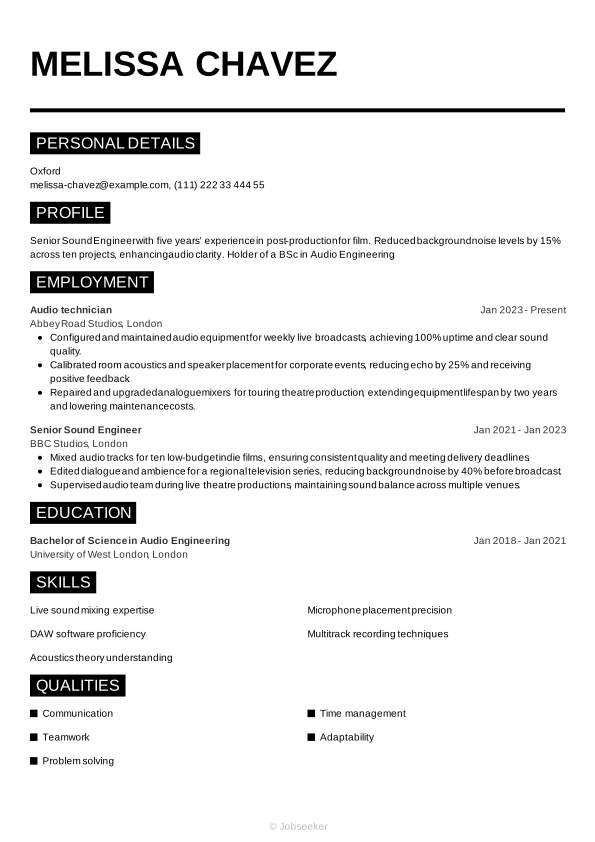
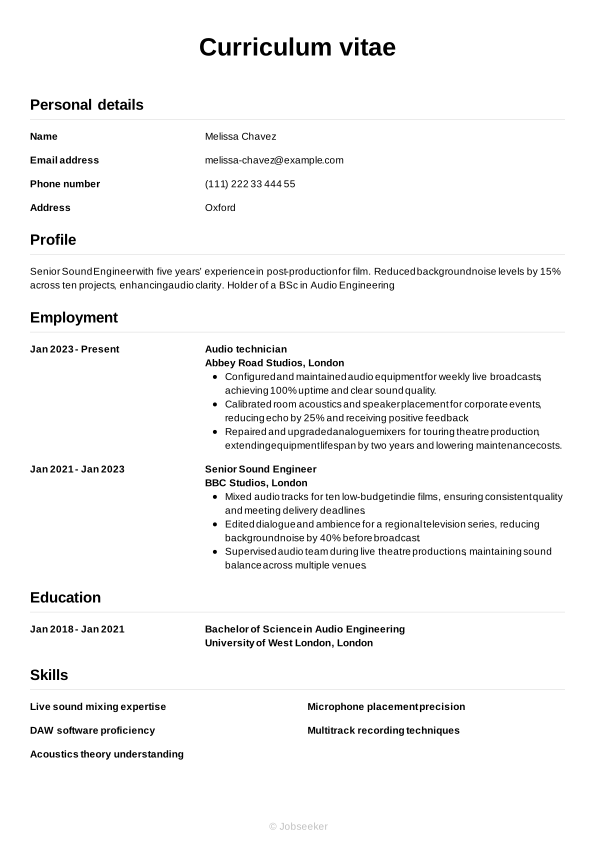
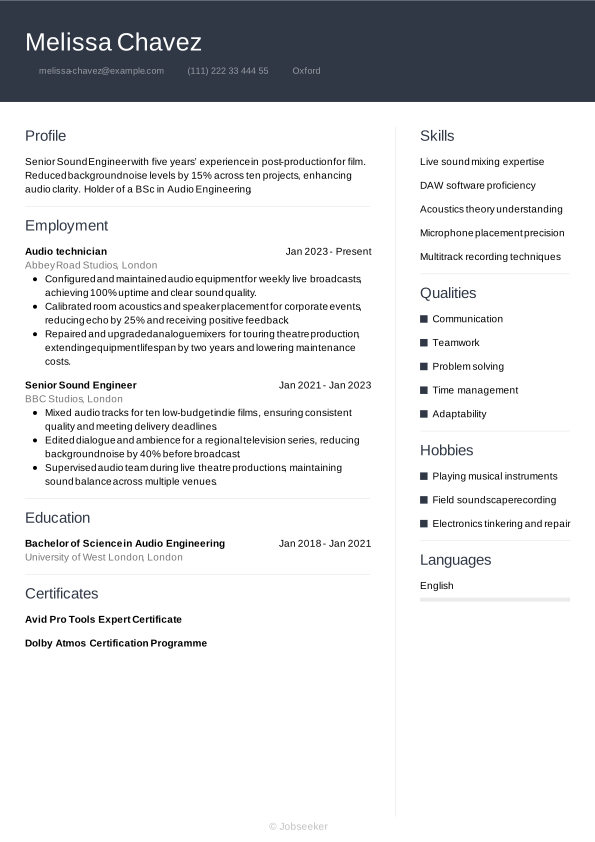
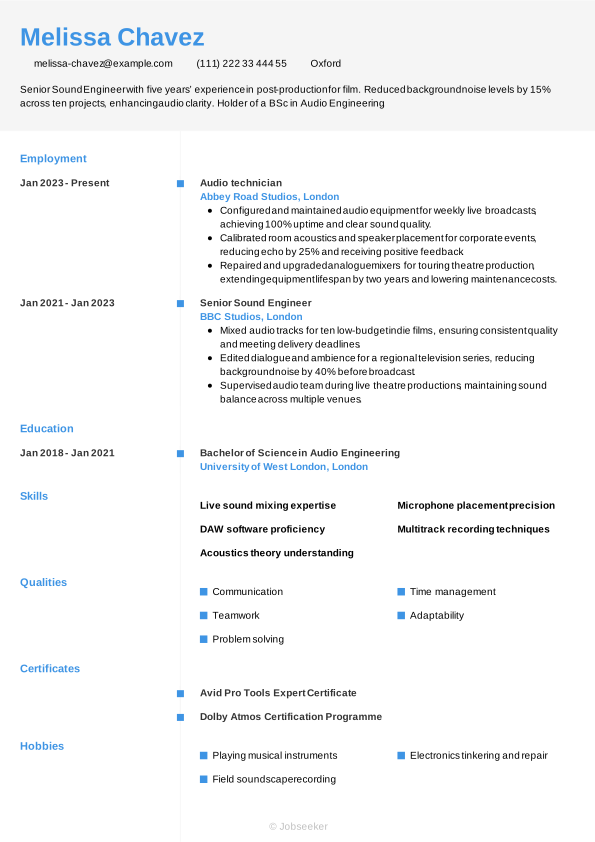
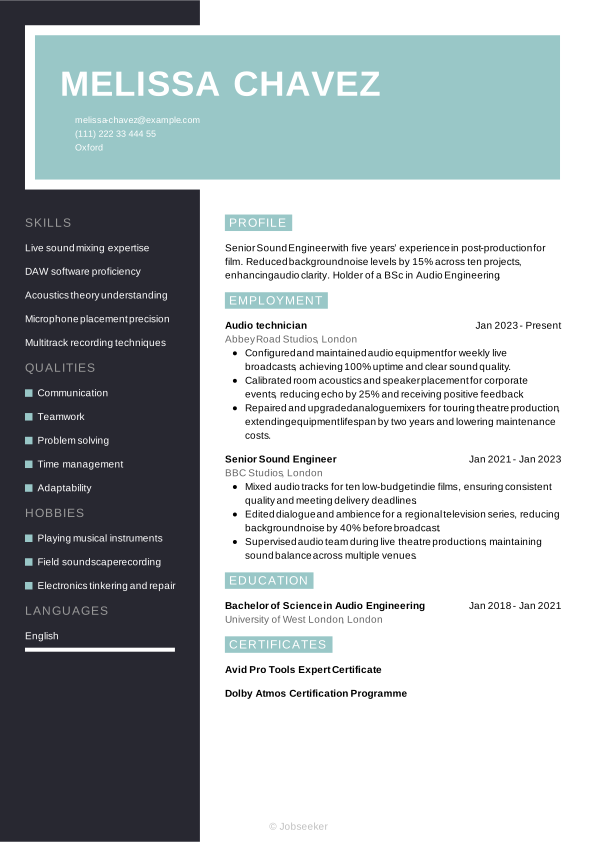
However, regardless of your years of experience, a sound engineer CV needs to connect the dots of your career into a cohesive story. In the following sections, we’ll dive into the specific chapters of your CV step-by-step, showing you how to refine everything from your initial introduction to your long-term achievements.
CV Header
At the top of your sound engineer CV, add a header that establishes the design language of the document. Include the necessary contact information: your full name, email address, phone number and location. It's not typically necessary to include your full address. Additionally, listing your LinkedIn profile in your CV header can be valuable. It serves to provide more detailed information about your career journey, your qualifications and your industry standing, in an easily accessible way.
When you're applying for jobs in the UK, it's generally not advisable to include a photo or more personal details than are strictly necessary, such as your age, gender, ethnicity or nationality. Including these can jeopardise the recruitment process by introducing bias, and can fall foul of the Equality Act 2010.
Melissa Chavez
melissa-chavez@example.com
(111) 222 33 444 55
Oxford
linkedin․com/in/melissa–chavez–123
CV Summary
Below your CV header, the next section tends to be a CV summary or CV objective. This paragraph briefly explains a few of your key skills and qualities, so employers can easily understand whether you're likely to be a suitable candidate for the sound engineer job. The CV objective provides an alternative to the standard CV summary. While the CV summary focuses on your skills and achievements through your work experience, a CV objective highlights your ambitions and plans for the future, including how the role fits with these. This makes it ideal for junior candidates.
For either a CV summary or an objective, aim for a length of two or three sentences. Showcase a few key skills, personal qualities and career achievements or ambitions, always reviewing the job description as you write, to show how you fulfil the requirements of the role.
A good CV summary would typically focus on a couple of key skills that match the job description, demonstrating how you've used them to good effect in previous roles. It's important to focus on your unique qualities and provide a preview of how they've made an impact in your career to date, which you'll unpack later in the document. See below for an example of a strong sound engineer CV summary, featuring quantifiable evidence of your impact and concise, easy-to-read sentences.
Strong example:
Experienced sound engineer with 5 years’ expertise in studio and live event production. Holds a Bachelor of Science in Audio Engineering. Consistently delivered high-quality audio solutions, enhancing client satisfaction and streamlining workflows.
Poor example:
A sound engineer with a background in various projects, possessing academic training in audio engineering, has worked on studio recordings and events, providing decent audio support and aiding workflow.
Above is an example of CV summary that doesn't follow best practice, with some subtle shortcomings and failings. Common mistakes that lead to an ineffective summary include a lack of quantifiable experience, vague statements or failing to tailor your summary to the job description. Long, rambling sentences that lack structure can also make your summary harder to read.
Work Experience
A CV's work experience section is usually its most important element. Employers will want to see how you've developed relevant skills in previous roles, and how you've put them to good use in successful projects and career achievements. Always tailor this section of your CV, focusing on keywords and phrases that match the job description, so employers can assess how you might put the same skills and qualities to good use in the future.
Create a list of all your most relevant roles, going back up to 10 or 15 years if necessary. Include your job title, the name of the employer, its location and the dates you worked there. Include bullet points that explain how you put your skills to good use in each previous role.
The difference between an average CV work experience section and an outstanding one is the use of action verbs and quantifiable evidence. You'll want to show how your actions led to measurable positive outcomes for employers, and indicate a progression in your skills throughout your career. Take a look at an example of a strong sound engineer CV work experience section below.
Strong example:
Sound Engineer, January 2023 - Present
AudioCraft Productions, Bristol
- Mixed live audio for over 50 events without major technical issues.
- Optimised studio recording workflow to improve session efficiency, reducing setup time by an average of 20 minutes.
- Collaborated with producers to refine audio mixes, ensuring consistency across multiple platforms and formats.
Poor example:
Sound Engineer, January 2023 - Present
AudioCraft Productions, Bristol
- Mixed live audio for multiple events without incidents.
- Optimised studio recording workflow to enhance session efficiency.
- Collaborated with producers to refine audio mixes for different formats and platforms.
Above you'll find a less effective example of a sound engineer CV work experience section. An unengaging work experience section could be too generic, focusing too much on day-to-day duties rather than skills and achievements. It could also fail to address the job description or lack evidence to show the impact you've made in your career to date.
Portfolio
For some applications, including a link in your CV to a career portfolio or examples of your previous work can be advantageous.
While this is most common for creative roles or positions where the appearance and presentation is particularly important, you could include any type of work in a portfolio, as long as it can be showcased online. Either add your portfolio as a link in its own section, or add separate links to examples of your previous work or projects. This could be on a company website, a personal website or your LinkedIn profile. Alternatively, if your portfolio is a particularly important element of your job application, you may wish to include a link to it in your CV header.
Education and Qualifications
Your education section should showcase your most recent and highest qualifications, paying particular attention to anything that's specifically required for the role.
For working in sound engineer positions, it's essential to have a relevant university degree, and as such, you'll want to feature it in your CV. Include your Bachelor of Science in Audio Engineering or another related degree that qualifies you for the role, in your CV, along with any other degrees or qualifications that highlight your strongest key skills, including DAW software proficiency or acoustics theory understanding.
When creating your education section, think about which qualifications are most relevant to the role, and list them in reverse-chronological order, starting with the most recent and working back from there. When adding each qualification, include the name and level of the award, the institution, its location (if necessary), and the dates you attended or graduated. It can also be valuable to add bullet points outlining your key achievements and activities, such as projects you worked on, modules you completed, awards you won or societies you participated in while studying.
If the job description requires any specialist certifications or licences, you may wish to add these in your education section. If you add these, it's also a good idea to include the expiration date of the licence or qualification, if it has one.
Bachelor of Science in Audio Engineering, 2018 - 2021
University of Salford, Salford
Skills
A CV's skills section is the place to show the reader, in an easily accessible format, that you have the necessary skills for the job. Read the job description to understand the most essential skills, and create a list of both hard and soft skills, ensuring you include some of your strongest, most unique characteristics and qualities to set you apart from the competition. For a sound engineer CV, you'll want to focus on the most relevant skills for the role that match your skill set, including problem solving and acoustics theory understanding, to catch the reader's attention and show you're qualified for the sound engineer position.
Hard Skills
Hard and technical skills are the essential skills required for carrying out the everyday duties of the role. They might include specialist operation of certain software or equipment, or knowledge of certain industry standards and regulations. You could gain these skills via training, certifications or industry experience. For sound engineer jobs, essential hard skills from your career-to-date might include multitrack recording techniques, and live sound mixing expertise. After checking the job description, include a list of four or five key hard skills in your CV to confirm that you have the necessary expertise for the role.
The best hard skills section will contain a mix of your strongest technical skills and those listed in the job description as 'essential' or 'desirable'. The closer your skills list is to matching the essential job description skills, the better your chances of success.
Review the examples below to understand which skills are often added to the hard skills section of a sound engineer CV.
- Live sound mixing expertise
- DAW software proficiency
- Acoustics theory understanding
Soft Skills
In your soft skills list, add any personal qualities and transferable skills that show you'll be a good fit for the role, you'll settle in well with the organisation and you'll complement other team members. Soft skills are typically more transferable and applicable to different roles than hard and technical skills. As a result of rapid technological changes in the world of work, soft skills are becoming ever-more valued by employers. Soft skills can also be particularly valuable for junior or entry-level roles where candidates haven't necessarily had the time to develop hard skills and career achievements.
As with your sound engineer CV hard skills list, review the job description to learn the key soft skills for the role. Include the best soft skills that you can provide evidence for throughout your CV. Aim to add up to five soft and transferable skills, including a mix of the most essential skills from the job description, together with some skills that make you stand out as a unique and compelling candidate.
Consider the following soft skills that frequently appear in a sound engineer CV.
- Communication
- Teamwork
- Problem solving
Expert Insight:
The UK’s National Careers Service advises keeping a CV easy to read with clear fonts such as Arial or Calibri, supported by headings and bullet points. (1)
Certifications, Training and Licences
If you have extra qualifications beyond the basics of what's expected or required for the role, you might want to include a separate certifications section in your CV. It can be a valuable way of differentiating yourself from other candidates and showing employers your dedication, motivation and commitment to professional development. Furthermore, the CV certifications and training section is a great showcase for official licences and certifications when applying for roles where these are a key requirement listed in the job description. These could include positions where the use of specialist software and equipment is a routine part of your everyday responsibilities.
These example certifications and licences are ideal for candidates applying for sound engineer roles:
- Avid Pro Tools Expert Certificate, 2023
- Dolby Atmos Certification Programme, 2023
- Waves Certified Sound Designer, 2023
Language Skills
Including a section on language skills can be beneficial, if you speak at least one language to a reasonable level of competency, in addition to your mother tongue. This is true even if language skills aren't a requirement for the role, as foreign language abilities often correlate to other valuable soft skills. In the languages section, list the languages you speak to at least a reasonable level, with an indicator of your competency level.
There are several ways to cite your proficiency in foreign languages. Firstly, you could use a simple descriptive word to indicate your abilities, such as:
- English: Fluent
- Spanish: Intermediate
You could adopt the Common European Framework of Reference (CEFR), as this provides standardised levels to describe your competence, as follows:
- A1: Beginner
- A2: Elementary
- B1: Intermediate
- B2: Upper intermediate
- C1: Advanced
- C2: Proficiency
Additional Sections
Optional sections can be useful to add to your CV, to provide additional evidence that you have the skills for the sound engineer job. Consider including a few optional sections to your CV if you think you need to provide extra information to prove your credentials. These sections can be particularly valuable if you lack relevant work experience, such as for entry-level roles, or if you're changing careers to a completely new field or specialism.
And if you'd like more tips on making your CV stand out, explore our career resources. They’re designed to help you showcase your strengths and boost your chances of landing the job.
Hobbies and Interests
Your hobbies and interests can be a useful way of showcasing additional skills that are relevant to the job description, but that you haven't been able to prove via your work experience. Additionally, hobbies and interests are an ideal way to show the employers some elements of your personality and interests beyond work, which can set you apart from other candidates. However, a hobbies and interests section will only make an impact with the reader if the skills you showcase are relevant to the role. As such, only include this section if it helps you fulfil requirements of the role that you've been unable to show elsewhere.
Career Achievements
Compiling your key career achievements into a single list is an effective way of making your CV more readable at a glance. If you've won any awards or achieved any key milestones in your career to date, you might want to mention them here.
Voluntary Roles
Listing volunteer roles is another effective way of showing employers your skills and experience. If you're lacking work experience, either as a junior candidate or a career changer, adding volunteering activities gives you a chance to show how you've put your skills into action. In your volunteering section, use a similar structure to your work experience section.
Add your job title or a description of the volunteer role, the organisation name, its location and the dates you volunteered (start and end date). Under this, add bullet points to show the skills you used, and evidence of how they contributed to positive achievements for the organisation.
References
When applying for roles in the UK, it's not standard to include references on your CV, and employers only tend to require them later in the process. Nevertheless, it's worth checking the job advert and being ready just in case. If references are needed, opt for two or three, and always make sure you approach them for permission before including them.
Add their name, their job title, the organisation they work for and their contact details. Alternatively, if references aren't required you could simply add a line to your CV confirming you can provide them when needed, such as 'references are available upon request'.
Analytical Insight:
If you're adding images or visuals to your CV, make sure they're relevant. While half of HR specialists accept appropriate images on CVs, almost as many (46%), prefer text-only CVs. (2)
Top action words to use in a sound engineer CV
Using strong action verbs in your work experience bullet points is a great way to focus this section and show the impact you've made in your career to date. Starting each bullet point with an action verb that reflects the skills required for the role will help the reader to easily cross-reference your skills to the job description. Always remember to back up any action verbs you use with evidence that shows the impact it made and the achievements that it led to. Use past tense for action verbs that describe previous roles, and present tense for your current position.
- Mix
- Master
- Record
- Edit
- Calibrate
- Adjust
- Configure
- Troubleshoot
- Optimise
- Synchronise
Sound engineer CV example
Now that you know exactly what to include in your sound engineer CV, we can take a look at a final, finished example below:
Oxford
•
melissa-chavez@example.com
•
(111) 222 33 444 55
•
linkedin․com/in/melissa–chavez–123
Senior Sound Engineer with five years’ experience in post-production for film. Reduced background noise levels by 15% across ten projects, enhancing audio clarity. Holder of a BSc in Audio Engineering.
Audio technician
2023
-2026
Abbey Road Studios (London)
- Configured and maintained audio equipment for weekly live broadcasts, achieving 100% uptime and clear sound quality.
- Calibrated room acoustics and speaker placement for corporate events, reducing echo by 25% and receiving positive feedback.
- Repaired and upgraded analogue mixers for touring theatre production, extending equipment lifespan by two years and lowering maintenance costs.
Bachelor of Science in Audio Engineering
2018
-2021
University of West London (London)
Live sound mixing expertise
DAW software proficiency
Acoustics theory understanding
Communication
Teamwork
Problem solving
Avid Pro Tools Expert Certificate
Dolby Atmos Certification Programme
English - Native
French - Advanced
If you want a sneak preview of what your one-page, fully designed and finalised CV might look like, see our completed examples.
Best practice and common mistakes for your sound engineer CV
Tips to follow
- List your qualifications in a standalone education section, adding grades and awards where these can help you stand apart from other candidates, such as for junior positions.
- Quantify your achievements throughout your CV whenever possible, drawing on evidence from your career in the form of key data, client feedback or other metrics.
- Use reverse-chronological order, starting with your most recent work experience or qualifications and working back from there.
- Keep your CV as concise as possible, aiming for a length of one side of A4 for junior roles, or two for more experienced candidates (longer than two sides is only necessary for senior or academic positions).
- Use a clear, professional CV format that includes a standard font, regular, consistent line spacing and clear headings, to ensure it's easy to read.
Common mistakes to avoid
- Don't add a hobbies and interests section unless they're directly related to the position or help you show skills that you can't prove through work experience.
- Don't lie or exaggerate to make your application look stronger – misleading claims about jobs or qualifications can be considered fraud.
- Avoid adding personal information, for example your age, gender or marital status, or a personal photo, unless this is required for the role.
- Don't use overly elaborate CV formatting and designs that make your document harder to read and more confusing for ATS software.
- Don't crowd your CV by trying to fit too much in, but let your key experience and achievements speak for themselves.
Guide to CV ATS optimisation
Applicant tracking systems (ATS) are now commonly used by employers, to help them manage the recruitment process. One of the main functions of ATS software is the scanning and ranking of CVs according to their likely suitability for the role. By assuming this role in the recruitment process, ATS apps can reduce the amount of time employers need to spend reviewing CVs. With hundreds of applications for a single vacancy becoming increasingly commonplace, this increased efficiency is extremely valuable for employers.
With ATS apps becoming more prominent, it's essential for candidates to optimise their CVs to increase their chances of passing the initial screening stage. You can read a list of the top tips for ATS optimisation below:
- Include keywords and phrases that mirror the job description to maximise your chances of ranking highly in the ATS screening stage.
- Use clear, standard CV headings that are easily recognisable, such as 'work experience', 'education' and 'skills'.
- Choose a standard CV layout, avoiding special design elements such as text boxes, columns or unlabelled graphics that can confound ATS scanning apps.
- Select a font that can enhance the readability of your CV, such as popular serif and sans serif fonts, with size 10 to 12 for body text and 14 to 16 for headings.
- Use bullet points in place of full sentences and paragraphs, as these are easier for ATS apps to scan and parse, and help your keywords stand out.
There are lots of things to think about when crafting an effective, engaging sound engineer CV, but ATS compatibility is something that's easy to overcome. Use one of our expert-designed, ATS-compatible CV templates and remove the stress from creating a CV that puts you in the frame for the role.
To make a splash with your CV, use one of Jobseeker's professional-looking CV templates. They come approved by HR specialists to maximise your chances of success.
Sound engineer CV FAQs
Should I add a personal photo to my CV?
You may be tempted to add a personal photo to your CV as part of its overall design, to improve its appearance.
However, in the UK, applicants are generally discouraged from including a personal photo. This is because, like other personal details, it can create bias in the selection process, whether intentional or not.
Nevertheless, some employers may request a personal photo, depending on the role they're hiring for. Acting and modelling jobs, or anything where your appearance and presentation is a factor, may require a photo on your CV. If you're unsure, check the job advert and if in doubt, leave the photo off your CV.
How do I produce an effective sound engineer cover letter for my application?
A cover letter that makes a positive impact with the reader can be just as important as your CV. For the best impact, choose a formal, professional letter layout and a cover letter template that reflects the look and feel of your CV, reinforcing your application's design language.
A typical cover letter layout includes three key paragraphs of written content. Firstly, the opening paragraph includes an introduction to yourself and confirms the role you're applying for, as well as outlining your motivation for applying. Secondly, you'll want to detail some of your key skills and achievements, without repeating your CV. Close your cover letter by expressing your gratitude and enthusiasm, and leaving a call to action that encourages the reader to make contact with you.
As an alternative to the traditional cover letter, you may wish to send your application via email with a simple cover note. This includes a short introduction to yourself, confirms the role you're applying for and directs the reader towards the attached CV. With email cover notes, you don't need to follow full letter-writing conventions and can be less formal in your tone. Always include your contact details in your sign-off or email footer.
Jobseeker's cover letter examples for sound engineer roles and other key engineering industry positions provide useful HR-expert tips and guidance on how to write a compelling cover letter.
How do I write a compelling sound engineer CV without experience?
Even without relevant work experience, it's possible to write a sound engineer CV that impresses employers.
Select a CV structure that makes the most of your relevant skills, rather than focusing on your work experience, such as a functional format. In this layout, the skills and education sections come before work experience.
If you're an entry-level candidate with no relevant work experience, focus on your soft and transferable skills in your sound engineer CV. Employers will be looking for candidates who can show they have the soft skills to learn a new role and adapt to new environments.
How do you write an impactful sound engineer CV headline?
A well-crafted CV headline can draw the reader in, providing a hint of your suitability for the role, while increasing the likelihood of passing the ATS screening stage.
Aim for a short, snappy sentence that includes the job title and introduces one of your strongest, most relevant skills or qualities.
The most impactful CV headlines focus on the most critical keywords and phrases from the job description, helping the reader to make a snap judgement on whether to read your CV in more depth, while increasing the likelihood of passing the ATS stage.
See below for some examples that you can use as inspiration for writing a CV headline for different experience levels:
- Innovative Junior Sound Engineer
- Experienced Female Studio Sound Engineer
- Senior Sound Engineer and Mentor
A professional cover letter is a key element of any successful job application. Match your cover letter to your CV's style with our professionally-designed cover letter templates.
Key takeaways for success with your sound engineer CV
To grab the attention of the reader with your CV, tailor it to the exact specifications of the job description, incorporating keywords and phrases that match the employer's requirements. Choose the most fitting CV format for your experience level, and focus on showcasing how you've developed the necessary skills for the role, and used them to positive effect in previous roles.
Finally, creating your CV using one of Jobseeker's expert-designed CV templates can give your application the edge, placing you among the leading candidates and positioning you for success with your job applications.
References:
- National Careers Service, How to write a CV
- Jobseeker, HR Trends

Impress employers with your CV
Step-by-step guidance to create a professional CV in minutes.