Payroll CV Example
Applying for payroll specialist positions requires a strong CV that showcases your best skills and career achievements. Mentioning responsibilities from your previous experience, such as processing payroll calculations and calculating statutory deductions will indicate to the employer that you're a good fit for the role. In this article, we'll provide all the tips and advice you'll need to create a payroll CV that gives you the best chance to progress to the next stage of the recruitment process.
A stronger, more engaging payroll CV gives you the best chance of success. It can help you pass the ATS CV screening stage and impress the recruiter or hiring manager, increasing your prospects of reaching the interview stage. We’ll now go through the key sections of a CV and explain how to write them strategically.
Key sections for a payroll CV
Your payroll CV writing strategy may vary significantly according to numerous factors, such as your previous experience, your seniority and the requirements in the job description.
If you're lacking experience in the role or industry you're applying for, you may wish to select a CV format that reduces the emphasis on the work experience section and finds other ways to showcase your skills and achievements. Therefore, if you're just starting out in your career, a functional, or skills-based, CV format might be the best option for you. This structure emphasises your skills and education sections over your work experience. You can also draw on optional sections such as volunteering, certifications and training and hobbies and interests to showcase your skills.
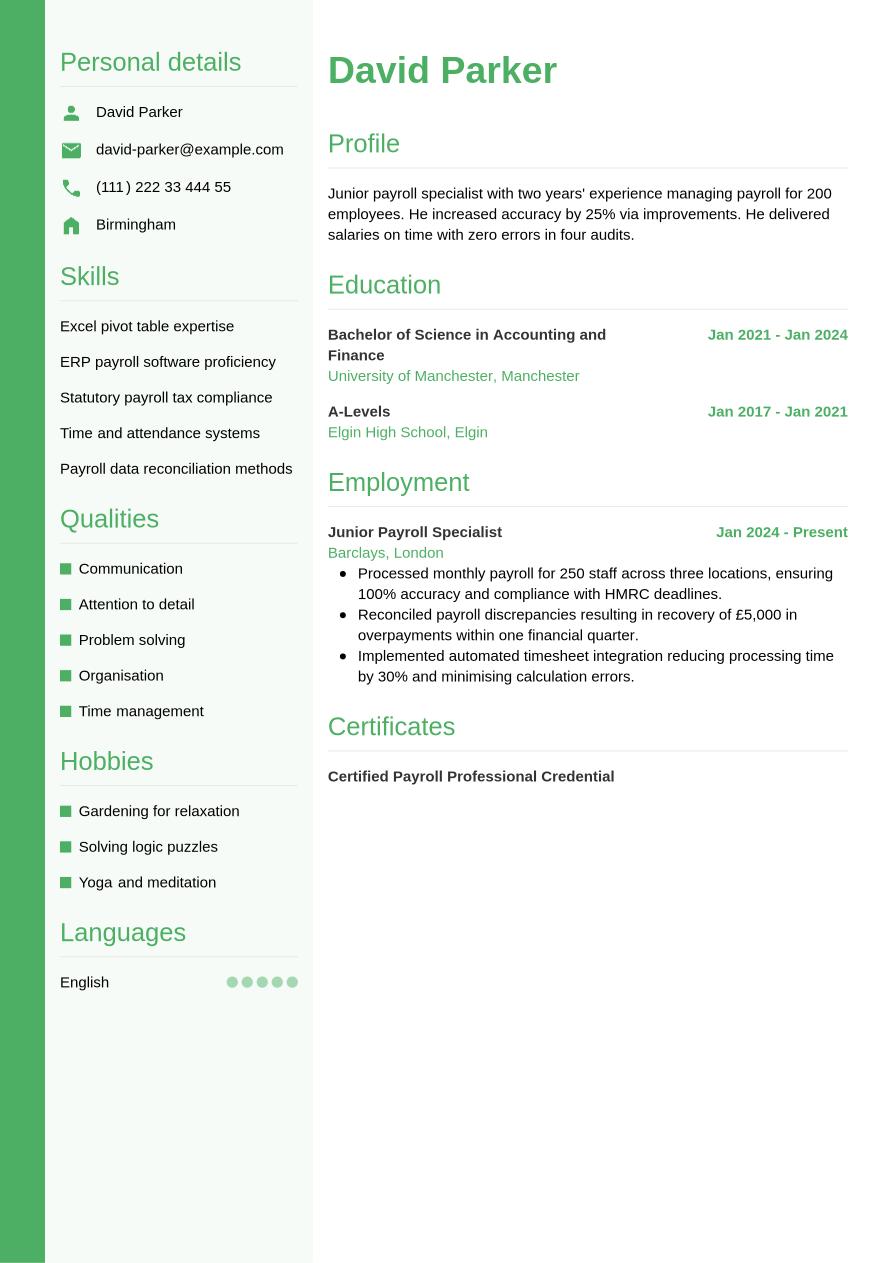
If you've built up some work experience in relevant roles or industry sectors, you'll want to choose a CV format that showcases your career trajectory. Hiring managers will be keen to see how you've used your skills to create positive results for employers in previous roles. In this scenario, a reverse-chronological CV format is usually the most effective choice. Focus on your most recent and relevant previous roles and use bullet points to show your key skills and achievements, offering evidence that showcases your impact.
As an executive or senior-level candidate, it's critical to focus primarily on work experience in your CV. This is because employers will be expecting candidates to have a wealth of relevant experience, and to have reached a prominent position within the industry. As such, a traditional, reverse-chronological CV format is typically the best option, but you may want to add more detail than the standard structure. You can also make space for publications, awards or professional memberships, all of which can help you prove your standing in the industry.
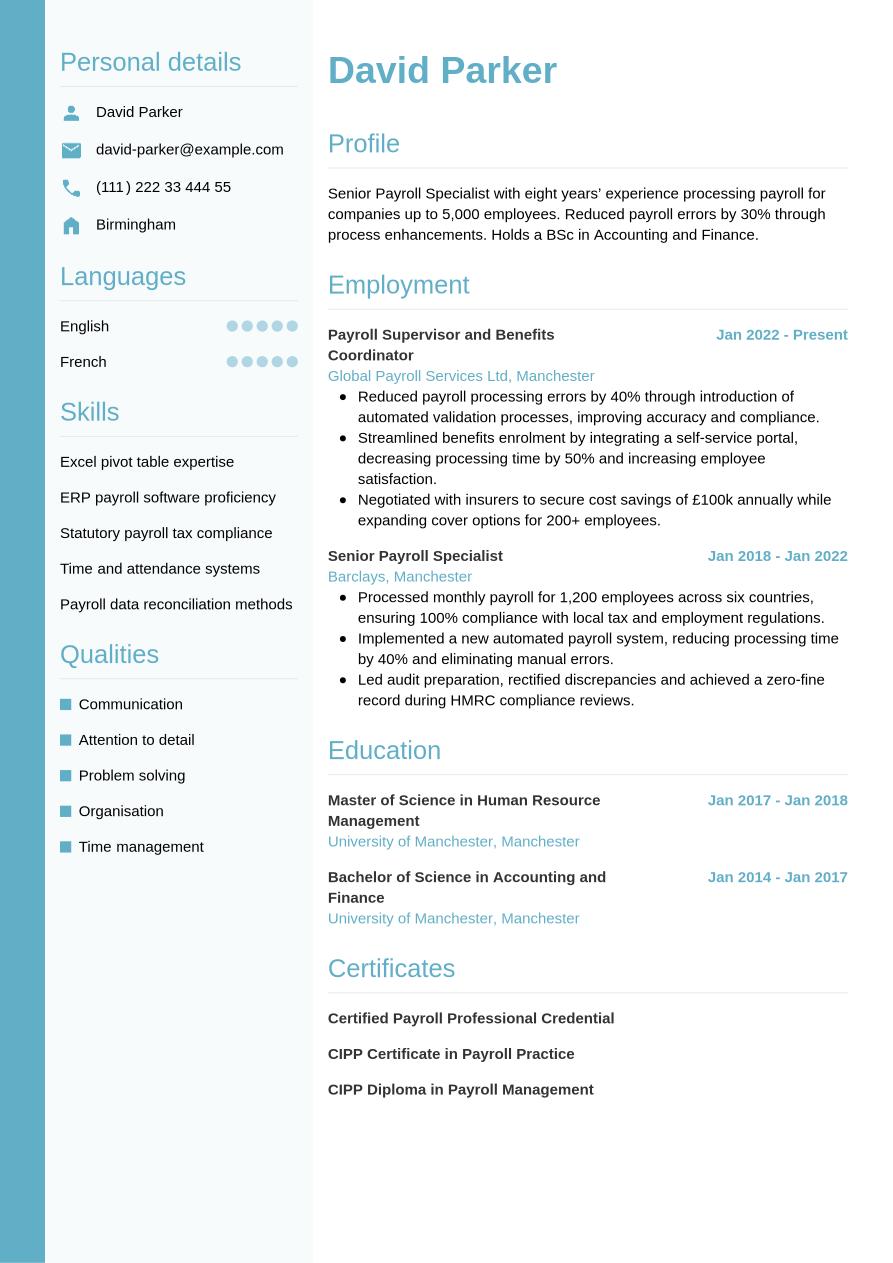
However, no matter where you are in your career, a payroll CV must present a clear, compelling narrative of your professional journey. To help you build that story, we’ll now break down the document piece-by-piece—from the initial contact header to your most significant career milestones.
CV Header
At the top of your payroll CV, add a header that establishes the design language of the document. Include the necessary contact information: your full name, email address, phone number and location. It's not typically necessary to include your full address. If you have a LinkedIn profile, consider adding a URL to this in your header, to help the reader easily find more information on your career and credentials.
When you're applying for jobs in the UK, it's generally not advisable to include a photo or more personal details than are strictly necessary, such as your age, gender, ethnicity or nationality. Including these can jeopardise the recruitment process by introducing bias, and can fall foul of the Equality Act 2010.
David Parker
david-parker@example.com
(111) 222 33 444 55
Birmingham
linkedin․com/in/david–parker–123
CV Summary or Objective
Below your contact information, a short, concise CV summary or CV objective can set the tone for your application and provide brief, basic information on your key skills and qualities that gives a strong indication to the reader about your suitability for the payroll specialist role. A CV summary focuses on your key skills and achievements, while a CV objective provides an alternative approach, showcasing your career ambitions and how the role fits with these. This makes a CV objective ideal for entry-level candidates.
Whether you choose to write a summary or an objective, aim for a length of two or three sentences, introducing your key skills, unique qualities and key achievements or ambitions, making sure they reflect what's included in the job description.
A good CV summary would typically focus on a couple of key skills that match the job description, demonstrating how you've used them to good effect in previous roles. It's important to focus on your unique qualities and provide a preview of how they've made an impact in your career to date, which you'll unpack later in the document. Here's an example of an effective payroll CV summary, with evidence of your impact and neat, well-structured sentences:
Best example:
Payroll specialist with five years’ experience overseeing payroll for over 500 employees. Holds BSc in Accounting and Finance and introduced automation that cut payroll errors by 30%. Skilled in compliance.
Weak example:
Dedicated payroll specialist with a background in processing payroll for large organisations and a proactive approach to streamlining practices, seeking to apply reliable expertise within a collaborative team environment.
See above for an example of an ineffective summary, with subtle differences leading to a reduction of impact. An ineffective summary might be vague or generic, failing to highlight specific personal qualities that help you stand out and failing to address the requirements specified in the job description. They might also lack firm evidence of your skills, and be structured with long, hard-to-read sentences.
Professional Experience
The work experience section of a CV is usually the most important part. Employers look for evidence of how you've developed and used your skills to good effect in your career to date, as an indication of your likely future performance. Remember, it's essential to tailor this section to match the job description, including keywords and phrases to help employers see how you'll fit the role, and how you might put the required skills to good use in the future.
Create a list of all your most relevant roles, going back up to 10 or 15 years if necessary. Include your job title, the name of the employer, its location and the dates you worked there. Include bullet points that explain how you put your skills to good use in each previous role.
To differentiate your work experience section from other candidates, include action verbs and quantifiable evidence that showcases the impact you made. Show your career progression through the skills you developed and used in each role. Here's an example of best practice in a payroll CV work experience section:
Best example:
Payroll Specialist, January 2023 - Present
Thames Payroll Services Ltd, Oxford
- Processed monthly payroll for 650 employees across three regions, ensuring full compliance with HMRC regulations and zero errors.
- Reduced payroll processing time by 30 percent through automating calculations and integrating advanced payroll software solutions.
- Led year-end payroll reconciliation for 800 records, identifying and rectifying discrepancies totalling £50,000, strengthening audit readiness.
Weak example:
Payroll Specialist, January 2023 - Present
Thames Payroll Services Ltd, Oxford
- Processed payroll information for employees across various departments following established guidelines.
- Ensured timely and accurate payroll processing in line with company standards and statutory obligations.
- Provided comprehensive support for payroll inquiries and coordinated resolution of payroll discrepancies with stakeholders.
Above you'll find a less effective example of a payroll CV work experience section. A less-effective work experience section could focus too much on irrelevant or out-of-date roles, or include generic information about your responsibilities that fails to show the impact you made. It might lack tailoring to the job description or fail to provide evidence to support the claims made in the bullet points.
Education and Qualifications
With your education section, you'll draw attention to your most recent and highest qualifications, particularly emphasising any qualifications listed as a requirement in the job description.
For working in payroll specialist positions, it's essential to have a relevant university degree, and as such, you'll want to feature it in your CV. Include your Bachelor of Science in Accounting and Finance or another related degree that qualifies you for the role, in your CV, along with any other degrees or qualifications that highlight your strongest key skills, including ERP payroll software proficiency or statutory payroll tax compliance.
When adding your qualifications to your education section, choose the highest relevant qualifications, and list them in reverse-chronological order, starting with your most recent. When adding each qualification, include the name and level of the award, the institution, its location (if necessary), and the dates you attended or graduated. It can also be valuable to add bullet points outlining your key achievements and activities, such as projects you worked on, modules you completed, awards you won or societies you participated in while studying.
You might also wish to add specialist qualifications, certifications or licences that are required for the role. If you add any of these, include the expiry date, if the qualification requires renewal in the future.
Bachelor of Science (BSc) in Accounting and Finance, 2018 - 2021
University of Manchester, Manchester
Skills
The skills section of a payroll CV provides space for showcasing the key skills and qualities that set you apart as a candidate. You'll want to only include the most relevant skills, so review the job description and list hard and soft skills that match the requirements, while reserving some space to mention your own unique characteristics. For a payroll CV, you'll want to focus on the most relevant skills for the role that match your skill set, including problem solving and statutory payroll tax compliance, to catch the reader's attention and show you're qualified for the payroll specialist position.
Hard Skills
Hard skills are the specialist technical skills that are essential for carrying out the duties of the role. They might be developed through study, on-the-job training or experience in the industry, and some hard skills may require a licence or certification. For payroll specialist roles, key hard skills you've gained, such as excel pivot table expertise, and statutory payroll tax compliance, are typically among the most critical for the job. After checking the job description, include a list of four or five key hard skills in your CV to confirm that you have the necessary expertise for the role.
The best hard skills section will contain a mix of your strongest technical skills and those listed in the job description as 'essential' or 'desirable'. The closer your skills list is to matching the essential job description skills, the better your chances of success.
The following section highlights skills that are commonly listed under hard skills in a payroll CV:
- Excel pivot table expertise
- ERP payroll software proficiency
- Statutory payroll tax compliance
Soft Skills
Soft skills are distinct from hard skills and tend to reflect your inherent personal qualities and strengths. These are often more transferable to different roles, and help the reader understand your working style, and your likely fit to the team and the organisational culture. As a result of rapid technological changes in the world of work, soft skills are becoming ever-more valued by employers. Soft skills can also be particularly valuable for junior or entry-level roles where candidates haven't necessarily had the time to develop hard skills and career achievements.
Similar to your hard skills section, it's best to first review the job description to know which soft skills to focus on in your payroll CV. You'll want to include a combination of soft skills that you can provide evidence for throughout your CV. Draft a list of up to five key soft and transferable skills, combining the most essential skills from the job description with your strongest personal qualities.
Explore the examples below to identify soft skills commonly presented in a payroll CV.
- Communication
- Attention to detail
- Problem solving
Language Skills
Adding foreign language skills to your payroll CV can be a valuable addition that reflects well on you as a candidate. Even if language skills aren't listed as a requirement in the job description, if you speak a foreign language, it can be beneficial to add it to your CV. Within this section, list the foreign languages you speak to a reasonable degree of competence, together with an indicator of your skill levels.
There are a few acceptable ways of citing your foreign language proficiency levels. The simplest way is to assign a basic descriptive word to indicate your skills, such as:
- English: Fluent
- Spanish: Intermediate
You could adopt the Common European Framework of Reference (CEFR), as this provides standardised levels to describe your competence, as follows:
- A1: Beginner
- A2: Elementary
- B1: Intermediate
- B2: Upper intermediate
- C1: Advanced
- C2: Proficiency
Certifications and Training
If you have extra qualifications beyond the basics of what's expected or required for the role, you might want to include a separate certifications section in your CV. It can enhance your chances of success to show specific training and certifications. Not only do these prove you're qualified for the role, but they also indicate proactivity and a dedication to professional development. In addition, the certifications section can be a valuable addition to your payroll CV if you're applying for a role that cites certain certifications or licences as a necessity in the job description. These might include roles where the use of specialist software or equipment forms part of your everyday duties.
Here is a list of some key certifications and licences that can be particularly useful for payroll specialist applications:
- Certified Payroll Professional Credential, 2023
- CIPP Certificate in Payroll Practice, 2023
- CIPP Diploma in Payroll Management, 2023
Expert Tip:
Barnet Council shows that recruiters spend only 8.8 seconds reviewing a CV, so a concise personal statement is essential to grab attention immediately. (1)
Optional Sections
Optional sections can be useful to add to your CV, to provide additional evidence that you have the skills for the payroll specialist job. Consider adding optional sections if you're unable to show all the necessary skills for the job through work experience, but could show them through extracurricular activities and other areas of life. This could be especially relevant if you're a junior candidate, or if you're changing careers.
If you're curious about other ways to make your CV more effective, our career resources will help you strengthen your application.
Hobbies and Interests
If you have any hobbies and interests that can showcase skills relevant to the job description, it might be worth including them. Additionally, hobbies and interests are an ideal way to show the employers some elements of your personality and interests beyond work, which can set you apart from other candidates. However, a hobbies and interests section will only make an impact with the reader if the skills you showcase are relevant to the role. As such, only include this section if it helps you fulfil requirements of the role that you've been unable to show elsewhere.
Key Achievements
Listing your key career achievements in a distinct section can be an effective way of drawing attention to them. In this section, add any awards or recognition you've received for achievements, and any career milestones you've reached that show you're a strong candidate for the job.
Volunteer Roles
Another way of showing employers your skills and experience is through volunteer roles. If you're struggling to show you have the necessary credentials through your work experience, volunteering can provide valuable examples of how you've put your skills into action. In your volunteering section, use a similar structure to your work experience section.
Add your job title or a description of the volunteer role, the organisation name, its location and the dates you volunteered (start and end date). Under this, add bullet points to show the skills you used, and evidence of how they contributed to positive achievements for the organisation.
Data Insight:
Hiring managers spend an average of 30 seconds reviewing a CV to assess its likely fit for the role, so it's essential to clearly highlight your skills, experience, and evidence of your achievements. (2)
Top action words to use in a payroll CV
Using strong action verbs in your work experience bullet points is a great way to focus this section and show the impact you've made in your career to date. Starting each bullet point with an action verb that reflects the skills required for the role will help the reader to easily cross-reference your skills to the job description. You'll also want to back up any action verbs you're using with quantifiable evidence that showcases the value you added for previous employers. Use the past tense for action verbs that describe previous roles, with the present tense for any current responsibilities and achievements.
- Calculate
- Process
- Reconcile
- Audit
- Administer
- Generate
- Verify
- Prepare
- Analyse
- Maintain
Payroll CV example
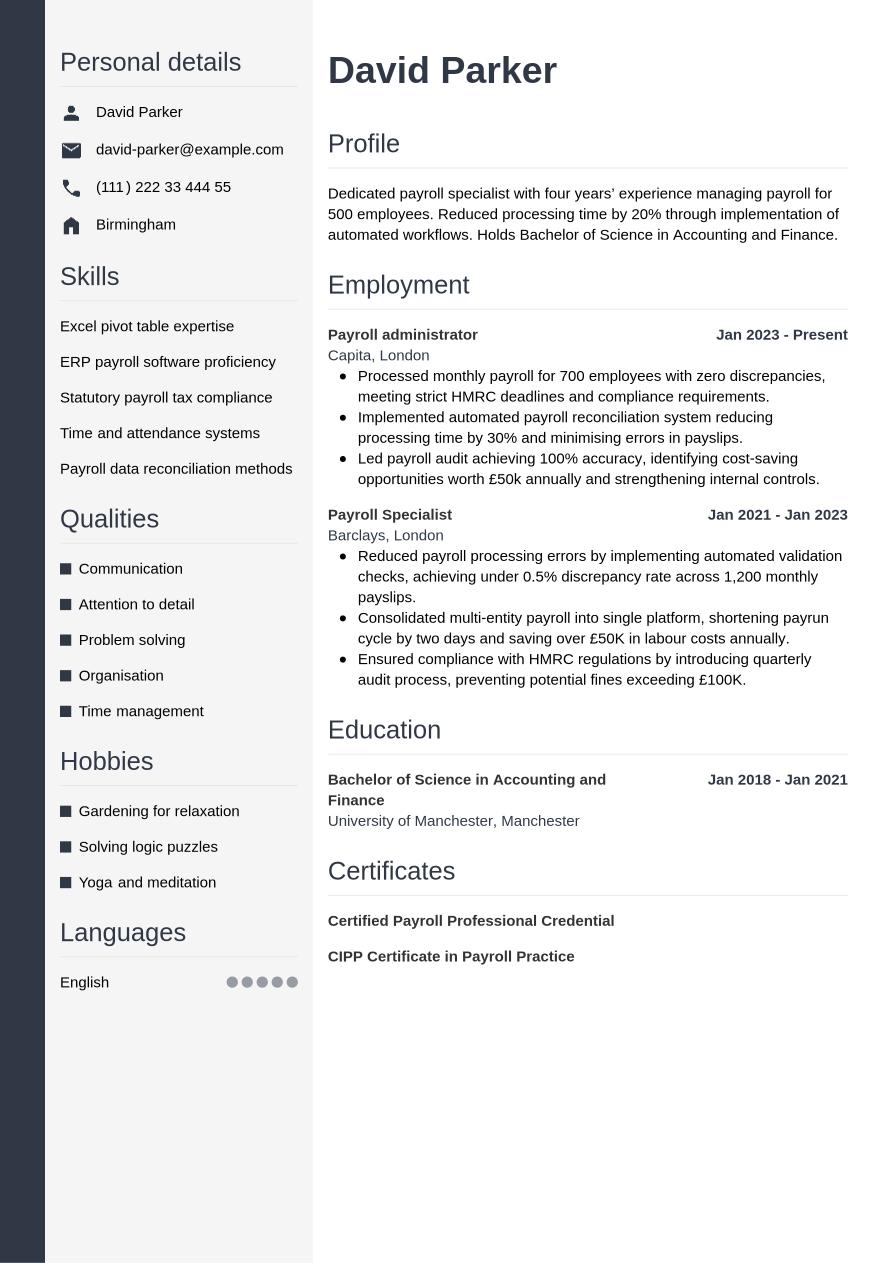
Now that you're aware of the key steps to creating a winning payroll CV, you can review a complete example to see how a final CV looks:
Birmingham
•
david-parker@example.com
•
(111) 222 33 444 55
•
linkedin․com/in/david–parker–123
Dedicated payroll specialist with four years’ experience managing payroll for 500 employees. Reduced processing time by 20% through implementation of automated workflows. Holds Bachelor of Science in Accounting and Finance.
Payroll administrator
2023
-2026
Capita (London)
- Processed monthly payroll for 700 employees with zero discrepancies, meeting strict HMRC deadlines and compliance requirements.
- Implemented automated payroll reconciliation system reducing processing time by 30% and minimising errors in payslips.
- Led payroll audit achieving 100% accuracy, identifying cost-saving opportunities worth £50k annually and strengthening internal controls.
Bachelor of Science in Accounting and Finance
2018
-2021
University of Manchester (Manchester)
Excel pivot table expertise
ERP payroll software proficiency
Statutory payroll tax compliance
Communication
Attention to detail
Problem solving
Certified Payroll Professional Credential
CIPP Certificate in Payroll Practice
English - Native
French - Advanced
To see how your CV might look after finalising its design and layout, take a look at our CV examples.
Dos and don'ts for a winning payroll CV
Tips to follow
- Open your CV with a strong CV summary or objective, providing a brief account of your career achievements and skills.
- Use strong action verbs that show how you've used your skills to add value for employers in your career to date.
- List your qualifications in a dedicated education section, including grades and awards if these can help set you apart from other candidates (particularly for junior candidates).
- Proofread your CV carefully before sending, as any spelling or grammatical errors could seriously undermine your chances of success.
- Add a dedicated skills section, including a summary of your key hard and soft skills that also reflect the job description.
Common mistakes to avoid
- Don't fixate on irrelevant work experience that might take up valuable space and won't contribute significantly to your chances of success.
- Leave out any detailed personal information, such as age, gender or marital status, and avoid adding a personal photo unless it's required for the role.
- Don't forget to review your contact information to make sure it's current, and update your LinkedIn profile with your latest career details.
- Don't lie or exaggerate to make your application look stronger – misleading claims about jobs or qualifications can be considered fraud.
- Don't crowd your CV with too many details, but try to keep it focused, concise and relevant throughout.
A well-written cover letter is an essential element of any job application. Take a look at our HR-approved cover letter templates to find a design and layout that matches your CV.
Guide to making your CV ATS compatible
Many employers now use applicant tracking systems (ATS) to assist with managing the recruitment process. One of the key elements of most ATS apps is the ability to scan CVs and rank them according to their likely match to the job description. By assuming this role in the recruitment process, ATS apps can reduce the amount of time employers need to spend reviewing CVs. With hundreds of applications for a single vacancy becoming increasingly commonplace, this increased efficiency is extremely valuable for employers.
The growing prevalence of ATS apps requires a shift in approach by jobseekers, to prepare a CV with the best chance of passing the ATS screening stage. That's why we've put together a list of key ATS CV tips, to maximise your chances of success:
- Include keywords and phrases that match the job description, giving you the best chance of appearing as a strong fit for the role.
- Use standard CV headings that clearly identify each section, such as 'work experience', 'education' and 'skills'.
- Choose a standard CV layout that avoids the use of any special design elements that might make your CV less compatible with ATS scanning software.
- Select a font that increases the readability of your CV, such as popular serif and sans serif fonts, between the sizes of 10 and 12 for main text and 14 and 16 for headings.
- Use bullet points throughout your CV in place of full sentences. This serves a few purposes, reducing the overall length, helping keywords stand out and making it overall more scannable by ATS apps.
It's easy to get overwhelmed by the steps to creating an ATS-compatible payroll CV, but a few small changes can make a big difference. To smooth the process, use one of our expert-designed, ATS-optimised CV templates to increase your chances of success at this stage of the screening process.
If you want to stand out from other candidates with your CV, use Jobseeker's expert-designed CV templates, to instantly improve the look and feel of your application.
Payroll CV FAQs
How do I create a payroll specialist cover letter to go with my CV?
A cover letter that makes a positive impact with the reader can be just as important as your CV. For the best impact, choose a formal, professional letter layout and a cover letter template that reflects the look and feel of your CV, reinforcing your application's design language.
The typical cover letter includes three key sections of content. Firstly, introduce yourself, confirm the role you're applying for and explain why you're applying for the position. Next, outline some relevant key skills and achievements from your career without repeating the details in your CV. Finally, express your gratitude to the employer for considering your application and leave a call to action that encourages them to contact you for an interview, or to establish dialogue.
Alternatively, if you're applying for the role via email, you may want to send a less formal cover note. This simply includes a brief introduction, confirming the role you're applying for and directing the reader to the relevant attached documents, rather than following the traditional professional letter conventions. Remember to include your contact details in your email, so the employer can follow up with you if necessary.
Jobseeker's cover letter examples for payroll specialist roles and other key finance industry positions provide useful HR-expert tips and guidance on how to write a compelling cover letter.
How do I write a payroll CV without experience?
Even if you don't have much work experience, you can still write a payroll CV that impresses employers.
Choose a CV format that places greater emphasis on your skills over your work experience, such as the functional format. In this CV layout, your skills section and education typically come before your work experience.
For junior or entry-level roles, employers may be more keen to know whether you have the right soft and transferable skills to adapt to the requirements of the role. In this case, place greater emphasis on soft skills for a junior payroll CV.
How do you write an attention-grabbing payroll CV headline?
A CV headline can help you add relevant keywords into your CV, aiding ATS compatibility while catching the attention of the reader from the outset.
Aim for a short, snappy sentence that includes the job title and introduces one of your strongest, most relevant skills or qualities.
To give your CV the best shot at success, write a CV headline that focuses on the most essential keywords and phrases from the job description. This will strike a chord with the hiring manager and help your CV to pass the ATS screening stage.
See below for some examples that you can use as inspiration for writing a CV headline for different experience levels:
- Proactive Junior Payroll Specialist Excelling
- Accurate Payroll Specialist Delivering Results
- Senior Payroll Specialist Ensuring Accuracy
What's the most effective CV format for a payroll CV in 2026?
The best payroll CV format for success in your 2026 job hunt might vary according to your experience levels, the type and level of the role, the company and standard industry practices.
Typically, the most effective CV format for most candidates is a standard reverse-chronological structure that prioritises your work experience section as a showcase of your skills and career achievements.
Alternatively, for entry-level candidates or career changers who don't have much relevant work experience, a functional CV format tends to work better. This layout places skills and qualifications above work experience.
Key takeaways for your payroll CV
To make a strong first impression on hiring managers, tailor your CV for every application, adding keywords and phrases that match the job description. Use a CV format that reflects your experience levels, and emphasise your skills and achievements throughout your CV, to show employers you've got the required skills and experience for the job.
Finally, enhancing the look and feel of your CV using one of Jobseeker's HR-approved CV templates can help leave a lasting impression on the reader, and boost your chances of success with your job applications.
Sources:
- Barnet Council (UK local government), Recruitment tips: How to write a supporting statement
- Jobseeker, HR Trends

Impress employers with your CV
Step-by-step guidance to create a professional CV in minutes.