Landscape CV Example
Achieving success with your landscaper applications requires a strong, compelling CV that gives your skills and career achievements a chance to shine. You'll want to showcase strong skills that are relevant to the role and reflect your experience, including maintaining lawn equipment and installing irrigation systems. In this guide, we'll equip you with all the key tips and advice you'll need to craft a landscape CV that sets you up for success in your job applications.
A landscape CV that includes all the necessary details and is tailored carefully to the job description puts you in a great position. It can help you pass the ATS screening stage, make a strong impression with the employer and reach the latter stages of the recruitment process. Now let’s explore the main sections of a CV and see how to structure each one for maximum impact.
Main sections of a landscape CV
Your landscape CV writing strategy may vary significantly according to numerous factors, such as your previous experience, your seniority and the requirements in the job description.
As a junior candidate, you might lack a wealth of work experience, so you'll want to show the employer you have the skills necessary for the job through other sections. As such, it's worth considering using a functional, or skills-based, CV format. This structure places the skills and education sections above your work experience in the order of sections. Optional sections such as volunteering, internships and hobbies and interests can also help you show you have the necessary skills.
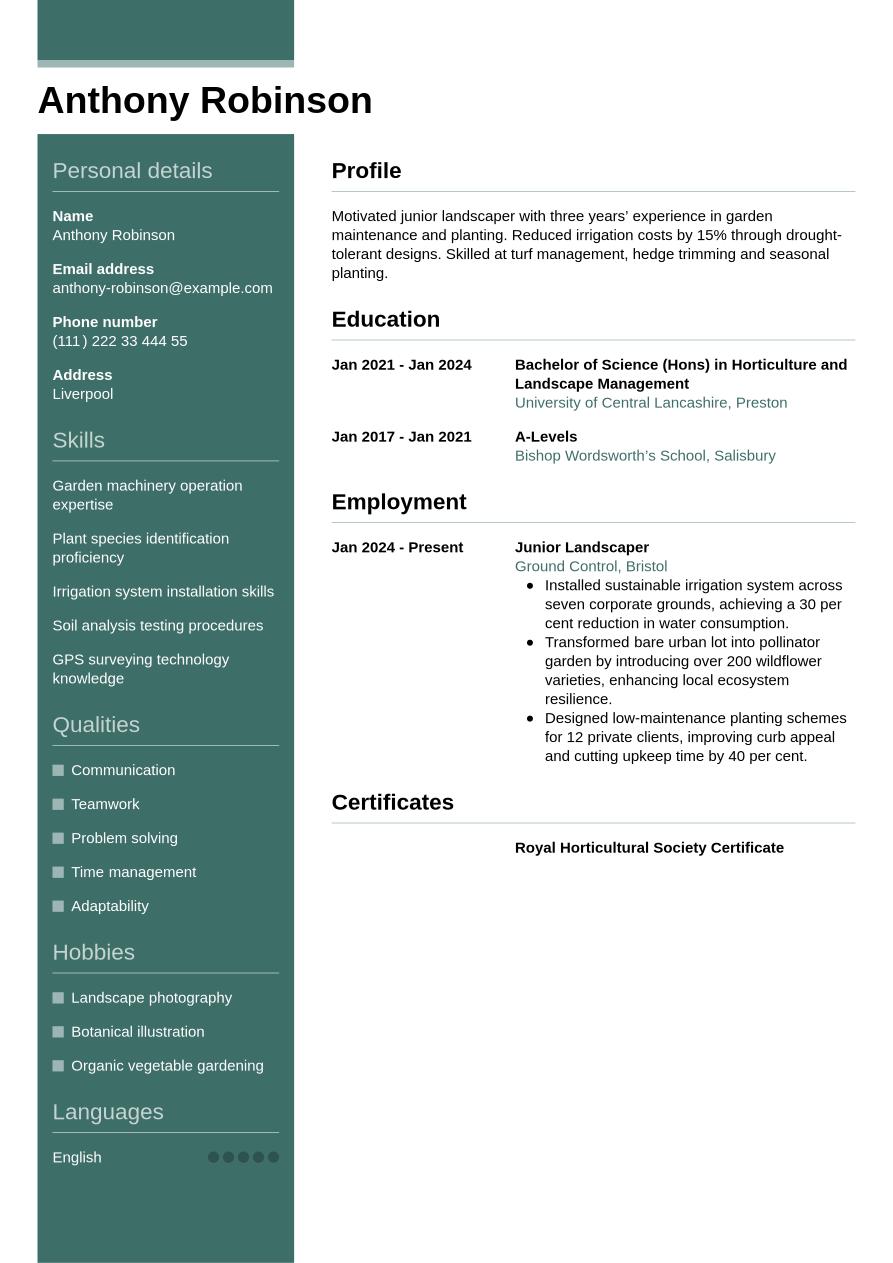
Once you've got some relevant work experience under your belt, you'll want your CV to focus on this as much as possible, and show how you've developed your skills and put them to good use in the workplace. Employers will be keen to see the impact you've had in other roles, and for other organisations. In this scenario, a reverse-chronological CV format is usually the most effective choice. Focus on your most recent and relevant previous roles and use bullet points to show your key skills and achievements, offering evidence that showcases your impact.
As a senior candidate with a wealth of relevant experience, it's important that your CV showcases your reputation within your industry. Employers will be looking for candidates with the expertise, industry standing and track record to lead a team or organisation. Therefore, you'll want to create a detailed CV that follows the traditional, reverse-chronological format and showcase the depth of your experience and your career progression. You could also include professional memberships, publications, awards and key achievements to show your expertise.
However, at any stage of your career, a landscape CV serves as a professional biography that must clearly illustrate your career trajectory. To help you tell that story effectively, we will now break down the document piece-by-piece, starting with your contact header and moving through the key pieces of your professional path.
CV Header
Start your landscape CV with a professional-looking header that includes all the relevant contact information. This usually includes your name, your email address, your phone number and your location, but not your full address. If you have a LinkedIn profile, consider adding a URL to this in your header, to help the reader easily find more information on your career and credentials.
For jobs in the UK, a personal photo is usually not required on your CV. That, along with any other personal details such as age, gender, ethnicity and nationality, are generally discouraged under the terms of the Equality Act 2010, which aims to reduce and eliminate discriminatory practices, such as recruitment bias.
Anthony Robinson
anthony-robinson@example.com
(111) 222 33 444 55
Liverpool
linkedin․com/in/anthony–robinson–123
CV Summary or Objective
Below your CV header, the next section tends to be a CV summary or CV objective. This paragraph briefly explains a few of your key skills and qualities, so employers can easily understand whether you're likely to be a suitable candidate for the landscaper job. While the CV summary focuses on your key skills and achievements, a CV objective highlights your career ambitions, making it more suitable for junior candidates.
Both a CV summary and objective should be concise, with an ideal length of two or three sentences. List your key skills, personal strengths and career achievements or ambitions, taking care to ensure the content reflects the requirements listed in the job description.
A good CV summary would typically focus on a couple of key skills that match the job description, demonstrating how you've used them to good effect in previous roles. It's important to focus on your unique qualities and provide a preview of how they've made an impact in your career to date, which you'll unpack later in the document. Here's an example of an effective landscape CV summary, with evidence of your impact and neat, well-structured sentences:
Strong example:
Dynamic landscaper with 5 years’ experience creating sustainable outdoor environments. Former Landscape Architect who delivered 8 public parks on time. Holds a BSc in Landscape Architecture and cut maintenance costs 20%.
Worst example:
Enthusiastic and adaptable landscaper with broad experience in designing and maintaining outdoor spaces, committed to delivering quality results, fostering effective teamwork and applying practical solutions across diverse horticultural projects.
The CV summary above contains various red flags and things to avoid. While the differences are subtle, they can make all the difference. There are several factors that could make your summary less engaging. These include using long, poorly-structured sentences, failing to add evidence of your impact, being too generic with the skills you mention and not adapting your CV summary to specifically respond to the job description.
Work History
A CV's work experience section is usually its most important element. Employers tend to value the work experience section, as it shows evidence of how you've put your relevant skills to good use in your career to date. It's crucial to tailor your work experience section to match the requirements listed in the job description, using keywords and phrases so employers can easily see how well you fit the role and organisation.
Create a list of all your most relevant roles, going back up to 10 or 15 years if necessary. Include your job title, the name of the employer, its location and the dates you worked there. Include bullet points that explain how you put your skills to good use in each previous role.
To differentiate your work experience section from other candidates, include action verbs and quantifiable evidence that showcases the impact you made. Show your career progression through the skills you developed and used in each role. See below for an example of a strong work experience section for a landscape CV.
Strong example:
Landscape Architect, January 2023 - Present
GreenHaven Gardens Ltd, Cambridge
- Designed and managed restoration of a Victorian garden at a Grade II listed building, increasing biodiversity and visitor engagement.
- Secured planning approval for a 10-acre urban park, collaborating with local authorities to meet sustainability and community requirements.
- Developed planting scheme for corporate headquarters garden, selecting native species to reduce maintenance costs and support wildlife.
Worst example:
Landscape Architect, January 2023 - Present
GreenHaven Gardens Ltd, Cambridge
- Oversaw plant care duties and completed various landscaping assignments with attention to detail.
- Delivered garden maintenance services across diverse environments, meeting client requirements and upholding aesthetic standards.
- Assisted with grounds upkeep, performed routine planting and pruning tasks in compliance with company guidelines.
Above you can see an example of what not to do with your landscape CV work experience section. A less-engaging work experience section might include irrelevant roles or jobs from a long time ago, and generic information that fails to address the requirements of the job description. It could also lack evidence to support the claims made in the bullet points.
Education
In your education section you'll want to list your highest and most recent qualifications, particularly if they're a requirement for the role.
To work as a landscaper, it's not necessary to have a specific degree. However, while a degree isn't usually requested in the job description, it can be useful to include other relevant qualifications in your CV's education section. These might include Royal Horticultural Society Certificate, or other courses that show your hard skills, such as garden machinery operation expertise or plant species identification proficiency.
Your education section should contain only the qualifications that you consider most relevant to the role. List them in reverse-chronological order, starting with the most recent and working back from there. For each qualification, add its name and level, the awarding body or institution, its location (if necessary) and your dates of attendance or graduation. If you want to emphasise your education in your CV, include bullet points showing specialist areas of study, projects, awards, society memberships or anything else that helps show you've got the necessary skills for the job.
Specialist licences or certifications can also be a valuable addition to your CV's education section. If these are essential for the job and are referenced in the job description, it's a good idea to include them here rather than further down your CV. Include any expiration or renewal dates for certifications, if applicable.
Bachelor of Science in Landscape Architecture, 2018 - 2021
University of Sheffield, Sheffield
Skills
Your CV's skills section CV's skills section is a great place to showcase some of the key skills necessary for the role. Check the job description to understand which skills are most essential, and provide a combination of hard and soft skills, reserving space to include some unique qualities that can help you to stand out from the competition. In a landscape CV, focus on the most relevant and essential skills in your skills portfolio, such as communication and GPS surveying technology knowledge, to show you're qualified for the landscaper position and to put you in a strong position to progress.
Hard Skills
Hard skills and technical skills are the specialist skills required for completing the everyday duties of the role, such as the use of certain software or equipment, or specialist industry knowledge. You can develop these skills through study, training, on-the-job or through completing industry certifications. For landscaper positions, hard skills that match your abilities, such as plant species identification proficiency, and irrigation system installation skills tend to be valued by recruiters and hiring managers. Check the skills specified in the job description, and add four or five key hard skills to your CV that show employers you're capable of completing the key duties of the role.
The ideal hard skills section will feature the most essential hard skills from the job description, while closely reflecting your own best technical abilities. The closer your strongest skills are to matching the job description, the higher your chances of success.
Below, you can find the types of skills typically featured in the hard skills section of a landscape CV:
- Garden machinery operation expertise
- Plant species identification proficiency
- Irrigation system installation skills
Soft Skills
Soft skills are the personal strengths and qualities that show employers how well you'll fit into the role and complement other members of the team. Soft skills tend to be more transferable and applicable to different roles than hard and technical skills. Owing to the rapidly evolving nature of the work landscape, soft skills are growing in importance for a number of roles and industry sectors where technology is replacing hard skills. Additionally, soft skills are particularly valuable for junior and entry-level candidates, who might not have much work experience but have the right building blocks for a successful career.
As with hard skills, review the job description to understand the best soft skills to mention in your landscape CV. The best CV soft skills section includes specific skills that you can evidence with examples throughout your CV. Aim to add up to five soft and transferable skills, including a mix of the most essential skills from the job description, together with some skills that make you stand out as a unique and compelling candidate.
Below is a selection of soft skills regularly featured in a landscape CV.
- Communication
- Teamwork
- Problem solving
Languages
If you speak any additional languages, you might want to consider adding a languages section to your CV. Even if languages aren't a requirement of the job description, speaking a foreign language can reflect well on you as a candidate, and correlate with other soft skills that can increase your employability. List any foreign languages you speak, together with an indication of your proficiency level.
There are several methods of confirming your foreign language skills on your CV. The simplest way is by assigning a basic descriptive word, such as:
- English: Fluent
- Spanish: Intermediate
You could adopt the Common European Framework of Reference (CEFR), as this provides standardised levels to describe your competence, as follows:
- A1: Beginner
- A2: Elementary
- B1: Intermediate
- B2: Upper intermediate
- C1: Advanced
- C2: Proficiency
Certifications
If you have extra qualifications beyond the basics of what's expected or required for the role, you might want to include a separate certifications section in your CV. It can be a valuable way of differentiating yourself from other candidates and showing employers your dedication, motivation and commitment to professional development. In addition, the certifications section can be a valuable addition to your landscape CV if you're applying for a role that cites certain certifications or licences as a necessity in the job description. These might include roles where the use of specialist software or equipment forms part of your everyday duties.
These example certifications and licences are ideal for candidates applying for landscaper roles:
- Royal Horticultural Society Certificate, 2023
- City and Guilds Horticulture Diploma, 2023
- Arboricultural Association Certification, 2023
Pro Tip:
Since recruiters give under ten seconds to each CV, Barnet Council advises starting with a clear summary that grabs attention quickly. (1)
Additional Information
Including optional sections in addition to the core sections of your landscape CV can help you to show employers you're a strong candidate for the job. Consider optional sections for your CV if you're looking for ways to show you're right for the job, beyond your work experience. Optional sections are particularly valuable if you haven't had the chance to build up relevant work experience, for example, if you're applying for entry-level roles or you're changing careers to a new industry or role.
You can find more detailed advice on tailoring your CV in our career resources, where we cover proven ways to highlight your skills effectively.
Hobbies and Interests
Your hobbies and interests can be a useful way of showcasing additional skills that are relevant to the job description, but that you haven't been able to prove via your work experience. Additionally, this section gives you the chance to show employers different facets of your personality and interests beyond work, which can help them to differentiate you from other applicants. However, hobbies and interests can only add value to your CV if they provide evidence of skills and experience that you can use in the role you're applying for. As such, only add hobbies as a way of filling gaps in the skills you've developed or used through work experience.
Career Achievements
Compiling your key career achievements into a single list is an effective way of making your CV more readable at a glance. Add any awards you've won or career milestones you've reached, so employers can easily see the impact you've made in your career to date.
Volunteering
Another valuable optional section for your CV is volunteering. This section can offer a great alternative showcase for your skills and experience, if you don't have much relevant work experience. Consider adding this section if you have any relevant unpaid experience, either as a junior candidate or a career changer. In your volunteering section, use a similar structure to your work experience section.
Add your job title or a description of the volunteer role, the organisation name, its location and the dates you volunteered (start and end date). Under this, add bullet points to show the skills you used, and evidence of how they contributed to positive achievements for the organisation.
Data Insight:
Hiring managers spend an average of 30 seconds reviewing a CV to assess its likely fit for the role, so it's essential to clearly highlight your skills, experience, and evidence of your achievements. (2)
Most impactful action verbs for a landscape CV
Including strong action verbs with your work experience bullet points can help you show the impact you made in previous roles. Starting each bullet point with an action verb is a great way to match your experience and achievements to the job description, giving the reader an easy way of identifying your key skills and seeing how you've applied them. Remember, it's essential to evidence any action verbs you add to your work experience. This will help show your achievements and the impact you made in previous roles. Use past tense for action verbs that describe previous roles, and present tense for your current position.
- Design
- Maintain
- Plant
- Prune
- Cultivate
- Dig
- Mow
- Irrigate
- Mulch
- Trim
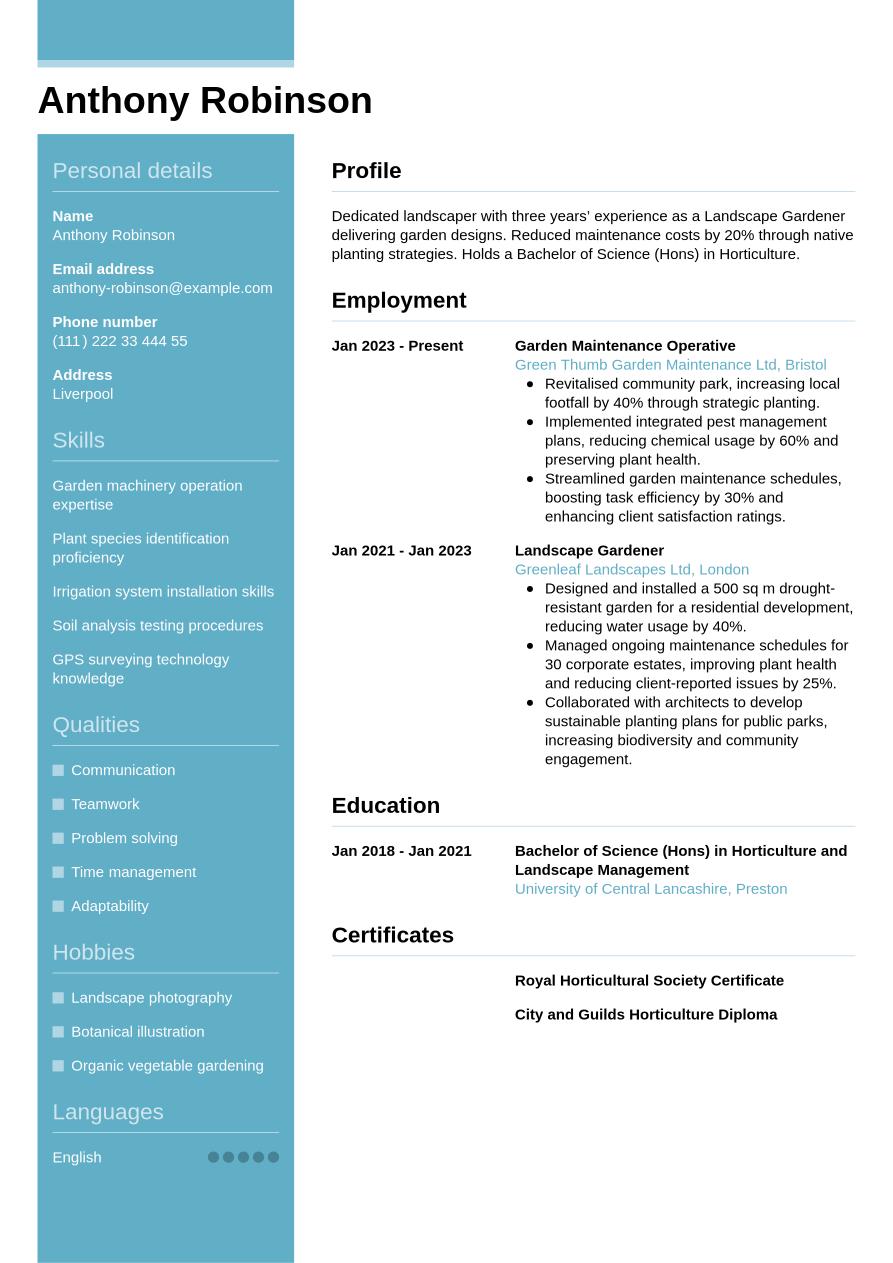
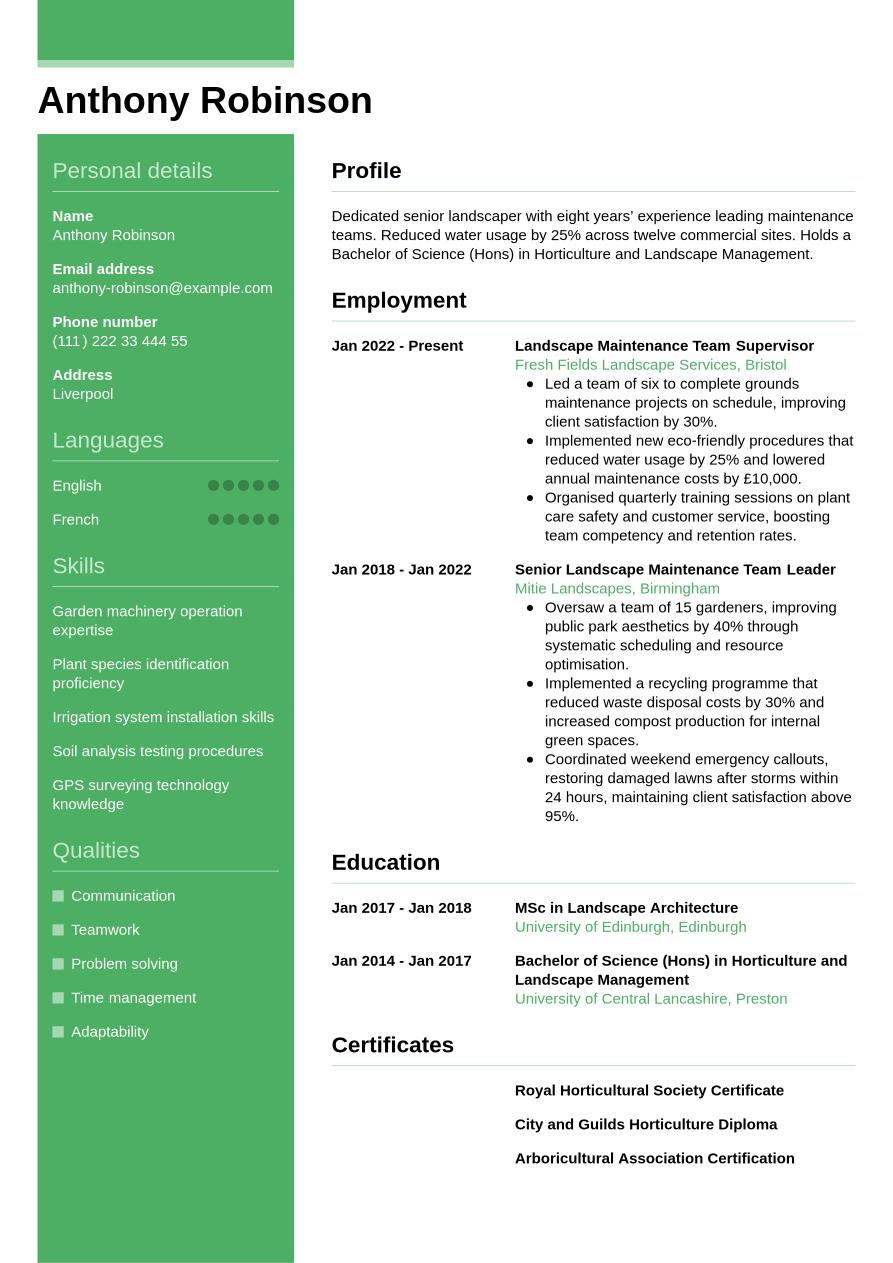
Example of a landscape CV
Now that you're aware of the key steps to creating a winning landscape CV, you can review a complete example to see how a final CV looks:
Liverpool
•
anthony-robinson@example.com
•
(111) 222 33 444 55
•
linkedin․com/in/anthony–robinson–123
Dedicated landscaper with three years’ experience as a Landscape Gardener delivering garden designs. Reduced maintenance costs by 20% through native planting strategies. Holds a Bachelor of Science (Hons) in Horticulture.
Garden Maintenance Operative
2023
-2026
Green Thumb Garden Maintenance Ltd (Bristol)
- Revitalised community park, increasing local footfall by 40% through strategic planting.
- Implemented integrated pest management plans, reducing chemical usage by 60% and preserving plant health.
- Streamlined garden maintenance schedules, boosting task efficiency by 30% and enhancing client satisfaction ratings.
Bachelor of Science (Hons) in Horticulture and Landscape Management
2018
-2021
University of Central Lancashire (Preston)
Garden machinery operation expertise
Plant species identification proficiency
Irrigation system installation skills
Communication
Teamwork
Problem solving
Royal Horticultural Society Certificate
City and Guilds Horticulture Diploma
English - Native
French - Advanced
To see how your CV might look after finalising its design and layout, take a look at our CV examples.
The dos and don'ts of a successful landscape CV
Tips to follow
- Quantify your career achievements where possible, using key metrics and positive endorsements and feedback.
- Start with a strong CV summary or objective, providing a snapshot of your best qualities and achievements to help employers form a positive first impression.
- Use reverse-chronological order, starting with your most recent work experience or qualifications and working back from there.
- Outline your qualifications in your education section, detailing grades and awards where these can help you stand out (especially for junior applications).
- Add a dedicated skills section to showcase your strongest hard and soft skills, ensuring they reflect the skills listed in the job description.
Common mistakes to avoid
- Don't make exaggerated claims or lie about jobs, qualifications or career achievements – it can backfire and disqualify you from the selection process.
- Don't crowd your CV with unnecessary extra details, but stick to the key facts and present them in a clear, readable fashion.
- Don't forget to update your contact information to ensure it's current, including keeping your LinkedIn profile updated with your latest career details.
- Don't use an inappropriate email address with informal language or nicknames. If necessary, create a professional email address based on your name, initials and/or profession.
- Don't use industry jargon or acronyms to try to impress the reader, when it's easier and clearer to communicate with simple, straightforward language.
A courteous, professional cover letter can make all the difference to your job applications. Our cover letter templates have been designed by experts to help you make the best impression with hiring managers.
Tips for optimising your CV for ATS
Many employers now use applicant tracking systems (ATS) to assist with managing the recruitment process. One of the key elements of most ATS apps is the ability to scan CVs and rank them according to their likely match to the job description. This saves recruiters and hiring managers the time and effort of reading every CV in detail. With many vacancies often receiving hundreds of applications, ATS software can really relieve the burden on hiring teams and free them up to focus only on the most suitable candidates.
The increasing usage of ATS apps by recruiters and employers means it's critical to adapt and prepare your applications to successfully navigate this stage of the selection process. Following the tips below will give you everything you need for an ATS-compatible CV:
- Include keywords and phrases from the job description that are easy for ATS apps to identify, and help make you appear a strong fit for the role.
- Use clear, standard CV headings that are easily recognisable, such as 'work experience', 'education' and 'skills'.
- Choose a standard CV layout, avoiding special design elements such as text boxes, columns or unlabelled graphics that can confound ATS scanning apps.
- Select a font that enhances the readability of your CV, including recognised serif and sans serif fonts between sizes 10 and 12 for body text, and 14 and 16 for headings.
- Use bullet points in place of full sentences and paragraphs. This can reduce the overall length of the document, make the keywords stand out and make it easier for ATS apps to scan.
You might feel there are a lot of steps to creating an ATS-compatible landscape CV, but with just a few small changes, you can ensure your CV passes this stage. Use one of our ATS-compatible CV templates, which are designed by experts to give you the best chances of success.
Jobseeker's CV templates can help your CV to make a strong first impression with recruiters. Each template is expertly designed and approved by HR specialists to help you craft a winning application.
Landscape CV FAQs
How do I write a landscaper cover letter for my job application?
Your cover letter can have just as strong an impact on your chances of success as your CV. When writing a cover letter, use a professional, formal letter structure and select a cover letter template to match the look and feel of your CV.
The standard cover letter format includes three main paragraphs of content. The first paragraph includes a brief introduction to yourself and the role you're applying for, and references your motivation for applying for the job. In the second paragraph, list some key skills and achievements, taking care to differentiate from the content in your CV. The closing paragraph typically contains a recap of your enthusiasm for the role, and adds a call to action that establishes dialogue with the employer.
Alternatively, if you're applying for the role via email, you may want to send a less formal cover note. This simply includes a brief introduction, confirming the role you're applying for and directing the reader to the relevant attached documents, rather than following the traditional professional letter conventions. Remember to include your contact details in your email, so the employer can follow up with you if necessary.
Jobseeker's cover letter examples for landscaper and architecture industry roles provide useful tips and guidance from HR experts on how to write a compelling cover letter.
How do I write a compelling landscape CV without experience?
Even without a history of relevant work experience, you can still write a landscape CV that makes its mark with employers.
Select a CV structure that makes the most of your relevant skills, rather than focusing on your work experience, such as a functional format. In this layout, the skills and education sections come before work experience.
If you're an entry-level candidate with no relevant work experience, focus on your soft and transferable skills in your landscape CV. Employers will be looking for candidates who can show they have the soft skills to learn a new role and adapt to new environments.
How do I write a landscape CV headline for maximum impact?
A well-written CV headline can be an effective way of introducing your CV, helping it be more compatible with ATS apps and engaging the reader early in the document.
Aim to write a short, engaging sentence that includes the job title and shows you to be a good match for the job description.
To give your CV the best shot at success, write a CV headline that focuses on the most essential keywords and phrases from the job description. This will strike a chord with the hiring manager and help your CV to pass the ATS screening stage.
See these examples to understand best practice for writing a CV headline for different experience levels:
- Dedicated Junior Landscaper with Passion
- Expert Landscaper Enhancing Outdoor Environments
- Senior Landscaping and Maintenance Expert
What's the best landscape CV format for 2026?
The best CV format for a landscape CV in 2026 depends on both your experience levels, and the role you're applying for, including its level, the company and industry norms.
Typically, the reverse-chronological CV is most effective if you have some work experience under your belt. This is because the layout showcases your work experience, providing evidence of how you've used relevant skills to achieve success in previous roles.
Alternatively, for entry-level candidates or career changers who don't have much relevant work experience, a functional CV format tends to work better. This layout places skills and qualifications above work experience.
Key takeaways for an impactful landscape CV
To stand out from the crowd with your CV, tailor your approach to each individual application, incorporating keywords and phrases that match the job description. Select a suitable CV format that reflects your experience level, and focus on highlighting your key skills, and demonstrating how you've put them to good use to achieve positive outcomes in your career to date.
Finally, enhancing the look and feel of your CV using one of Jobseeker's HR-approved CV templates can help leave a lasting impression on the reader, and boost your chances of success with your job applications.
Citations:
- Barnet Council (UK local government), Recruitment tips: How to write a supporting statement
- Jobseeker, Hiring Trends

Impress employers with your CV
Step-by-step guidance to create a professional CV in minutes.