Infrastructure Engineer CV Example
Achieving success with your infrastructure engineer applications requires a strong, compelling CV that gives your skills and career achievements a chance to shine. You'll want to showcase strong skills that are relevant to the role and reflect your experience, including implementing security protocols and monitoring system performance. In this article, you'll discover all the advice you'll need for writing an infrastructure engineer CV that sets you apart from the crowd and boosts your chances of success.
A stronger, more engaging infrastructure engineer CV gives you the best chance of success. It can help you pass the ATS CV screening stage and impress the recruiter or hiring manager, increasing your prospects of reaching the interview stage. Now let’s explore the main sections of a CV and see how to structure each one for maximum impact.
Main sections of an infrastructure engineer CV
How you approach writing your infrastructure engineer CV will vary according to your experience, your level and the details outlined in the job description.
If you're just starting out in your career, it's likely you won't have much work experience to showcase on your CV. As such, you'll want to flesh out your skills and achievements through other sections of your CV. As a junior candidate, therefore, you might prefer to use a functional, or skills-based, CV format. This layout brings your skills and education sections to the fore, de-prioritising your work experience section. Use optional sections such as hobbies and interests, volunteering and certifications and training to help you prove you have the necessary skills for the job.
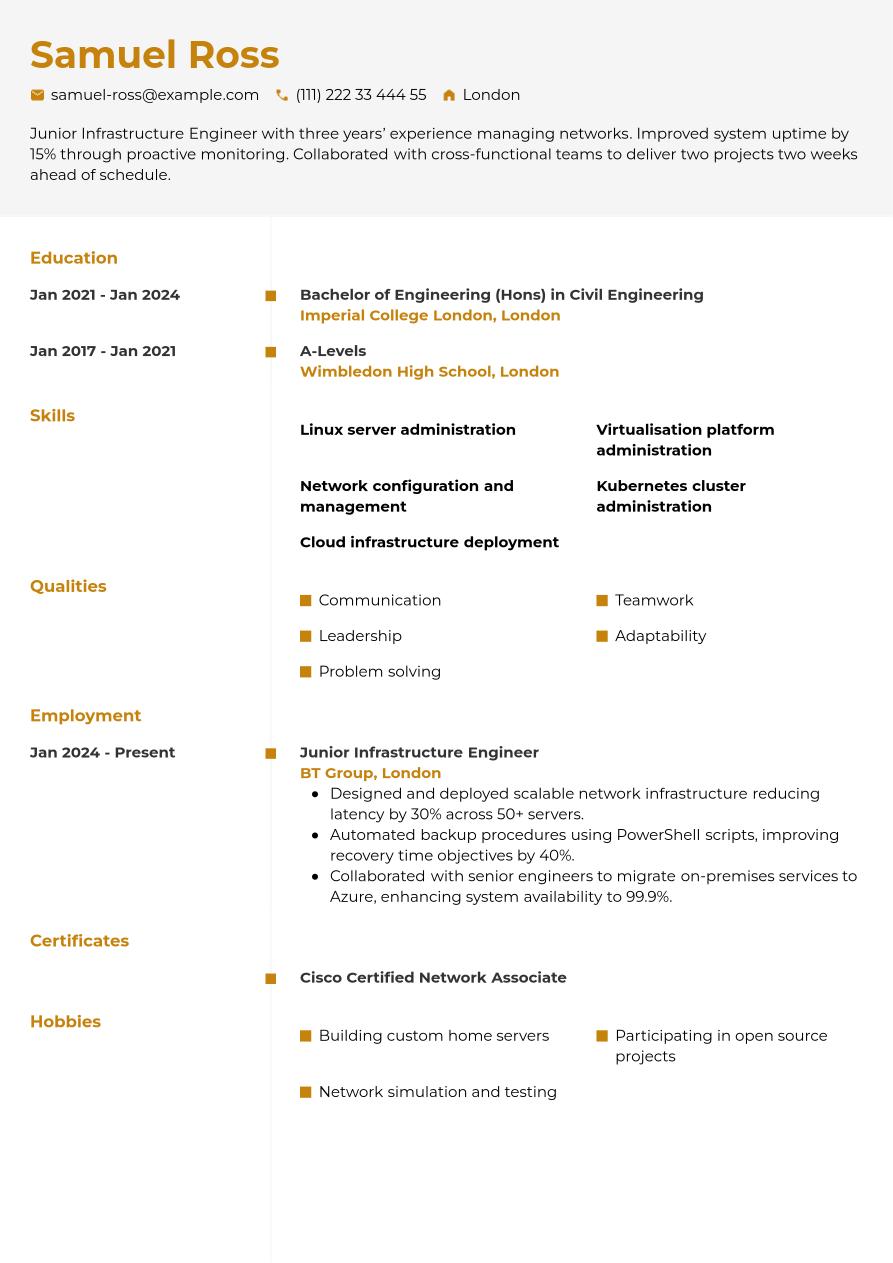
If you're a bit further down the road with your career journey, you'll want your CV to be focused mainly on your experience. Hiring managers will be keen to see examples and evidence of how you've used relevant skills to create positive results and outcomes for previous employers, as an indication of your likely future performance. In this situation, you'll probably want to choose a reverse-chronological CV format, placing the most emphasis on your work experience. List your most relevant previous roles and provide evidence of the impact you made.
As an executive or senior-level candidate, it's critical to focus primarily on work experience in your CV. This is because employers will be expecting candidates to have a wealth of relevant experience, and to have reached a prominent position within the industry. Therefore, you'll want to create a detailed, reverse-chronological CV that shows the depth and extent of your work experience. You might also include optional sections, such as awards, publications or professional memberships.
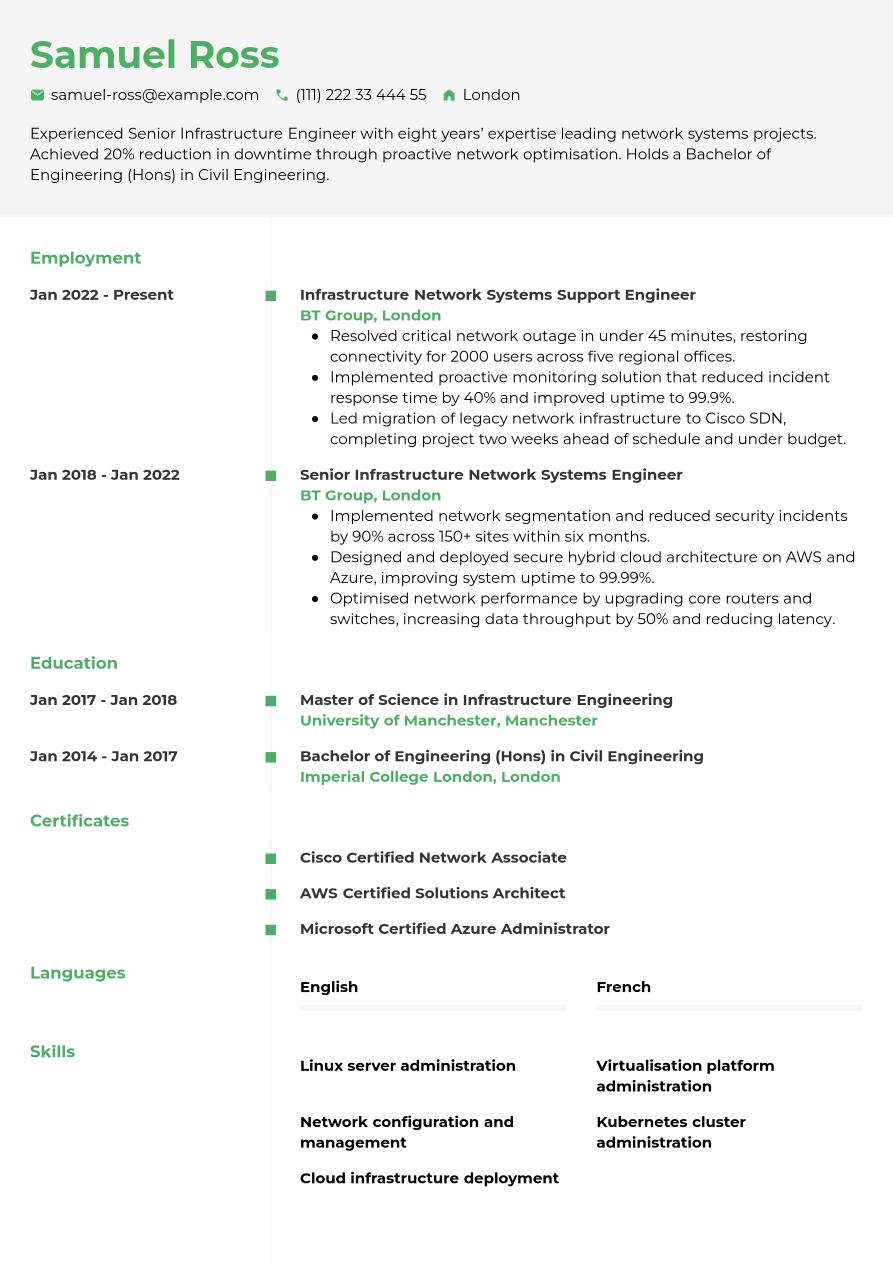
However, regardless of your years of experience, an infrastructure engineer CV needs to connect the dots of your career into a cohesive story. In the following sections, we’ll dive into the specific chapters of your CV step-by-step, showing you how to refine everything from your initial introduction to your long-term achievements.
CV Header
Start your infrastructure engineer CV by adding a professional-looking header that contains all your relevant contact information. Include your name, email address, phone number and location (your full address isn't typically necessary for UK job applications). Additionally, including your LinkedIn profile as a URL can be useful, as it will help the reader to quickly and easily access further information about your career and credentials.
For jobs in the UK, a personal photo is usually not required on your CV. That, along with any other personal details such as age, gender, ethnicity and nationality, are generally discouraged under the terms of the Equality Act 2010, which aims to reduce and eliminate discriminatory practices, such as recruitment bias.
Samuel Ross
samuel-ross@example.com
(111) 222 33 444 55
London
linkedin․com/in/samuel–ross–123
CV Summary or Objective
Under your header, write a brief CV summary or CV objective, outlining a few of your key skills, qualities and achievements. This short paragraph can help employers to quickly assess your suitability for the role, setting the tone for your infrastructure engineer CV. As an alternative to the CV summary, you might wish to write a CV objective. This serves a similar purpose, but instead of focusing on your experience, it highlights you career ambitions and objectives.
In your summary or objective, write two or three sentences introducing your key skills, unique qualities and career achievements, making sure they match the key requirements listed in the job description.
The most effective way to approach a CV summary is to focus on one or two key skills that reflect the requirements of the job description and show how you've used them to create positive outcomes for previous employers. You'll also want to showcase your unique personal strengths, and touch on how they've contributed to your career progression up to now. Here's an example of an effective infrastructure engineer CV summary, with evidence of your impact and neat, well-structured sentences:
Strong example:
Experienced infrastructure engineer with five years’ experience designing networks. Led migration of 200+ servers to cloud, reducing downtime by 40%. Holds a Bachelor of Engineering (Hons) in Civil Engineering.
Worst example:
Experienced infrastructure engineer with expertise in network design and cloud environments, capable of supporting IT infrastructure activities and collaborating with stakeholders to maintain system performance and deliver technical solutions.
Above is an example of CV summary that doesn't follow best practice, with some subtle shortcomings and failings. Common mistakes that lead to an ineffective summary include a lack of quantifiable experience, vague statements or failing to tailor your summary to the job description. Long, rambling sentences that lack structure can also make your summary harder to read.
Work Experience
The work experience section of a CV is usually the most important part. Employers look for evidence of how you've developed and used your skills to good effect in your career to date, as an indication of your likely future performance. Ensure you tailor your work experience section to reflect the job description and show you meet all the essential requirements. This means picking out skills and qualities as keywords and reflecting them back in your work experience bullet points, so employers can assess your likely fit for the role.
List only relevant previous jobs, and add your job title, the name of the employer, its location and your dates of employment. Under this, write several bullet points showing employers how your skills and key qualities contributed to positive outcomes.
What differentiates an excellent work experience section from an average one is the use of action verbs and quantifiable evidence, showing how your actions led directly to positive results in previous roles. You'll also want to show how you've added relevant skills and increased your impact throughout your career progression. Take a look at this infrastructure engineer CV example work experience section for inspiration:
Strong example:
Infrastructure Engineer, January 2023 - Present
Stanton Infrastructure Solutions, Manchester
- Deployed a scalable hybrid cloud infrastructure on AWS and Azure, reducing deployment times by 50%.
- Optimised network performance across 200+ servers, cutting latency by 40% and improving user experience.
- Automated system monitoring and alerting with Ansible and Nagios, decreasing incident response time by 60%.
Worst example:
Infrastructure Engineer, January 2023 - Present
Stanton Infrastructure Solutions, Manchester
- Managed network infrastructure to support business operations and maintain overall system performance.
- Coordinated cross-departmental efforts to plan and implement IT solutions for infrastructure improvements.
- Maintained servers and network components to ensure availability and reliability for all end-users.
Above you can see an example of what not to do with your infrastructure engineer CV work experience section. A poor work experience section might look more like a generic list of responsibilities rather than an account of how you've used your skills to positive effect in previous roles. It might also include old or irrelevant job entries and lack tailoring to the job description.
Education and Qualifications
With your education section, you'll draw attention to your most recent and highest qualifications, particularly emphasising any qualifications listed as a requirement in the job description.
A degree is typically a strict requirement for infrastructure engineer jobs, and as such, you'll want to showcase yours in your CV. If you have a Bachelor of Engineering (Hons) in Civil Engineering or another similar, relevant degree that confirms your eligibility for the position, include it in your CV. You might also wish to add other degrees or qualifications that highlight your strongest skills, such as virtualisation platform administration or cloud infrastructure deployment.
Your education section should contain only the qualifications that you consider most relevant to the role. List them in reverse-chronological order, starting with the most recent and working back from there. Add the name and level of the award, the institution, its location and your dates of study or graduation. If you have space or if you particularly want to emphasise your qualifications, you could add one or two bullet points under each entry, highlighting specialist areas of study, projects you worked on, awards you won or societies you were a member of.
If you have any specialist certifications or licences that are necessary for the role, or help you stand out above other candidates, you may wish to mention them here. When adding any special licences, it's a good idea to also reference their expiry or renewal dates, if applicable.
Bachelor of Engineering in Civil Engineering, 2018 - 2021
Cranfield University, Cranfield
Skills
In your CV's skills section, you'll want to draw attention to some of your strongest skills that make you suitable for the role. Review the job description to get an idea of the most essential skills, and create a list of hard and soft skills, including some of your strongest, most unique qualities that set you apart from other candidates. For an infrastructure engineer CV, you'll want to focus on the most relevant skills for the role that match your skill set, including problem solving and cloud infrastructure deployment, to catch the reader's attention and show you're qualified for the infrastructure engineer position.
Hard Skills
Hard skills and technical skills are the specialist skills required for completing the everyday duties of the role, such as the use of certain software or equipment, or specialist industry knowledge. You can develop these skills through study, training, on-the-job or through completing industry certifications. For infrastructure engineer jobs, critical hard skills you've gained in your career can include virtualisation platform administration, and network configuration and management. Review the job description, and include four or five key hard skills in your CV that show employers you're capable of completing the key duties of the role.
The ideal hard skills section will feature the most essential hard skills from the job description, while closely reflecting your own best technical abilities. The closer your strongest skills are to matching the job description, the higher your chances of success.
Below, you can find the types of skills typically featured in the hard skills section of an infrastructure engineer CV:
- Linux server administration
- Network configuration and management
- Cloud infrastructure deployment
Soft Skills
Your soft skills list should contain a list of your personal strengths that make you suitable for the role, and a good fit for the team and the organisation. In contrast to hard skills, these tend to be transferable and applicable to different roles and levels. As a result of rapid technological changes in the world of work, soft skills are becoming ever-more valued by employers. Soft skills can also be particularly valuable for junior or entry-level roles where candidates haven't necessarily had the time to develop hard skills and career achievements.
As with your infrastructure engineer CV hard skills list, review the job description to learn the key soft skills for the role. Include the best soft skills that you can provide evidence for throughout your CV. Your soft skills list should reflect the job description as closely as possible, while also reflecting your strongest, unique talents and personal qualities. Aim for a list of around five key skills.
Here are typical soft skills candidates include in an infrastructure engineer CV.
- Communication
- Leadership
- Problem solving
Language Skills
If you speak any languages in addition to your mother tongue, you might want to include them in your infrastructure engineer CV as a languages section. These can be valuable for your application, whether languages are specified as a requirement in the job description or not. Within this section, list the foreign languages you speak to a reasonable degree of competence, together with an indicator of your skill levels.
There are a few acceptable ways of citing your foreign language proficiency levels. The simplest way is to assign a basic descriptive word to indicate your skills, such as:
- English: Fluent
- Spanish: Intermediate
You could adopt the Common European Framework of Reference (CEFR), as this provides standardised levels to describe your competence, as follows:
- A1: Beginner
- A2: Elementary
- B1: Intermediate
- B2: Upper intermediate
- C1: Advanced
- C2: Proficiency
Certifications, Training and Licences
To showcase additional qualifications and training beyond the basic requirements for the role, consider adding a certifications section to your CV. If you've been proactive in pursuing professional development opportunities throughout your career, it's worth showcasing them. Not only do they make you more qualified, they also show a proactive and motivated mindset. In addition, some roles require specific licences or training just to be eligible for the job, making the certifications section more important. This might include technical roles or positions which require the operation of specialist software, equipment or machinery.
See below for a list of example certifications and licences you might add to your CV for infrastructure engineer roles:
- Cisco Certified Network Associate, 2023
- AWS Certified Solutions Architect, 2023
- Microsoft Certified Azure Administrator, 2023
Expert Tip:
Barnet Council’s data shows that CVs beginning with a clear, strong personal statement stand out during the brief recruiter scan. (1)
Additional Sections
In addition to the core sections of your CV, optional sections can be a useful way of proving you've got the necessary infrastructure engineer skills. Consider adding optional sections if you're unable to show all the necessary skills for the job through work experience, but could show them through extracurricular activities and other areas of life. This could be especially relevant if you're a junior candidate, or if you're changing careers.
If you're curious about other ways to make your CV more effective, our career resources will help you strengthen your application.
Hobbies and Interests
Hobbies and interests are a legitimate way to showcase your skills, if you have any hobbies relevant to the role. In addition, this section is the ideal way to show aspects of your personality that might not otherwise shine through in your CV, helping to offer a point of difference compared to other candidates. However, it's important to only mention hobbies and interests that are relevant, or related to, the role you're applying for. If your hobbies don't help you to show skills required for the role, that are missing elsewhere in your CV, it's best to leave this section out.
Awards and Achievements
Creating a section for your achievements and awards can help you draw attention to the things you're most proud of in your career to date. If you've been awarded any prizes or accolades, or reached any key career milestones, these can all help to show you have the required status and experience for the role.
Volunteering
Another alternative to showcasing your skills and experience through work experience is by adding a volunteering section. This can give you a valuable showcase of your skills, particularly if you're a junior candidate or career changer without much relevant work experience. For this section, use a similar structure to your work experience section.
List your job title or a description of the role, the organisation name, its location and the dates you occupied the role. Use bullet points to show employers how you put your skills to use, and any positive achievements from your time in the role.
Data Insight:
Hiring managers spend an average of 30 seconds reviewing a CV to assess its likely fit for the role, so it's essential to clearly highlight your skills, experience, and evidence of your achievements. (2)
Best action words for an infrastructure engineer CV
Adding strong action verbs to the bullet points in your CV's work experience section is a great way to focus on the key skills required for the job, while showing the impact you've made. Start each bullet point with an action word that reflects the job description, so the reader can easily identify your best qualities. You'll also want to back up any action verbs you're using with quantifiable evidence that showcases the value you added for previous employers. Use the past tense for action verbs that describe previous roles, with the present tense for any current responsibilities and achievements.
- Design
- Implement
- Configure
- Automate
- Optimise
- Provision
- Monitor
- Troubleshoot
- Secure
- Maintain
Full example of infrastructure engineer CV
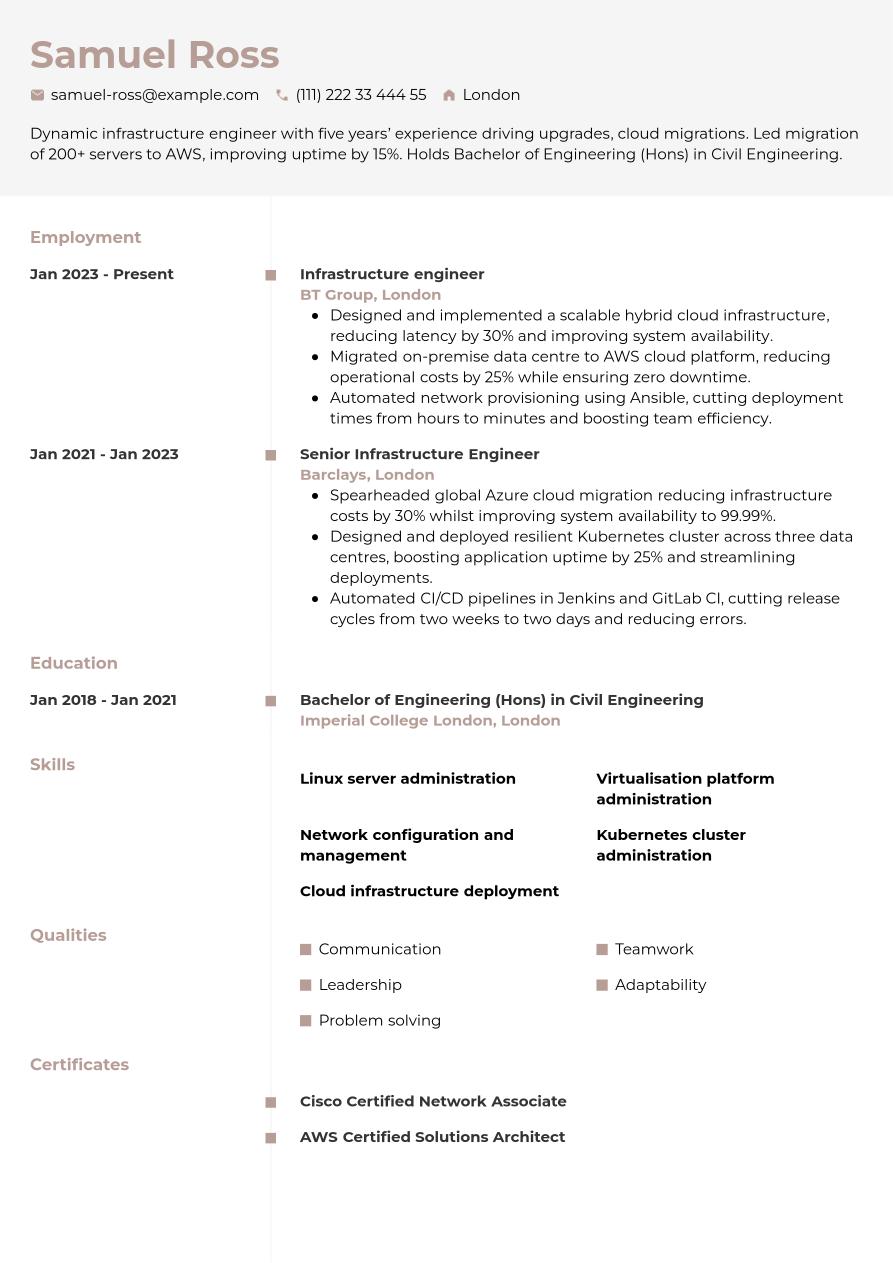
Now we've shown you everything that needs to go into your infrastructure engineer CV, we can take a look at how it comes together in its final form in the following example:
London
•
samuel-ross@example.com
•
(111) 222 33 444 55
•
linkedin․com/in/samuel–ross–123
Dynamic infrastructure engineer with five years’ experience driving upgrades, cloud migrations. Led migration of 200+ servers to AWS, improving uptime by 15%. Holds Bachelor of Engineering (Hons) in Civil Engineering.
Infrastructure engineer
2023
-2026
BT Group (London)
- Designed and implemented a scalable hybrid cloud infrastructure, reducing latency by 30% and improving system availability.
- Migrated on-premise data centre to AWS cloud platform, reducing operational costs by 25% while ensuring zero downtime.
- Automated network provisioning using Ansible, cutting deployment times from hours to minutes and boosting team efficiency.
Bachelor of Engineering (Hons) in Civil Engineering
2018
-2021
Imperial College London (London)
Linux server administration
Network configuration and management
Cloud infrastructure deployment
Communication
Leadership
Problem solving
Cisco Certified Network Associate
AWS Certified Solutions Architect
English - Native
French - Advanced
To get an idea of how your completed, one-page CV will look once its been fully designed, see our selection of CV examples.
Best practice and common mistakes for your infrastructure engineer CV
Tips to follow
- Quantify your achievements as much as possible, offering evidence to support your claims, such as key performance metrics, other data or feedback you received.
- Keep your CV concise, with a target length of one side of A4 for junior roles, two for more experienced candidates and longer only for high-level, executive or academic positions.
- Start your CV with a CV summary or objective that grabs the attention of the reader, clearly summarising your key skills and achievements.
- Select a clear, professional CV format that helps your application to be as readable and accessible as possible, including standard fonts, consistent line spacing and clear headings.
- Proofread your CV forensically before sending, so you can correct any errors of spelling or grammar that could dent your chances of success.
Common mistakes to avoid
- Don't fixate on irrelevant work experience that might take up valuable space and won't contribute significantly to your chances of success.
- Avoid adding personal information, for example your age, gender or marital status, or a personal photo, unless this is required for the role.
- Don't lie or exaggerate about previous jobs or your qualifications – it can backfire or even be considered fraud.
- Don't use passive voice, such as 'positive feedback was received', but instead fill your CV with action verbs that clearly show the impact you made.
- Don't use an unsuitable email address with informal language or nicknames, but instead opt for a professional email address combining elements of your name, initials or profession.
A well-designed and concise cover letter can make a big difference to your job applications. Match your cover letter to your CV's design and styling with our HR-approved cover letter templates.
Guide to making your CV ATS compatible
Many employers now use applicant tracking systems (ATS) to assist with managing the recruitment process. One of the key elements of most ATS apps is the ability to scan CVs and rank them according to their likely match to the job description. By taking on this task, the systems can save hiring managers the time and effort of reviewing every CV in detail. With vacancies regularly receiving hundreds of applications, this can increase the efficiency of the recruitment process.
The growing prevalence of ATS means candidates need to write and format their CV in a way that's compatible with the software, giving it the best chance of being accurately scanned and parsed, and ranking highly against other candidates. Here are some tips on how to optimise your CV for ATS screening:
- Include keywords and phrases that match the job description, giving you the best chance of appearing as a strong fit for the role.
- Use standard CV headings that make your CV easier to navigate, such as 'work experience', 'education' and 'skills'.
- Choose a standard CV layout, avoiding special design elements such as text boxes, columns or unlabelled graphics that can confound ATS scanning apps.
- Select a font that's widely used and maximises readability, including popular serif and sans serif fonts between size 10 and 12 for body text, and 14 and 16 for headings.
- Use bullet points in place of full sentences and paragraphs. This can reduce the overall length of the document, make the keywords stand out and make it easier for ATS apps to scan.
It might seem like there's a lot to remember when it comes to making an ATS-compatible CV, but taking care with this stage can really improve your chances of success. To make the process as easy as possible, use one of our expert-designed, ATS-optimised CV templates and boost your chances of success.
Jobseeker's CV templates can help your CV to make a strong first impression with recruiters. Each template is expertly designed and approved by HR specialists to help you craft a winning application.
Infrastructure engineer CV FAQs
How do I create an accompanying infrastructure engineer cover letter for my CV?
Your cover letter can have just as strong an impact on your chances of success as your CV. When writing a cover letter, use a professional, formal letter structure and select a cover letter template to match the look and feel of your CV.
Most cover letters include three standard paragraphs of information. The letter opens with a brief personal introduction and confirmation of the role you're applying for, and your motivations for applying. In the next paragraph, list some key skills and career achievements related to the role, taking care not to repeat your CV. Finally, end your cover letter with an expression of gratitude for considering your application, and a call to action that puts the ball in the court of the employer to arrange an interview or establish dialogue with you.
Alternatively, if you're sending your application via email and prefer a more informal tone, you might wish to include a short cover note. This can adopt more casual email conventions rather than following a professional letter format, and simply needs to introduce you, confirm the role you're applying for and direct the reader to the attached CV or application form. Include your contact details at the end of your CV.
Jobseeker's cover letter examples for infrastructure engineer and information technology industry roles provide useful tips and guidance from HR experts on how to write a compelling cover letter.
How do I write an engaging infrastructure engineer CV without experience?
Even without relevant work experience, it's possible to write an infrastructure engineer CV that impresses employers.
Select a CV structure that makes the most of your relevant skills, rather than focusing on your work experience, such as a functional format. In this layout, the skills and education sections come before work experience.
For junior or entry-level roles, employers may be more keen to know whether you have the right soft and transferable skills to adapt to the requirements of the role. In this case, place greater emphasis on soft skills for a junior infrastructure engineer CV.
How do I write a headline for an infrastructure engineer CV?
A CV headline can be a way to grab the attention of the reader early in your CV, indicating that you're a good fit for the role and you offer something different to other candidates.
Aim to write a short, concise sentence that mentions the job title and focuses on one of your best skills or qualities.
For the most attention-grabbing CV headline, match your sentence to the most critical keywords and phrases from the job description. This will catch the eye of the reader as well as giving you the best chance of passing the ATS screening stage.
Below you'll find some examples of CV headlines for different experience levels:
- Junior Infrastructure Engineer Delivering Results
- Experienced Infrastructure Engineer Optimising Performance
- Senior Infrastructure Engineer Ensuring Reliability
What's the best infrastructure engineer CV format for 2026?
The most suitable format for your infrastructure engineer CV in 2026 will depend heavily on numerous factors, such as your career stage and experience levels, the type and level of the role, the organisation and established industry norms.
Typically, the most effective CV format for most candidates is a standard reverse-chronological structure that prioritises your work experience section as a showcase of your skills and career achievements.
On the other hand, for candidates with less experience, including graduates and career changers, a functional or skills-based CV format can be more effective, as it showcases your key skills and qualifications over your work experience.
Key takeaways for a successful infrastructure engineer CV
For the best chance of impressing employers, always tailor your CV for every application and include keywords and phrases that reflect the job description. Choose the most fitting CV format for your experience level, and focus on showcasing how you've developed the necessary skills for the role, and used them to positive effect in previous roles.
Finally, building your CV using Jobseeker's HR-approved CV templates can help to catch the eye of recruiters and hiring managers, making your application stand out and giving you the best chance of gaining your dream job.
Sources:
- Barnet Council (UK local government), Recruitment tips: How to write a supporting statement
- Jobseeker, HR Insights

Impress employers with your CV
Step-by-step guidance to create a professional CV in minutes.