Factory Worker CV Example
If you're considering applying for factory worker positions, you'll want to draft a CV that gives your skills and career achievements a chance to shine. It's the mention of key responsibilities from your career, such as operating machinery safely and ensuring quality standards that will show employers you're a good fit for the role. In this comprehensive guide, you'll learn the steps to producing a factory worker CV that puts you in pole position to progress to the interview stage.
A stronger, more engaging factory worker CV gives you the best chance of success. It can help you pass the ATS CV screening stage and impress the recruiter or hiring manager, increasing your prospects of reaching the interview stage. Now let’s explore the main sections of a CV and see how to structure each one for maximum impact.
Main factory worker CV sections
Your factory worker CV strategy will depend on various factors, including your previous experience, your seniority and the details listed in the job description.
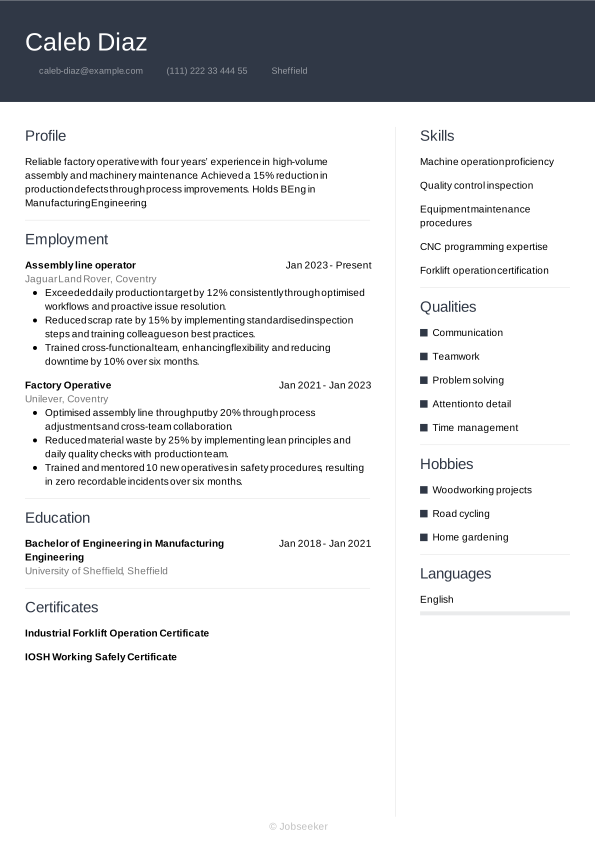
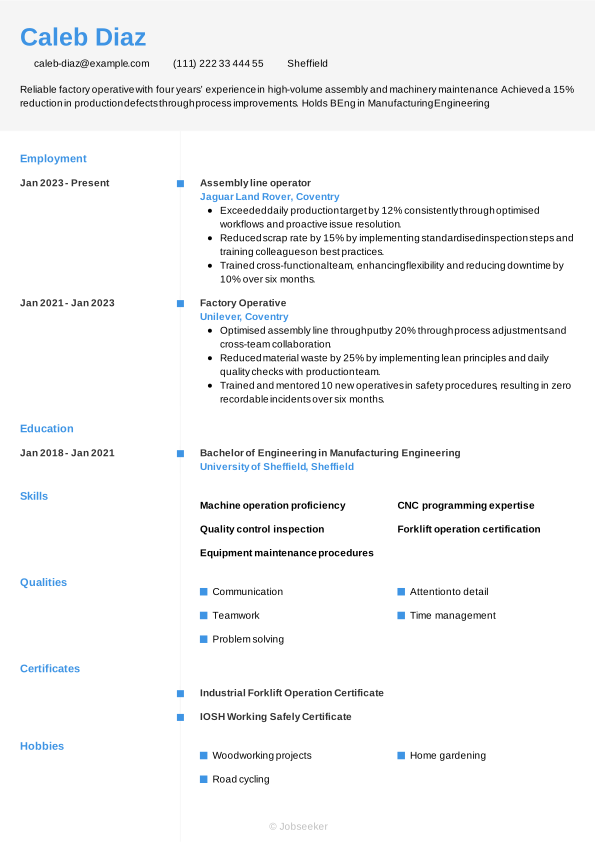
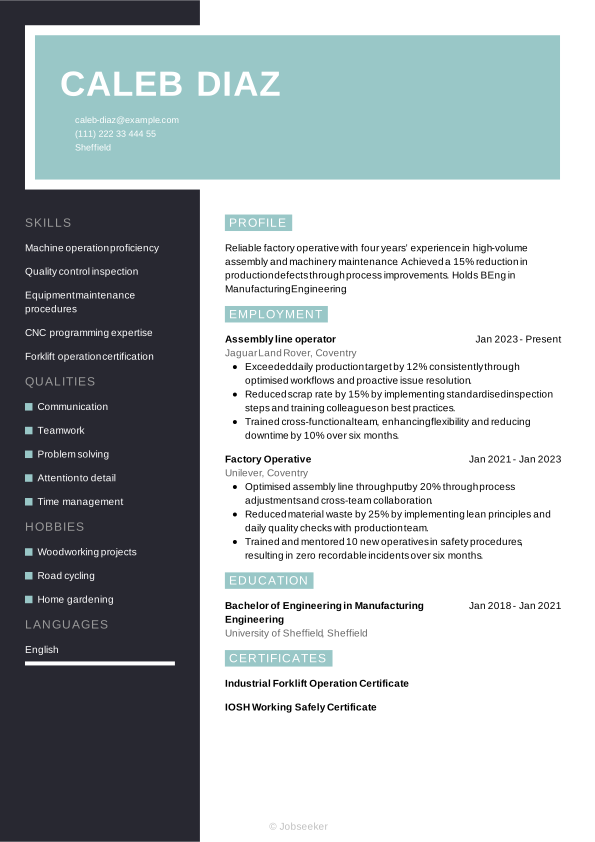
However, regardless of your years of experience, a factory worker CV needs to connect the dots of your career into a cohesive story. In the following sections, we’ll dive into the specific chapters of your CV step-by-step, showing you how to refine everything from your initial introduction to your long-term achievements.
CV Header
Start your factory worker CV with a professional-looking header that includes all the relevant contact information. This usually includes your name, your email address, your phone number and your location, but not your full address. Additionally, add your LinkedIn profile, if this is in use and up-to-date. A well-utilised LinkedIn profile can give further information to the reader about your skills, experience, industry knowledge and career achievements.
For UK applications, it's not usually advisable to include a personal photo or any other personal details, such as your age, gender, nationality or ethnicity. These can risk introducing bias to the decision-making process and are discouraged under the terms of the Equality Act 2010.
Caleb Diaz
caleb-diaz@example.com
(111) 222 33 444 55
Sheffield
linkedin․com/in/caleb–diaz–123
CV Summary or Objective
Below your contact information, a short, concise CV summary or CV objective can set the tone for your application and provide brief, basic information on your key skills and qualities that gives a strong indication to the reader about your suitability for the factory worker role. A CV summary focuses on your key skills and achievements, while a CV objective provides an alternative approach, showcasing your career ambitions and how the role fits with these. This makes a CV objective ideal for entry-level candidates.
Both a CV summary and objective should be concise, with an ideal length of two or three sentences. List your key skills, personal strengths and career achievements or ambitions, taking care to ensure the content reflects the requirements listed in the job description.
An effective CV summary will focus on a few of the key skills required for the role and show how you've put them to good use in your career to date. You'll want to give the reader a good impression of your unique qualities and briefly provide evidence of their impact in previous roles. Below you'll find a good example of how to write an effective factory worker CV summary. The example shows quantifiable achievements and well-structured sentences.
Strong example:
Experienced Production Line Operative with five years in assembly and quality control. Reduced defect rate by 20% through lean manufacturing improvements. Holds a Bachelor of Engineering in Manufacturing Engineering.
Poor example:
Dedicated reliable production line operative with broad experience in assembly processes, quality control routines and general manufacturing principles seeking to contribute to a dynamic team with strong work ethic.
Above is an example of CV summary that doesn't follow best practice, with some subtle shortcomings and failings. An ineffective summary might be vague or generic, failing to highlight specific personal qualities that help you stand out and failing to address the requirements specified in the job description. They might also lack firm evidence of your skills, and be structured with long, hard-to-read sentences.
Professional Experience
A CV's work experience section is usually its most important element. Employers tend to value the work experience section, as it shows evidence of how you've put your relevant skills to good use in your career to date. It's crucial to tailor your work experience section to match the requirements listed in the job description, using keywords and phrases so employers can easily see how well you fit the role and organisation.
List only relevant previous jobs, and add your job title, the name of the employer, its location and your dates of employment. Under this, write several bullet points showing employers how your skills and key qualities contributed to positive outcomes.
What differentiates one CV work experience section from all the others is the use of action verbs and quantifiable evidence in your bullet points. It should showcase how your actions led to positive outcomes for the employer, and show a progression in your skills throughout your career. Take a look at this factory worker CV example work experience section for inspiration:
Strong example:
Production Line Operative, January 2023 - Present
Greenfield Manufacturing Ltd, Birmingham
- Exceeded daily production targets by 15% through streamlining assembly procedures and optimising workflow.
- Reduced component rejection rate by 20% by implementing quality checkpoints and training team members on inspection standards.
- Improved line efficiency by reorganising tool layout and introducing cross-training, boosting output by 10% while maintaining safety compliance.
Poor example:
Production Line Operative, January 2023 - Present
Greenfield Manufacturing Ltd, Birmingham
- Operated and maintained production equipment to ensure smooth workflow.
- Collaborated with team members to complete daily manufacturing tasks.
- Conducted basic quality checks on finished items before packaging.
Above you can see an example of what not to do with your factory worker CV work experience section. A less-effective work experience section could focus too much on irrelevant or out-of-date roles, or include generic information about your responsibilities that fails to show the impact you made. It might lack tailoring to the job description or fail to provide evidence to support the claims made in the bullet points.
Skills
In your CV skills section, include a combination of the key hard and soft skills you possess, that make you a suitable candidate for the position. Make sure your skills list reflects the requirements specified in the job description, and include a few skills that are unique to you, and help set you apart from the pack. For a factory worker CV, you'll want to focus on the most relevant skills for the role that match your skill set, including problem solving and equipment maintenance procedures, to catch the reader's attention and show you're qualified for the factory worker position.
Hard Skills
Hard skills refer to the technical and specialist skills required for the everyday duties of the job. They might include specialist knowledge, or the use of certain software and equipment. You can gain these skills through study, training or industry experience, and they might require a licence or certification. For factory worker jobs, critical hard skills you've gained in your career can include CNC programming expertise, and quality control inspection. After reviewing the job description, compile a list of four or five key hard skills for your factory worker CV to show you're capable of carrying out the duties required for the role.
The ideal hard skills section will feature the most essential hard skills from the job description, while closely reflecting your own best technical abilities. The closer your strongest skills are to matching the job description, the higher your chances of success.
Review the examples below to understand which skills are often added to the hard skills section of a factory worker CV.
- Machine operation proficiency
- Quality control inspection
- Equipment maintenance procedures
Soft Skills
Soft skills are distinct from hard skills and tend to reflect your inherent personal qualities and strengths. These are often more transferable to different roles, and help the reader understand your working style, and your likely fit to the team and the organisational culture. The world of work is evolving at a rapid pace, changing the types of hard skills required for many roles, and therefore rendering soft and transferable skills more valuable than ever. Soft skills are also extremely valuable for junior and entry-level roles, where candidates aren't necessarily expected to have a wealth of relevant work experience.
Adopt the same approach as you did with your hard skills list, reviewing the job description to understand the requirements, before assessing which soft skills you can provide evidence for throughout your factory worker CV. Craft a list of up to five key soft and transferable skills that reflect the job description, while also including some of your strongest, most unique skills to stand out from the crowd.
The section below provides an overview of soft skills often highlighted in a factory worker CV.
- Communication
- Teamwork
- Problem solving
Education
Your education section should showcase your most recent and highest qualifications, paying particular attention to anything that's specifically required for the role.
Your career as a factory worker typically won't require a specific degree or degree-level equivalent qualification. However, you should still include your highest certifications, training and formal qualifications in your CV's education section, even if not specified in the job description. These might include IOSH Working Safely Certificate, or any other relevant training that demonstrates your skills in equipment maintenance procedures or forklift operation certification.
When adding your qualifications to your education section, choose the highest relevant qualifications, and list them in reverse-chronological order, starting with your most recent. For each entry, include the name and level of the degree or certification, the institution, its location and your graduation date or dates of study. To emphasise your qualifications and achievements, you might wish to include one or two bullet points, which highlight things like specialist areas of study, projects, dissertations or society memberships.
You might also wish to add specialist qualifications, certifications or licences that are required for the role. If you add any of these, include the expiry date, if the qualification requires renewal in the future.
Bachelor of Engineering in Manufacturing Engineering, 2018 - 2021
University of Sheffield, Sheffield
Certifications, Training and Licences
To showcase additional qualifications and training beyond the basic requirements for the role, consider adding a certifications section to your CV. It can enhance your chances of success to show specific training and certifications. Not only do these prove you're qualified for the role, but they also indicate proactivity and a dedication to professional development. In addition, the certifications section can be a valuable addition to your factory worker CV if you're applying for a role that cites certain certifications or licences as a necessity in the job description. These might include roles where the use of specialist software or equipment forms part of your everyday duties.
Here is a list of some key certifications and licences that can be particularly useful for factory worker applications:
- Industrial Forklift Operation Certificate, 2023
- IOSH Working Safely Certificate, 2023
- Certificate in Manual Handling Awareness, 2023
Languages
If you speak any additional languages, you might want to consider adding a languages section to your CV. Even if languages aren't a requirement of the job description, speaking a foreign language can reflect well on you as a candidate, and correlate with other soft skills that can increase your employability. Within this section, list the foreign languages you speak to a reasonable degree of competence, together with an indicator of your skill levels.
The methods for indicating your foreign language skills on your CV include assigning a basic descriptive word, such as:
- English: Fluent
- Spanish: Intermediate
Alternatively, use an internationally recognised framework for languages, such as the Common European Framework of Reference (CEFR). This gives your language skills a standardised competence indicator, as follows:
- A1: Beginner
- A2: Elementary
- B1: Intermediate
- B2: Upper intermediate
- C1: Advanced
- C2: Proficiency
Specialist Insight:
JobHelp points out that emphasizing non work achievements and transferable skills in your CV shows employers you can bring value even without job history. (1)
Optional Sections
Including optional sections in addition to the core elements of your factory worker CV can help you provide further evidence of your suitability for the role. If you're struggling to show all the necessary skills for the job through your work experience or other core sections, optional sections can give your CV the boost it needs to progress you to the interview stage. This could be particularly helpful for entry-level candidates or career changers.
You’ll find more in-depth guidance on structuring your CV in our career resources, designed to help you present your skills as effectively as possible.
Hobbies and Interests
If you have any hobbies and interests that can showcase skills relevant to the job description, it might be worth including them. Additionally, this section gives you the chance to show employers different facets of your personality and interests beyond work, which can help them to differentiate you from other applicants. However, it's important to only mention hobbies and interests that are relevant, or related to, the role you're applying for. If your hobbies don't help you to show skills required for the role, that are missing elsewhere in your CV, it's best to leave this section out.
Volunteering
Another valuable optional section for your CV is volunteering. This section can offer a great alternative showcase for your skills and experience, if you don't have much relevant work experience. Consider adding this section if you have any relevant unpaid experience, either as a junior candidate or a career changer. Approach your volunteering section in much the same way as your work experience section.
For each entry, include a job title or description of your role, the organisation, its location and the dates you volunteered. Adding bullet points can also help you to show how you developed relevant skills, and used them to good effect.
References
References aren't usually required on a UK CV, so leave them out in most cases. However, it's always worth checking the job advert and being ready to include them if requested. If you need to include references in your CV, aim for two or three and list their name, their contact details, their job title and the organisation they work for.
Always seek permission before you add them to your CV. Alternatively, it can be neater to simply add a line to your CV confirming you can provide references at the appropriate juncture, such as 'references are available upon request'.
Analytical Insight:
6 in 10 HR specialists look for skills in CV summaries. Communication, problem-solving and teamwork are the highest-valued soft skills. (2)
Most effective action verbs for a factory worker CV
Including strong action verbs with your work experience bullet points can help you show the impact you made in previous roles. Starting each bullet point with an action verb is a great way to match your experience and achievements to the job description, giving the reader an easy way of identifying your key skills and seeing how you've applied them. You'll also want to back up any action verbs you're using with quantifiable evidence that showcases the value you added for previous employers. Use the past tense for action verbs that describe previous roles, with the present tense for any current responsibilities and achievements.
- Assemble
- Operate
- Inspect
- Maintain
- Load
- Unload
- Package
- Monitor
- Troubleshoot
- Calibrate
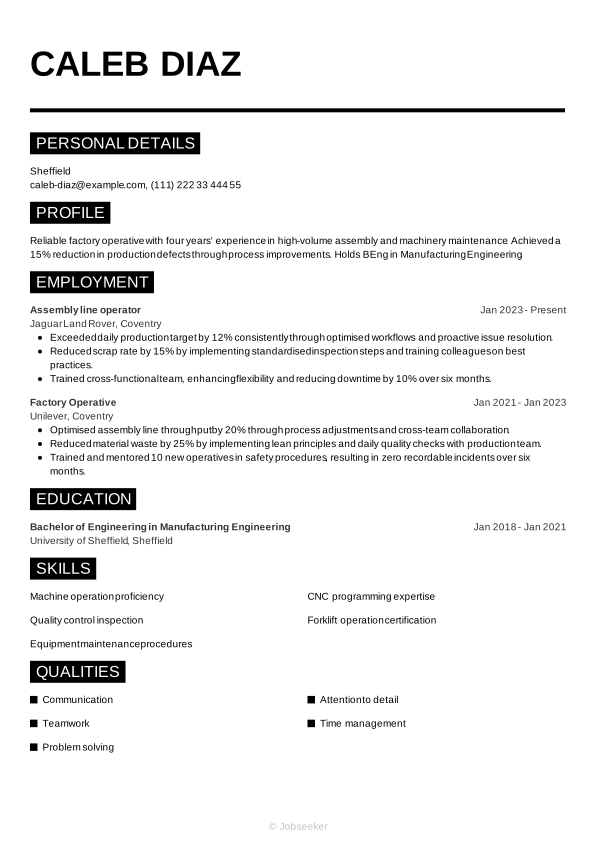
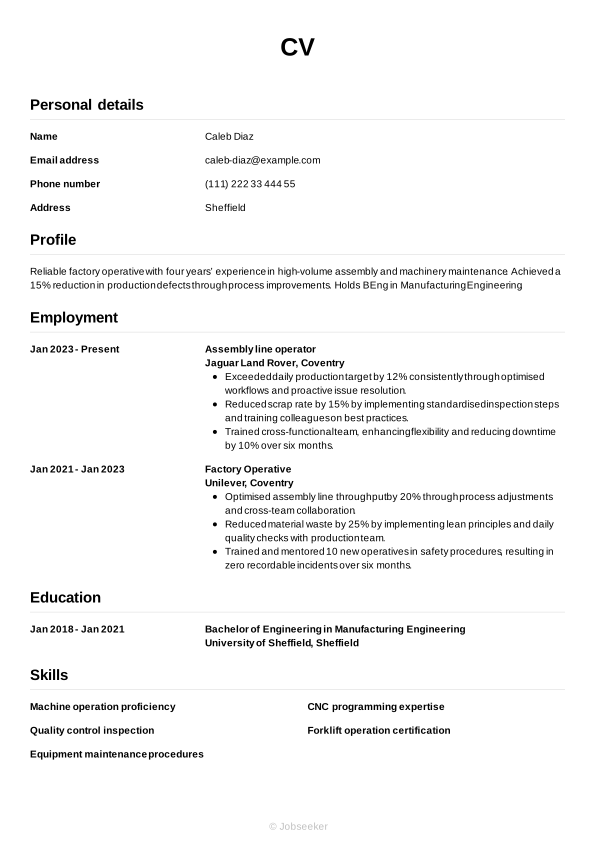
Factory worker CV example
Now that you're aware of the key steps to creating a winning factory worker CV, you can review a complete example to see how a final CV looks:
Sheffield
•
caleb-diaz@example.com
•
(111) 222 33 444 55
•
linkedin․com/in/caleb–diaz–123
Reliable factory operative with four years’ experience in high-volume assembly and machinery maintenance. Achieved a 15% reduction in production defects through process improvements. Holds BEng in Manufacturing Engineering.
Assembly line operator
2023
-2026
Jaguar Land Rover (Coventry)
- Exceeded daily production target by 12% consistently through optimised workflows and proactive issue resolution.
- Reduced scrap rate by 15% by implementing standardised inspection steps and training colleagues on best practices.
- Trained cross-functional team, enhancing flexibility and reducing downtime by 10% over six months.
Bachelor of Engineering in Manufacturing Engineering
2018
-2021
University of Sheffield (Sheffield)
Machine operation proficiency
Quality control inspection
Equipment maintenance procedures
Communication
Teamwork
Problem solving
Industrial Forklift Operation Certificate
IOSH Working Safely Certificate
English - Native
French - Advanced
If you want a sneak preview of what your one-page, fully designed and finalised CV might look like, see our completed examples.
Dos and don'ts for a winning factory worker CV
Tips to follow
- Use reverse-chronological order to list your work experience, starting with your current or most recent position and working back through relevant roles.
- Use strong action verbs to show how you've put your skills into action in your career to date, and the impact they've had.
- Quantify your achievements as much as possible, offering evidence to support your claims, such as key performance metrics, other data or feedback you received.
- Open your CV with a strong CV summary or objective, providing a brief account of your career achievements and skills.
- Use a clear, professional CV format, choosing a readable font, consistent line spacing and clear headings, to make your CV as accessible as possible.
Common mistakes to avoid
- Leave out any detailed personal information, such as age, gender or marital status, and avoid adding a personal photo unless it's required for the role.
- Don't use passive voice, such as 'the target was achieved', but instead use strong action verbs to show the value you added to previous roles.
- Don't fixate on irrelevant work experience that might take up valuable space and won't contribute significantly to your chances of success.
- Don't lie or exaggerate about events in your career, such as previous jobs, qualification or key achievements – it can backfire and disqualify you from the running.
- Don't include a section for hobbies and interests unless they're clearly relevant to the role and help you show skills you can't prove through other core CV sections.
Guide to CV ATS optimisation
Applicant tracking systems (ATS) are becoming more and more integral to the recruitment process for many employers. These systems ease the burden of the recruitment process by performing various tasks, including scanning and ranking CVs based on their likely fit to the job description. By taking on this task, the systems can save hiring managers the time and effort of reviewing every CV in detail. With vacancies regularly receiving hundreds of applications, this can increase the efficiency of the recruitment process.
The increasing usage of ATS apps by recruiters and employers means it's critical to adapt and prepare your applications to successfully navigate this stage of the selection process. Following the tips below will give you everything you need for an ATS-compatible CV:
- Include keywords and phrases that match the job description, giving you the best chance of appearing as a strong fit for the role.
- Use clear headings that reflect standard CV conventions, such as 'work experience', 'education' and 'skills'.
- Choose a standard CV layout that avoids the use of any special design elements that might make your CV less compatible with ATS scanning software.
- Select a font that increases the readability of your CV, such as popular serif and sans serif fonts, between the sizes of 10 and 12 for main text and 14 and 16 for headings.
- Use bullet points instead of writing full sentences, to reduce the overall length of your CV, make it more keyword-dense and help ATS apps to scan it more easily.
There are lots of things to think about when crafting an effective, engaging factory worker CV, but ATS compatibility is something that's easy to overcome. Use one of our expert-designed, ATS-compatible CV templates and remove the stress from creating a CV that puts you in the frame for the role.
If you want to stand out from other candidates with your CV, use Jobseeker's expert-designed CV templates, to instantly improve the look and feel of your application.
Factory worker CV FAQs
How do I create a factory worker cover letter to go with my CV?
Your cover letter can have just as strong an impact on your chances of success as your CV. When writing a cover letter, use a professional, formal letter structure and select a cover letter template to match the look and feel of your CV.
Most cover letters include three main paragraphs of written content. In the first paragraph, confirm the role you're applying for and reference your reasons for applying, including how it fits with your career journey and why you want to work for the organisation. Secondly, write a brief paragraph outlining your key skills and achievements, taking care not to simply repeat the details in your CV. Finally, express your gratitude and enthusiasm, and leave a call to action that encourages the reader to reach out to you to arrange an interview or establish a dialogue.
As an alternative, if you're applying via email, you may wish to write a shorter, more informal cover note. Follow standard email conventions for this, which are more informal than traditional letter-writing norms. Introduce yourself and confirm the role you're applying for, and direct the reader to the attached documents. Add your contact details in your email sign-off or footer.
Jobseeker's cover letter examples for manufacturing industry job titles can help you gain valuable insights from HR specialists on how to craft the most engaging, professional cover letter.
How do you write a CV for an experienced factory worker position?
If you're an experienced factory worker, you'll want to choose a CV format that showcases your extensive work experience.
This means choosing a traditional reverse-chronological CV that focuses primarily on your work experience and prioritises this section in the document. Emphasise how you've used the required skills in each previous role, and how they contributed to successful outcomes and achievements as you've progressed through your career.
Additionally, you might want to make your factory worker CV go back further than the standard 10 to 15 years, giving employers an insight into the depth of your manufacturing industry expertise.
How do I write a factory worker CV headline?
A CV headline can help you add relevant keywords into your CV, aiding ATS compatibility while catching the attention of the reader from the outset.
Look to write a short, engaging sentence that encompasses your best qualities, including the job title to indicate your relevance and suitability for the role.
The most impactful CV headlines focus on the most critical keywords and phrases from the job description, helping the reader to make a snap judgement on whether to read your CV in more depth, while increasing the likelihood of passing the ATS stage.
See below for some examples that you can use as inspiration for writing a CV headline for different experience levels:
- Motivated Junior Factory Line Operative
- Dedicated Factory Worker Demonstrating Reliability
- Dedicated Senior Factory Production Operative
What factory worker CV format gives me the best chance of success in 2026?
The most suitable format for your factory worker CV in 2026 will depend heavily on numerous factors, such as your career stage and experience levels, the type and level of the role, the organisation and established industry norms.
Typically, the reverse-chronological CV is most effective if you have some work experience under your belt. This is because the layout showcases your work experience, providing evidence of how you've used relevant skills to achieve success in previous roles.
On the other hand, for candidates with less experience, including graduates and career changers, a functional or skills-based CV format can be more effective, as it showcases your key skills and qualifications over your work experience.
A well-designed and concise cover letter can make a big difference to your job applications. Match your cover letter to your CV's design and styling with our HR-approved cover letter templates.
Key takeaways for a winning factory worker CV
To stand out from the crowd with your CV, tailor your approach to each individual application, incorporating keywords and phrases that match the job description. Select a suitable CV format for your experience level, and show the reader how you've used skills relevant to the role, to create a positive impact in your career to date.
Finally, creating your CV using one of Jobseeker's expert-designed CV templates can give your application the edge, placing you among the leading candidates and positioning you for success with your job applications.
Sources:
- JobHelp (UK Department for Work & Pensions campaign), No work experience? Focus on what you do have
- Jobseeker, HR Statistics

Impress employers with your CV
Step-by-step guidance to create a professional CV in minutes.