15 CV Mistakes to Avoid (and How to Fix Them)
You’re applying for jobs but not getting responses? You might be making common CV mistakes that recruiters spot in seconds and reject just as quickly.
Your CV might seem fine at first glance — but small mistakes can quickly cost you interviews. Recruiters often scan applications in just a few seconds, meaning unclear structure, generic content, or formatting issues can lead to immediate rejection.
The good news? Most CV mistakes are easy to fix once you know what to look for.
Here’s what you’ll learn in this article:
- The most common CV mistakes that lead to rejection
- How to fix each mistake with practical examples
- What recruiters expect from a professional CV
The most common types of CV mistakes
The most common CV mistakes can generally be divided into two categories: issues involving content and those involving formatting. Both are important for different reasons. Content issues might signal that you're not the right candidate for the job, are trying to hide something, or are flat-out lying about your experience. Incorrect contact information can also make it impossible for a recruiter to contact you.
Formatting mistakes, on the other hand, chip away at your credibility by making it harder for the hiring manager to find the information they're looking for. Poor formatting choices might also signal that you're not the right fit for the company culture.
Did you know...
Our study found that recruiters can make a decision about a CV in as little as 30 seconds. In order to quickly narrow down the field, they often eliminate candidates whose CVs contain even the smallest mistakes. They assume that if you didn't pay close attention to your application, you might not be professional enough for the role.
Now let's take a look at some of the most common mistakes:
Mistake 1: Spelling and grammatical errors
Spelling and grammatical mistakes may seem minor, but they can quickly undermine your credibility. They suggest a lack of attention to detail, something recruiters immediately notice.
A study (1) found that candidates with over 99% spelling accuracy were three times more likely to be hired than those with 90% accuracy or less.
How to avoid spelling and grammar mistakes:
- Use spellcheck tools in MS Word or your preferred word processor
- Run your CV through language tools or AI assistants to refine your writing
- Read your CV aloud to catch awkward phrasing or errors
- Ask someone else to proofread your CV
- Take a break before your final review to spot mistakes more easily
Mistake 2: An unkempt layout
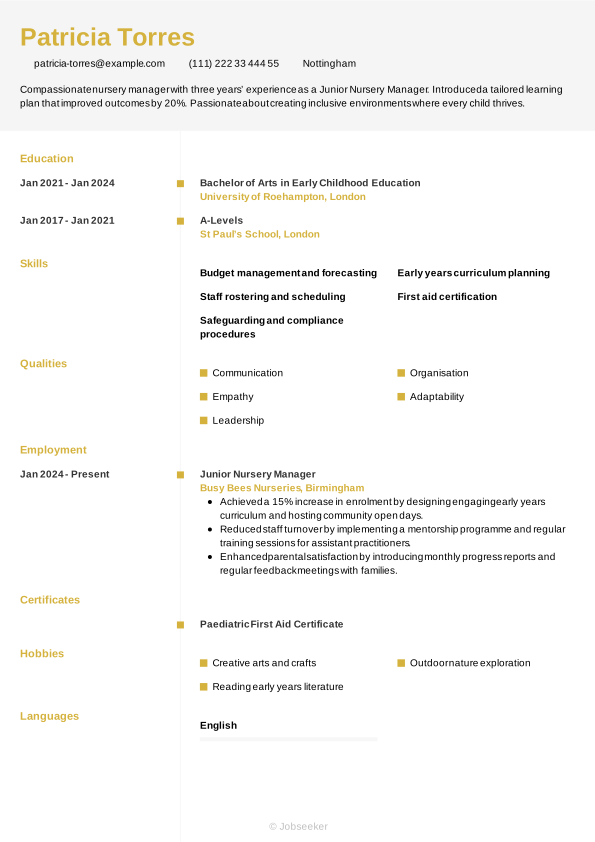
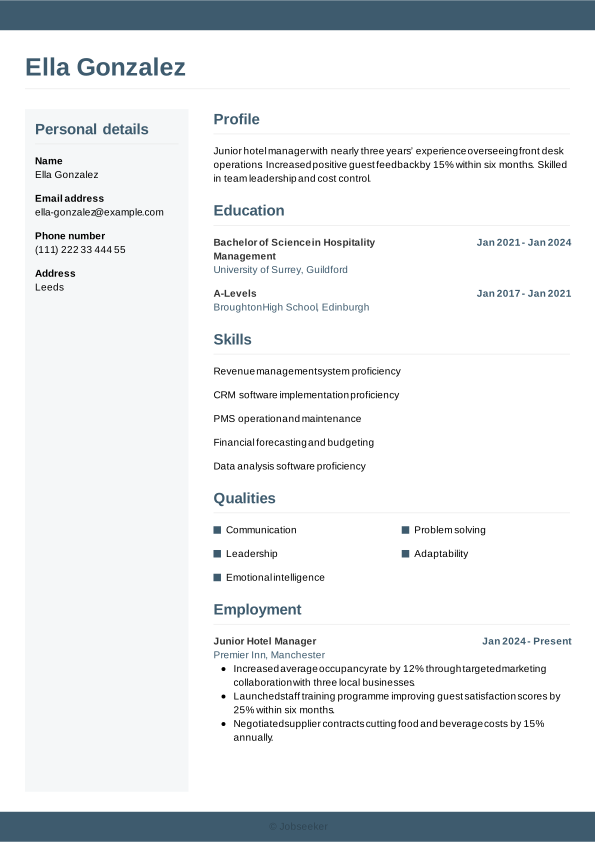
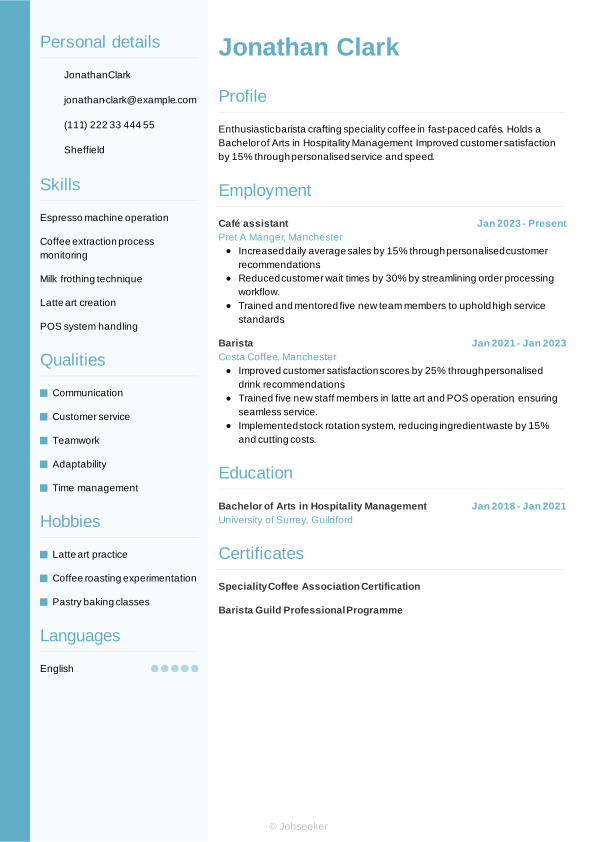
If your layout is cluttered or difficult to read, key information can easily be missed by both recruiters and applicant tracking systems (ATS). A clear, well-structured layout helps ensure your CV is easy to scan and highlights your most important information.
How to improve your CV layout:
- Select a standard font (e.g. Times New Roman, Arial, Verdana) and size (between 10-12 point)
- Leave plenty of white space between sections
- Add bold formatting for headings
- Keep at least 1”/2.5cm margins
- Use bullet points to help make information scannable
If you want to save some time, consider using a CV builder such as Jobseeker. You can choose from various professional CV templates, available in any colour, for a beautiful and neat layout. Once you’ve filled in relevant sections, you can download your CV immediately, and it's ready for use.
Mistake 3: A CV that is too long
Even though you may have plenty of work experience, knowledge and skills, your CV should ideally not exceed two A4 pages. For a rough idea of the perfect CV length at different stages of your career, take a look at this guide:
Experience level | Ideal CV length |
|---|---|
Student/graduate | 1 page |
Mid-level professional | 1-2 pages |
Senior/executive | Max 2 pages |
Academic/scientific roles | 2+ pages |
Focus on the most relevant and recent experience, and avoid adding unnecessary details that don’t strengthen your application.
Mistake 4: Not tailoring your CV to the job
Using a generic CV may seem efficient, but it significantly reduces your chances of success. Recruiters quickly recognise when an application isn’t tailored to the role.
Each job has different requirements, so your CV should clearly show why you’re a strong fit for that specific position.
How to tailor your CV to the job:
- Include the job title in your CV headline (e.g. “Senior Project Manager” or “Marketing Executive”)
- Adapt your CV summary to reflect the role and highlight 2–3 key relevant skills
- Prioritise relevant experience and use action verbs to demonstrate impact
- Remove outdated or unrelated information
- Align your achievements with the goals and requirements of the role
Mistake 5: Weak focus on results
One of the most common CV mistakes is to simply list the responsibilities you had for each of your previous jobs. This only lets employers know what you did, rather than how well you performed in each job.
Focusing on achievements and measurable impact helps you stand out and demonstrate your value.
Weak results | Strong results |
|---|---|
Negotiated new business and contract terms with key clients | Developed new client relationships and negotiated contract terms to increase sales revenue by 20%. |
Managed front-of-house staff team and greeted diners upon arrival. | Created a welcoming, positive environment for diners by developing a friendly, approachable front-of-house team, increasing Tripadvisor rating from 3.8 to 4.4 out of 5. |
Organised the warehouse and made sure orders were picked and packed correctly and sent out on time. | Organised warehouse operations, contributing to the team achieving a 98% on-time dispatch rate across the peak Christmas trading period. |
Responsible for teaching a class of Year 4 pupils across a range of core subjects including English and Maths. | Delivered differentiated literacy and numeracy lessons to a class of 28 Year 4 pupils, increasing expected standards in KS2 reading assessments from 71% to 89% over two academic years. |
The following formula is a simple way to structure your achievements: skill + activity + quantifiable result. See the examples below for how to apply it effectively.
Mistake 6: Keyword stuffing or overuse of buzzwords
Including keywords from the job description can help your CV pass ATS filters. However, overloading your CV with keywords or buzzwords can make your content feel unnatural and raise doubts about your credibility.
Instead, focus on integrating keywords naturally and demonstrating your impact through clear, results-driven language.
Bad example: keyword stuffing | Better version: natural integration |
|---|---|
Utilised project management, Agile methodology, Scrum, stakeholder management, risk management, budget management, and cross-functional team leadership skills to manage projects using project management best practices. | Led cross-functional teams of up to 15 using Agile and Scrum methodologies, delivering six concurrent software projects on time and 8% under budget through proactive risk management and weekly stakeholder reporting. |
Executed SEO, SEM, PPC, Google Analytics, content marketing, email marketing, social media marketing, and digital marketing campaigns across multiple digital marketing channels to drive digital marketing performance. | Managed a £40K monthly PPC budget across Google and Meta, using Analytics and SEO insights to optimise landing pages and reduce cost-per-acquisition by 31%. |
Skilled in Python, Java, JavaScript, React, Node.js, REST APIs, SQL, cloud computing, AWS, DevOps, CI/CD pipelines, Agile development, and software development lifecycle (SDLC) with full stack development experience. | Built and deployed a customer-facing React and Node.js web application on AWS, integrating REST APIs and automated CI/CD pipelines that reduced release cycle time from two weeks to under 48 hours. |
Mistake 7: Lying on your CV
Lying or exaggerating on your CV is never a good idea. Even small exaggerations or unintended inaccuracies can backfire. In some cases, it could be considered a criminal offence. Additionally, employers often verify the credentials listed on a CV. As such, remaining honest and accurate when showcasing your skills and achievements will help you build long-term credibility.
How to avoid exaggerating on your CV:
- Be honest about your skills and achievements — focus on relevance rather than overstating your experience
- Double-check that all facts, figures, and dates are accurate and consistent across platforms (e.g. LinkedIn)
- Review any AI-generated content carefully to ensure it hasn’t introduced misleading or incorrect information
Mistake 8: Inappropriate photo
Including a photo on your CV is not required for most applications; however, a photo can add a personal touch if you’re applying for an acting or modelling role.
Not every photo will be suitable for use in a CV. Holiday, party and nightlife photos may show your personality but are completely inappropriate in a professional setting. The best photo to use is one in which you have a neat and professional appearance and you smile.
Professional photo

Unprofessional photo

Mistake 9: Missing or incorrect contact details
If your CV is missing important information such as phone number and email address, recruiters will find it hard to get in touch with you. Furthermore, they won’t appreciate the implication that they have to hunt for your contact information to talk to you.
Make sure your email address is appropriate and conveys the right impression. Your jokey email address might be funny to your friends, but is inappropriate in a professional setting. To be on the safe side, use an email address that contains your first name and your last name, such as 'sarah.smith@example.com', or set one up for managing your job applications.
Good email
firstname.lastname@example.com
Bad email
funnybunny@example.com
Mistake 10: Non-representative online profile
Be aware that employers and recruiters will look you up online when you submit your application. Therefore, it’s important that your online presence is representative of the professional image that your CV (hopefully) conveys. A social media profile that doesn't match up to the details of your CV, or paints you in an unprofessional light, will raise questions for the recruiter about your suitability for the role.
How to manage your online presence:
- Review your social media privacy settings and keep personal profiles private
- Remove any content that could appear unprofessional
- Include your LinkedIn profile if it’s up to date and aligns with your CV
- Avoid linking personal platforms (e.g. Instagram, TikTok) unless they are relevant to the role
Mistake 11: Unclear order of CV sections
Using a non-standard or unclear CV structure can make it difficult for recruiters — and ATS software — to quickly find key information.
A clear, logical order helps ensure your CV is easy to scan and highlights your most relevant experience.
- Contact details
- CV summary/profile
- Work experience
- Education
- Skills
- Optional sections (for example, certifications/training, languages, volunteering, publications, awards, professional memberships, hobbies and interests)
This structure follows a reverse-chronological format, which is preferred by most recruiters as it prioritises your work experience.
If you have limited experience, you can use a skills-based format that places skills and education before work experience. Take a look at the CV examples here to learn exactly how to structure and order your CV.
Mistake 12: Not explaining career gaps
Submitting a CV with unexplained career gaps could raise doubts in the mind of the recruiter. You might think it's easier to gloss over career breaks, but employers will spot this, so leaving them out could cause more problems than including and justifying them.
To include career gaps in an honest yet unintrusive way, that doesn't detract from other details in your CV...
How to explain career gaps effectively:
- Add a short, neutral note in your work experience (e.g. “Career break for family responsibilities”)
- Include the gap as a separate entry using the same format as your other roles
- Mention the gap briefly in your CV summary if it’s your most recent activity
- Provide additional context in your cover letter if needed
Mistake 13: Overloaded skills section
Your skills section should highlight your most relevant strengths — not list everything you can do. Overloading it with too many skills makes it harder to scan and can appear like keyword stuffing.
How to keep your skills section effective:
- Include 5–8 key skills that are most relevant to the role
- Avoid long, generic lists that lack context
- Reinforce your skills throughout your CV (especially in your profile and work experience) by showing how you’ve applied them
Mistake 14: Outdated or irrelevant personal info
In the UK, it's best to keep personal information on a CV to a minimum. The Equality Act 2010 highlights nine personal characteristics that are protected from discrimination. As such, including personal details in your CV can complicate matters for recruiters and employers, who prefer this information to be omitted to reduce the risk of hiring bias.
Personal information to omit from your CV includes:
- Age/date of birth
- Ethnicity
- Gender
- Marital status
- Nationality
- Religion
- Full address
Mistake 15: Wrong file format
Using the wrong file format can make your CV difficult — or even impossible — for recruiters and ATS software to read properly. It can also affect how your CV appears when opened.
Do
- Use .docx when applying through job portals (ATS-friendly)
- Use PDF when sending directly to a recruiter (preserves formatting)
- Export your CV properly as a PDF
Don't
- Upload formats like Pages, PowerPoint, or image files
- Send files that may break formatting or be unreadable
- Print to PDF if it converts your CV into an image
Many of these mistakes can also affect how your CV is processed by applicant tracking systems (ATS), which scan and filter applications before they reach a recruiter.
Avoid these CV mistakes with Jobseeker
It's easy to allow mistakes to slip into your CV, which could be seriously harming your chances of job application success. Avoiding the CV errors listed above can significantly improve your chances of both passing the ATS stage, and impressing the hiring manager when they read your CV.
Using an online CV builder like Jobseeker makes it far easier to avoid some of the most common CV mistakes. Jobseeker's resources help you stay error-free with correct formatting and tailored templates. Choose from CV and cover letter templates that you can customise easily, add your content and use Jobseeker's AI suggestions to make your CV as relevant and engaging as possible. Sign up today to get started.
References:
(1) MIT: Job seekers with AI-boosted resumes more likely to be hired
Common CV mistake FAQs
What file format should I use for my CV?
The most compatible file formats for your CV are PDF or Word format. Word is a widely used, simple format that retains styling and document formatting. PDF is a highly accessible format that retains document styles, layouts and formatting. PDF is also more secure than Word, protecting your CV from unintended editing and changes to formatting.
How long should a CV be?
An ideal CV length is between one and two pages of A4. For junior candidates, a single side of A4 paper is sufficient, while for mid-level, more experienced candidates, a length between one and two pages is ideal. If you're a senior or executive candidate, you may wish to make your CV two pages long, while academic and scientific applicants might require an even longer, more detailed CV.
Remember, you can use your cover letter to add further context and expand on details you mention briefly in your CV. For tips on how to structure an impactful cover letter, take a look at Jobseeker's cover letter examples.
Should I include a photo in my CV?
In the UK it's best to omit a personal photo from your CV. Including personal details, such as a photo, can risk introducing hiring bias and discrimination into the recruitment process. As such, unless a photo is a requirement of the application (such as for modelling or acting jobs), avoid adding one to your CV.
Can I use the same CV for every job?
Using the same CV for every job application is one of the classic mistakes that could be holding you back from progressing to the interview stage. While it might save time to send the same CV for each application, an untailored CV is far less likely to impress an employer than one that's adapted to the specifics of the role. It's always better to be more selective with your applications, and to take the time to tailor your CV carefully for each role.

Impress employers with your CV
Step-by-step guidance to create a professional CV in minutes.