Electronics Engineer CV Example
If you're considering applying for electronics engineer positions, you'll want to draft a CV that gives your skills and career achievements a chance to shine. You'll want to focus on key responsibilities that are essential for the role and match your experience, such as testing prototype electronic systems and troubleshooting faulty circuit issues. In this comprehensive guide, you'll learn the steps to producing an electronics engineer CV that puts you in pole position to progress to the interview stage.
A meticulously crafted, tailored electronics engineer CV gives your application the best chance of passing the ATS screening stage, impressing the hiring manager and progressing to the interview stage. Let’s break down the core components of a CV and examine how to build them effectively.
Standard electronics engineer CV sections
Your approach to creating your winning electronics engineer CV will differ depending on your experience, your seniority and the details listed in the job description.
If you're a junior candidate, you may feel you lack the necessary depth of work experience to focus too much on this in your CV. As such, you can place greater emphasis on showing your skills via other sections. As a junior candidate, therefore, you might prefer to use a functional, or skills-based, CV format. This layout brings your skills and education sections to the fore, de-prioritising your work experience section. Use optional sections such as hobbies and interests, volunteering and certifications and training to help you prove you have the necessary skills for the job.
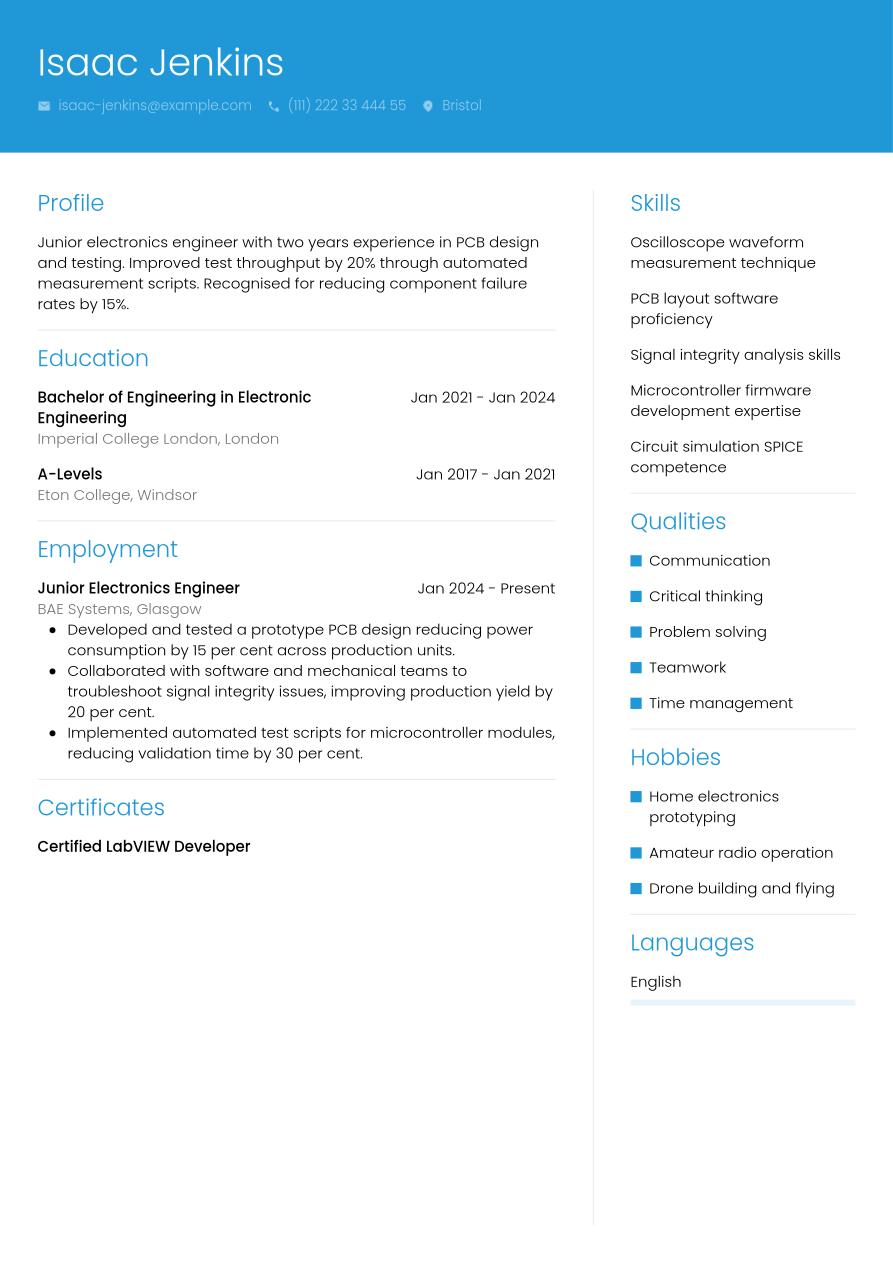
Once you've got some relevant work experience under your belt, you'll want your CV to focus on this as much as possible, and show how you've developed your skills and put them to good use in the workplace. Employers will be keen to see the impact you've had in other roles, and for other organisations. In this case, a reverse-chronological CV format is the most likely to make a positive impact. List the most recent and relevant work experience from your career and provide evidence to support your claims in the form of data, figures or other quantifiable results.
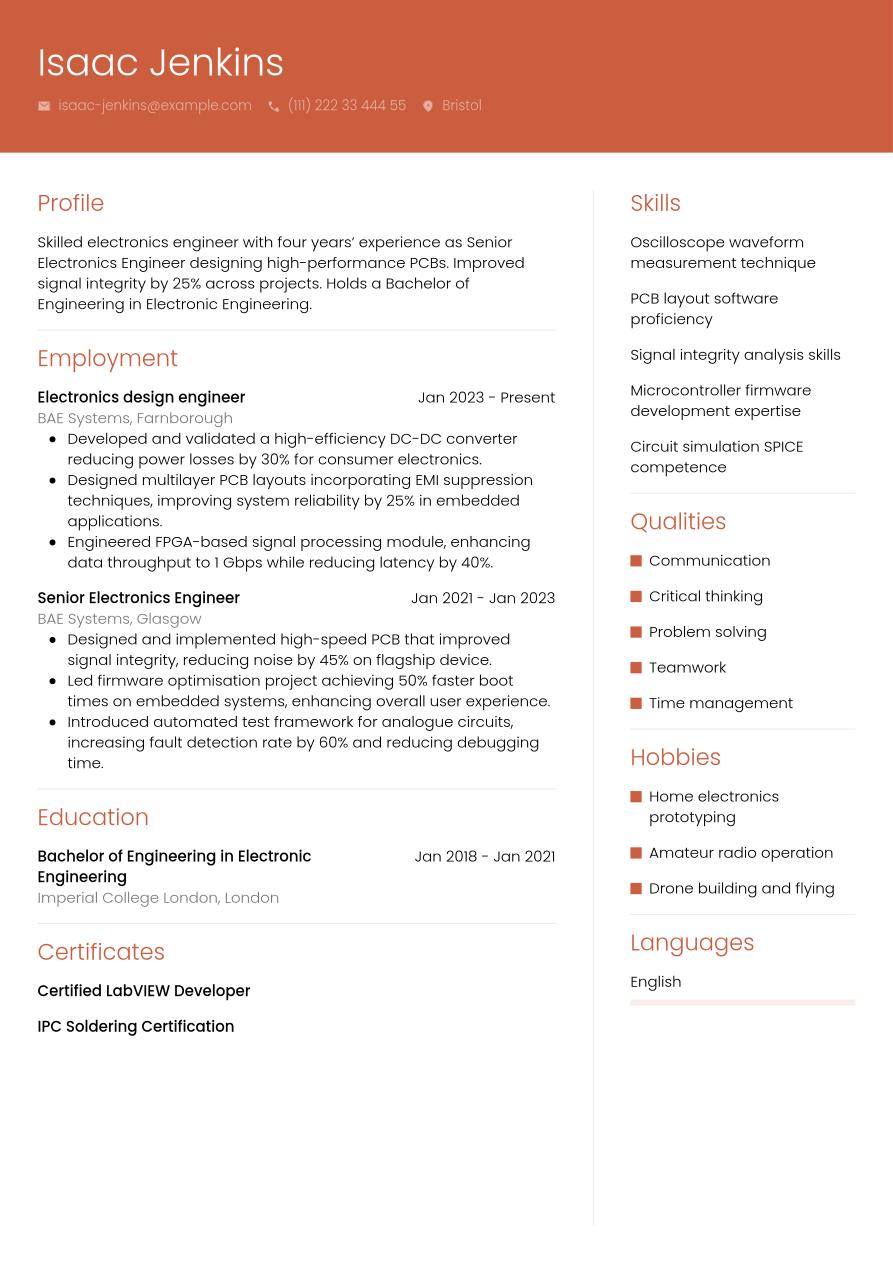
As a senior-level candidate, it's important to produce a CV that gives top billing to your wealth of relevant work experience. Employers will be expecting candidates to provide their expertise and reputation, and their ability to lead a team or organisation. As such, opt for a detailed reverse-chronological CV structure that can adequately showcase the quality and depth of your work experience. You could also add awards, publications, achievements and professional memberships to provide an indication of your standing and reputation.
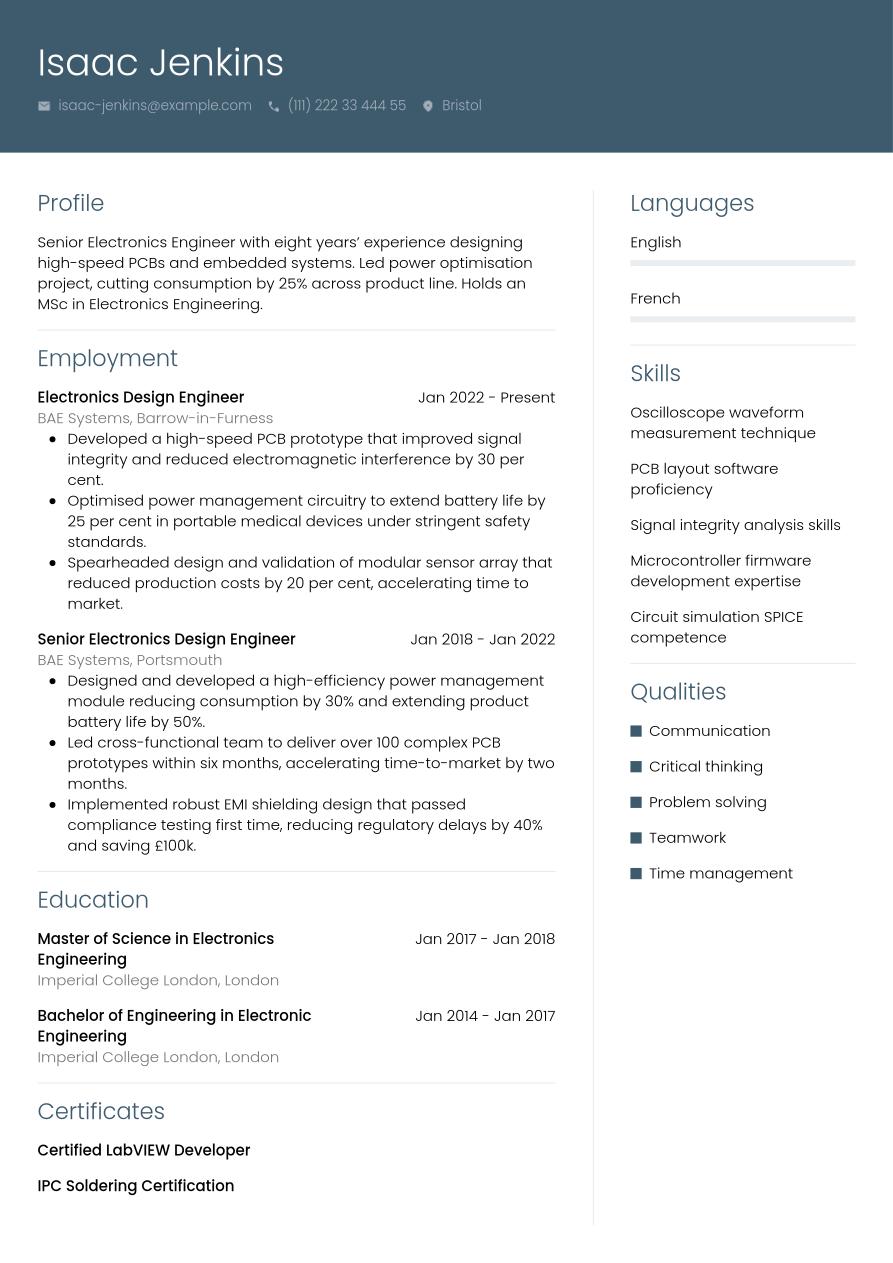
However, no matter where you are in your career, an electronics engineer CV must present a clear, compelling narrative of your professional journey. To help you build that story, we’ll now break down the document piece-by-piece—from the initial contact header to your most significant career milestones.
CV Header
Start your electronics engineer CV with a professional-looking header that includes all the relevant contact information. This usually includes your name, your email address, your phone number and your location, but not your full address. Additionally, consider adding a URL to your LinkedIn profile if you have one. This can help the reader to quickly access further information about your career and credentials that you haven't been able to add to your CV.
For jobs in the UK, a personal photo is usually not required on your CV. That, along with any other personal details such as age, gender, ethnicity and nationality, are generally discouraged under the terms of the Equality Act 2010, which aims to reduce and eliminate discriminatory practices, such as recruitment bias.
Isaac Jenkins
isaac-jenkins@example.com
(111) 222 33 444 55
Bristol
linkedin․com/in/isaac–jenkins–123
CV Objective
Below your CV header, the next section tends to be a CV summary or CV objective. This paragraph briefly explains a few of your key skills and qualities, so employers can easily understand whether you're likely to be a suitable candidate for the electronics engineer job. As an alternative to the CV summary, you might wish to write a CV objective. This serves a similar purpose, but instead of focusing on your experience, it highlights you career ambitions and objectives.
In your summary or objective, write two or three sentences introducing your key skills, unique qualities and career achievements, making sure they match the key requirements listed in the job description.
An effective CV summary will focus on a few of the key skills required for the role and show how you've put them to good use in your career to date. You'll want to give the reader a good impression of your unique qualities and briefly provide evidence of their impact in previous roles. Below you'll find a good example of how to write an effective electronics engineer CV summary. The example shows quantifiable achievements and well-structured sentences.
Best practice example:
Experienced electronics engineer with five years’ experience as Senior Electronics Engineer. Designed a power converter that boosted efficiency by 15%. Holds a Bachelor of Engineering in Electronic Engineering.
Poor example:
Enthusiastic electronics engineer who has developed various projects, working collaboratively to deliver reliable solutions and continually seeking to enhance skills and contribute positively to team objectives while driving innovation.
The electronics engineer CV summary above gives you an idea of what to avoid. The differences are subtle, yet significant. Your summary could miss the mark if it's too generic and doesn't describe unique personal qualities and strengths. It might also be vague, use long, unstructured sentences, lack quantifiable evidence of your impact, or not be tailored to the job description.
Work History
Work experience is usually the most important section of any CV. Employers will be looking for evidence of how you've developed relevant skills in your career to date, and how you've used them to positive effect in previous roles. It's crucial to tailor your work experience section to match the requirements listed in the job description, using keywords and phrases so employers can easily see how well you fit the role and organisation.
Add your most relevant previous jobs, including the job title, the name of the employer, its location and the dates you worked there. Below each entry, include several bullet points showcasing your skills and explaining how you used these to achieve positive results.
What differentiates an excellent work experience section from an average one is the use of action verbs and quantifiable evidence, showing how your actions led directly to positive results in previous roles. You'll also want to show how you've added relevant skills and increased your impact throughout your career progression. Take a look at this electronics engineer CV example work experience section for inspiration:
Best practice example:
Senior Electronics Engineer, January 2023 - Present
Northbridge Electronics Ltd, Cambridge
- Led design and validation of a power management system reducing power consumption by 30%.
- Managed cross functional team to deliver a high reliability PCB platform achieving 99.9% field uptime.
- Developed modular embedded firmware framework accelerating product time to market by 25%.
Poor example:
Senior Electronics Engineer, January 2023 - Present
Northbridge Electronics Ltd, Cambridge
- Designed and implemented hardware solutions to support organisational objectives.
- Collaborated with multidisciplinary teams to deliver engineering projects on schedule.
- Conducted technical evaluations and provided recommendations to improve system performance.
Above is an example of what not to do with your electronics engineer CV. A less-effective work experience section could focus too much on irrelevant or out-of-date roles, or include generic information about your responsibilities that fails to show the impact you made. It might lack tailoring to the job description or fail to provide evidence to support the claims made in the bullet points.
Education
In your education section, list any formal qualifications you've gained, particularly those that are most recent or required for the role.
Electronics engineer jobs tend to require a relevant university degree just to be eligible for the role, so you'll want to showcase this in your CV. If you have a Bachelor of Engineering in Electronic Engineering or another related degree that makes you an eligible candidate for the position, add it to your CV. You could also add other degrees or qualifications that highlight your key skills, like circuit simulation SPICE competence or oscilloscope waveform measurement technique.
Your education section should contain only the qualifications that you consider most relevant to the role. List them in reverse-chronological order, starting with the most recent and working back from there. For each entry into your education section, add the qualification name and level, the institution or awarding body, its location and your dates of study or graduation. For extra emphasis on your education section, include bullet points showcasing projects you worked on, modules you studied, awards you won or societies you participated in, if they help you to prove you're a suitable candidate.
If you have any specialist certifications or licences that are necessary for the role, or help you stand out above other candidates, you may wish to mention them here. When adding any special licences, it's a good idea to also reference their expiry or renewal dates, if applicable.
Bachelor of Engineering in Electronic Engineering, 2018 - 2021
University of Southampton, Southampton
Skills
Your CV's skills section CV's skills section is a great place to showcase some of the key skills necessary for the role. Check the job description to understand which skills are most essential, and provide a combination of hard and soft skills, reserving space to include some unique qualities that can help you to stand out from the competition. In an electronics engineer CV, focus on the most relevant and essential skills in your skills portfolio, such as communication and circuit simulation SPICE competence, to show you're qualified for the electronics engineer position and to put you in a strong position to progress.
Hard Skills
Hard skills refer to the technical and specialist skills required for the everyday duties of the job. They might include specialist knowledge, or the use of certain software and equipment. You can gain these skills through study, training or industry experience, and they might require a licence or certification. For electronics engineer jobs, critical hard skills you've gained in your career can include microcontroller firmware development expertise, and PCB layout software proficiency. Check the skills specified in the job description, and add four or five key hard skills to your CV that show employers you're capable of completing the key duties of the role.
The best hard skills section would be based around skills listed as 'essential' or 'required' in the job description. To give yourself the best chance of success, you'll want your strongest skills to match closely with those most desired by the employer, and your hard skills list should reflect this.
Below, you can find the types of skills typically featured in the hard skills section of an electronics engineer CV:
- Oscilloscope waveform measurement technique
- PCB layout software proficiency
- Signal integrity analysis skills
Soft Skills
Soft skills are distinct from hard skills and tend to reflect your inherent personal qualities and strengths. These are often more transferable to different roles, and help the reader understand your working style, and your likely fit to the team and the organisational culture. As a result of rapid technological changes to modern ways of working, soft skills are becoming more and more valuable to employers. Soft skills can also be particularly useful for junior or entry-level roles where candidates haven't had the time or career experience to develop hard skills and notable achievements.
As with hard skills, review the job description to understand the best soft skills to mention in your electronics engineer CV. The best CV soft skills section includes specific skills that you can evidence with examples throughout your CV. Your soft skills list should reflect the job description as closely as possible, while also reflecting your strongest, unique talents and personal qualities. Aim for a list of around five key skills.
The section below provides an overview of soft skills often highlighted in an electronics engineer CV.
- Communication
- Critical thinking
- Problem solving
Languages
Adding foreign language skills to your electronics engineer CV can be a valuable addition that reflects well on you as a candidate. Even if language skills aren't listed as a requirement in the job description, if you speak a foreign language, it can be beneficial to add it to your CV. In the languages section, list the languages you speak to at least a reasonable level, with an indicator of your competency level.
There are a few acceptable ways of citing your foreign language proficiency levels. The simplest way is to assign a basic descriptive word to indicate your skills, such as:
- English: Fluent
- Spanish: Intermediate
You might choose to adopt an international standard framework for languages, such as the Common European Framework of Reference (CEFR). This assigns a standardised level to your language skills, for example:
- A1: Beginner
- A2: Elementary
- B1: Intermediate
- B2: Upper intermediate
- C1: Advanced
- C2: Proficiency
Certifications and Licences
Depending on the role you're applying for, and the type of qualifications you have, you might want to include a separate section for certifications, in addition to the education section. Having a separate section can draw more attention to your training, and show employers your proactive, motivated mindset towards professional development, which could be a key asset. Furthermore, the CV certifications and training section is a great showcase for official licences and certifications when applying for roles where these are a key requirement listed in the job description. These could include positions where the use of specialist software and equipment is a routine part of your everyday responsibilities.
See below for a list of example certifications and licences you might add to your CV for electronics engineer roles:
- Certified LabVIEW Developer, 2023
- IPC Soldering Certification, 2023
- Embedded Systems Design Course, 2023
Expert Tip:
Barnet Council shows that recruiters spend only 8.8 seconds reviewing a CV, so a concise personal statement is essential to grab attention immediately. (1)
Optional Sections
Adding optional sections to the end of your electronics engineer CV is a good way of showing you have the necessary skills for the job. Consider optional sections for your CV if you're looking for ways to show you're right for the job, beyond your work experience. Optional sections are particularly valuable if you haven't had the chance to build up relevant work experience, for example, if you're applying for entry-level roles or you're changing careers to a new industry or role.
You can find more detailed advice on tailoring your CV in our career resources, where we cover proven ways to highlight your skills effectively.
Hobbies and Interests
Your hobbies and interests can be a useful way of showcasing additional skills that are relevant to the job description, but that you haven't been able to prove via your work experience. In addition, this section is the ideal way to show aspects of your personality that might not otherwise shine through in your CV, helping to offer a point of difference compared to other candidates. However, it's important to only mention hobbies and interests that are relevant, or related to, the role you're applying for. If your hobbies don't help you to show skills required for the role, that are missing elsewhere in your CV, it's best to leave this section out.
Achievements and Awards
Listing your key career achievements in a distinct section can be an effective way of drawing attention to them. Add any awards you've won or career milestones you've reached, so employers can easily see the impact you've made in your career to date.
Volunteer Roles
Listing volunteer roles is another effective way of showing employers your skills and experience. If you're lacking work experience, either as a junior candidate or a career changer, adding volunteering activities gives you a chance to show how you've put your skills into action. For this section, use a similar structure to your work experience section.
List your job title or a description of the role, the organisation name, its location and the dates you occupied the role. Use bullet points to show employers how you put your skills to use, and any positive achievements from your time in the role.
Analytical Insight:
9 out of 10 HR professionals want CVs to be tailored to the job description. (2)
Most effective action verbs for an electronics engineer CV
Using strong action verbs in your work experience bullet points gives you the opportunity to show how you've applied skills to good effect in previous roles. Starting each bullet point with an action verb, such as 'delivered', 'collaborated' or 'developed' also allows you to show your key skills and qualities in a way that's easily identifiable for the reader. When adding action verbs to your work experience bullet points, just remember to always provide quantifiable evidence that shows the value you added for each employer. Use past tense for any action verbs that describe previous roles (for example, 'developed') and present tense for current roles (for example 'collaborating').
- Design
- Develop
- Test
- Troubleshoot
- Optimise
- Simulate
- Analyse
- Integrate
- Validate
- Calibrate
Electronics engineer CV example
Now that we've covered the main sections to include in your electronics engineer CV, we can see how it would all come together in its final form in the example below:
Bristol
•
isaac-jenkins@example.com
•
(111) 222 33 444 55
•
linkedin․com/in/isaac–jenkins–123
Skilled electronics engineer with four years’ experience as Senior Electronics Engineer designing high-performance PCBs. Improved signal integrity by 25% across projects. Holds a Bachelor of Engineering in Electronic Engineering.
Electronics design engineer
2023
-2026
BAE Systems (Farnborough)
- Developed and validated a high-efficiency DC-DC converter reducing power losses by 30% for consumer electronics.
- Designed multilayer PCB layouts incorporating EMI suppression techniques, improving system reliability by 25% in embedded applications.
- Engineered FPGA-based signal processing module, enhancing data throughput to 1 Gbps while reducing latency by 40%.
Bachelor of Engineering in Electronic Engineering
2018
-2021
Imperial College London (London)
Oscilloscope waveform measurement technique
PCB layout software proficiency
Signal integrity analysis skills
Communication
Critical thinking
Problem solving
Certified LabVIEW Developer
IPC Soldering Certification
English - Native
French - Advanced
To get an idea of how your completed, one-page CV will look once its been fully designed, see our selection of CV examples.
Key tips and mistakes to avoid for your electronics engineer CV
Tips to follow
- Tailor your CV to reflect the key skills and experience listed in the job description, while highlighting your best career achievements.
- List your qualifications in a dedicated education section, including grades and awards if these can help set you apart from other candidates (particularly for junior candidates).
- Use action verbs to showcase how you put your strongest skills to good use in previous roles, and demonstrate the impact they had.
- Use a clear, professional CV format, choosing a readable font, consistent line spacing and clear headings, to make your CV as accessible as possible.
- Quantify your achievements whenever possible, adding key figures and evidence to support your claims.
Common mistakes to avoid
- Don't add unrelated information about previous work experience, as this takes up valuable space on your CV and ultimately won't increase your chances of success.
- Don't include personal information, for example your age, gender, marital status or a personal photo (unless necessary for the role).
- Don't use passive voice, such as 'strategies were devised', but instead add clear action verbs that place you and your impact at the heart of the CV narrative.
- Don't crowd your CV with unnecessary extra details, but stick to the key facts and present them in a clear, readable fashion.
- Don't include a section for hobbies and interests unless they're clearly relevant to the role and help you show skills you can't prove through other core CV sections.
A professional cover letter is a key element of any successful job application. Match your cover letter to your CV's style with our professionally-designed cover letter templates.
How to make your CV ATS compatible
Many employers now use applicant tracking systems (ATS) to assist with managing the recruitment process. One of the key elements of most ATS apps is the ability to scan CVs and rank them according to their likely match to the job description. This task can relieve some of the strain on hiring managers through the recruitment process, which can become very resource-intensive, with roles often eliciting hundreds of applications.
Because ATS software is becoming more common in the recruitment process, it's important to make some concessions in your CV to give yourself the best chance of progressing beyond the initial screening. With that in mind, here are some tips on preparing your CV for ATS screening:
- Include keywords and phrases from the job description that are easy for ATS apps to identify, and help make you appear a strong fit for the role.
- Use clear, conventional CV headings to make your CV easier to navigate, including 'work experience', 'education' and 'skills'.
- Choose a simple, straightforward CV layout with clear, consistent formatting, that avoids text boxes, graphics or other special design elements, as these can make your CV harder to scan.
- Select a widely-used font in either serif or sans serif style, with a font size between 10 and 12 for body text and 14 and 16 for heading text.
- Use bullet points rather than writing long, full sentences, as this will make your CV easier to scan and parse, and help your keywords and phrases to stand out.
You might feel there are a lot of steps to creating an ATS-compatible electronics engineer CV, but with just a few small changes, you can ensure your CV passes this stage. Use one of our ATS-compatible CV templates, which are designed by experts to give you the best chances of success.
If you're looking to make a strong first impression on hiring managers with your CV, use Jobseeker's eye-catching CV templates, which are approved by HR experts.
Electronics engineer CV FAQs
How do I create an electronics engineer cover letter to go with my CV?
A well-written cover letter can be just as important as a CV for your chances of job application success. When writing your cover letter, choose a formal professional letter format and use a cover letter template that matches the design of your CV.
Most cover letters include three standard paragraphs of information. The letter opens with a brief personal introduction and confirmation of the role you're applying for, and your motivations for applying. In the next paragraph, list some key skills and career achievements related to the role, taking care not to repeat your CV. Finally, end your cover letter with an expression of gratitude for considering your application, and a call to action that puts the ball in the court of the employer to arrange an interview or establish dialogue with you.
Alternatively, if applying via email, you may wish to write a shorter, more simple cover note. You can use traditional email conventions for this, which are less formal than standard letter conventions. Simply introduce yourself and confirm the role you're applying for, direct the reader to the attached documents and add your contact details in your email footer/sign-off.
Jobseeker's cover letter examples for electronics engineer roles and other engineering industry positions can provide valuable insights from HR specialists on how to craft the most persuasive cover letter.
How do I write an electronics engineer CV without experience?
Even without work experience that fits the job description, there are ways to write an electronics engineer CV that leaves a strong impression on employers.
Select a CV structure that makes the most of your relevant skills, rather than focusing on your work experience, such as a functional format. In this layout, the skills and education sections come before work experience.
For junior or entry-level roles, employers may be more keen to know whether you have the right soft and transferable skills to adapt to the requirements of the role. In this case, place greater emphasis on soft skills for a junior electronics engineer CV.
How do I write an electronics engineer CV headline for maximum impact?
A well-written CV headline can be an effective way of introducing your CV, helping it be more compatible with ATS apps and engaging the reader early in the document.
Aim to write a short, concise sentence that mentions the job title and focuses on one of your best skills or qualities.
For the most attention-grabbing CV headline, match your sentence to the most critical keywords and phrases from the job description. This will catch the eye of the reader as well as giving you the best chance of passing the ATS screening stage.
Below you'll find some examples of CV headlines for different experience levels:
- Results-Driven Junior Electronics Engineer
- Skilled Electronics Engineer Driving Innovation
- Senior Electronics Engineer Delivering Excellence
What's the most effective CV format for an electronics engineer CV in 2026?
The format that gives the best chance of success for your electronics engineer CV in 2026 depends on various factors, such as your experience levels, the type and level of role you're applying for and the norms of the company and industry.
In most cases, the traditional reverse-chronological CV format is most effective, as it showcases your work experience, providing examples of relevant skills and how you've used them to contribute towards key achievements in your career to date.
Alternatively, for entry-level candidates or career changers who don't have much relevant work experience, a functional CV format tends to work better. This layout places skills and qualifications above work experience.
Key takeaways for your electronics engineer CV
To make a strong first impression on hiring managers, tailor your CV for every application, adding keywords and phrases that match the job description. Select a suitable CV format that reflects your experience level, and focus on highlighting your key skills, and demonstrating how you've put them to good use to achieve positive outcomes in your career to date.
Finally, creating your CV using one of Jobseeker's expert-designed CV templates can give your application the edge, placing you among the leading candidates and positioning you for success with your job applications.
References:
- Barnet Council (UK local government), Recruitment tips: How to write a supporting statement
- Jobseeker, Recruitment Statistics

Impress employers with your CV
Step-by-step guidance to create a professional CV in minutes.