Costa CV Example
When applying to work at Costa, you'll want to write a CV that clearly shows your relevant food and beverage industry experience with similar organisations. Your CV is a showcase for your relevant key skills, and should clearly outline how you've used them in your career achievements in previous food and beverage sector roles.
Founded in 1971, Costa is a UK-based coffeehouse chain and leading roaster, revolutionising coffee culture with handcrafted beverages and welcoming café experiences. It operates in the food and beverage and hospitality industries.
After reading this article, you'll have all the information you need to create a positive first impression with Costa hiring teams, and stand out in a competitive field of applicants. Putting these tips into action will give your CV the best chance of passing the ATS screening stage and increase the likelihood of your Costa application progressing to the interview stage. Now let’s explore the main sections of a CV and see how to structure each one for maximum impact.
Main sections of a Costa CV
How you approach writing your Costa CV will vary according to your experience, your level and the details outlined in the job description.
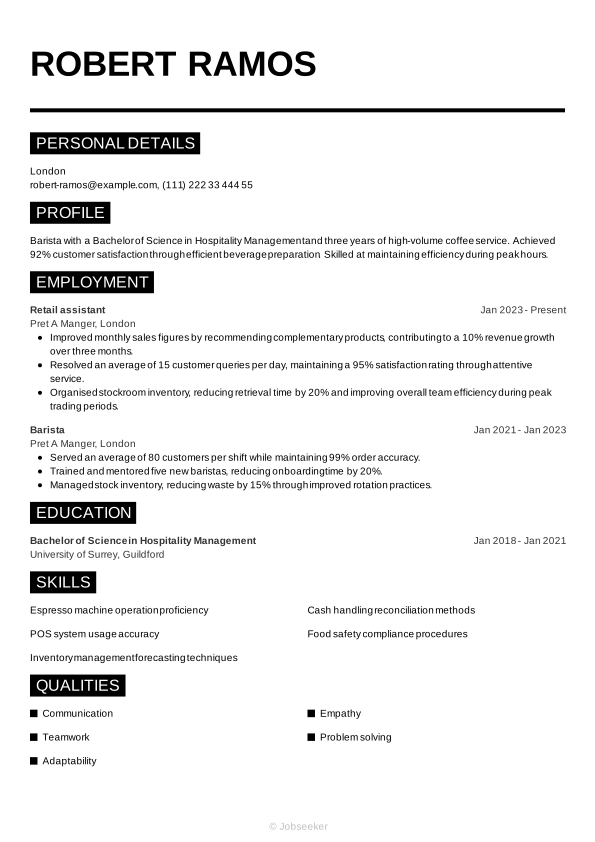
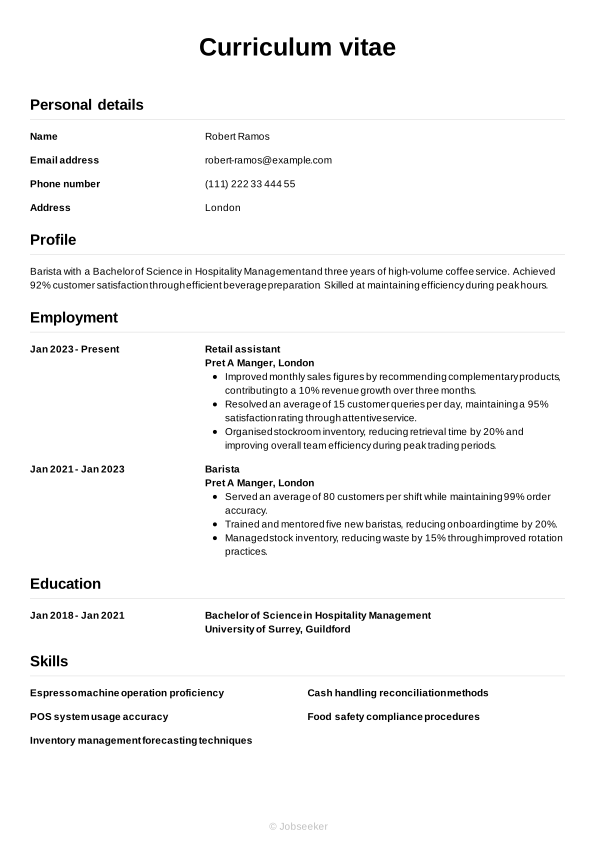
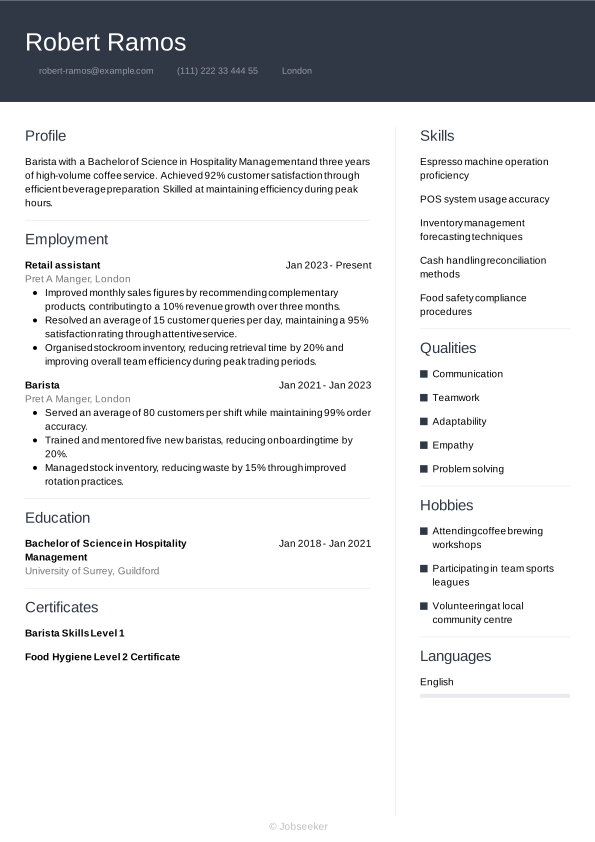
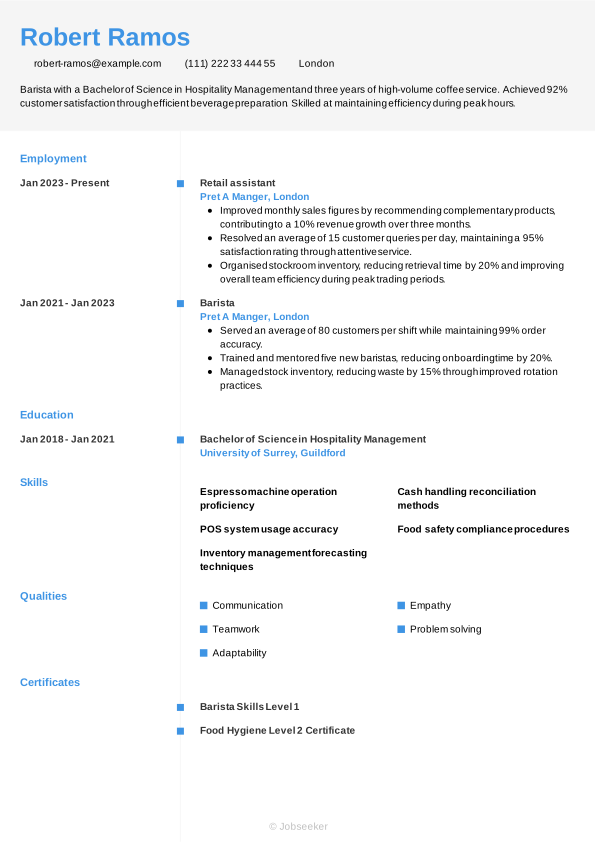
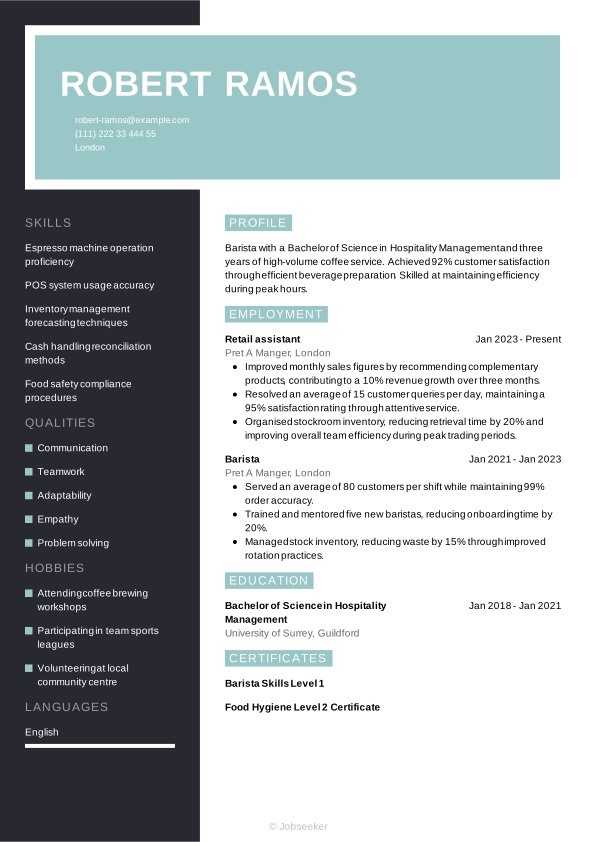
However, no matter where you are in your career, a Costa CV must present a clear, compelling narrative of your professional journey. To help you build that story, we’ll now break down the document piece-by-piece—from the initial contact header to your most significant career milestones.
CV Header
Start your Costa CV with a professional-looking header that includes all the relevant contact information. This usually includes your name, your email address, your phone number and your location, but not your full address. Additionally, listing your LinkedIn profile in your CV header can be valuable. It serves to provide more detailed information about your career journey, your qualifications and your industry standing, in an easily accessible way.
For UK jobs, it's generally not a good idea to add a photo or any other personal details beyond your basic contact information. This means leaving off details such as your age, gender, ethnicity and nationality, as these can introduce bias to the selection process and complications related to the Equality Act 2010.
Robert Ramos
robert-ramos@example.com
(111) 222 33 444 55
London
linkedin․com/in/robert–ramos–123
CV Objective
Under your header, write a brief CV summary or CV objective, outlining a few of your key skills, qualities and achievements. This short paragraph can help employers to quickly assess your suitability for the role, setting the tone for your Costa CV. The CV objective provides an alternative to the standard CV summary. While the CV summary focuses on your skills and achievements through your work experience, a CV objective highlights your ambitions and plans for the future, including how the role fits with these. This makes it ideal for junior candidates.
Whether you choose to write a summary or an objective, aim for a length of two or three sentences, introducing your key skills, unique qualities and key achievements or ambitions, making sure they reflect what's included in the job description.
An effective CV summary will focus on a few of the key skills required for the role and show how you've put them to good use in your career to date. You'll want to give the reader a good impression of your unique qualities and briefly provide evidence of their impact in previous roles. See below for an example of a strong Costa CV summary, featuring quantifiable evidence of your impact and concise, easy-to-read sentences.
Best practice example:
Barista with five years’ experience delivering high-quality coffee and customer satisfaction. Recognised for reducing wait times through refined workflow and attentive service. Eager to apply hospitality management expertise at Costa.
Weak example:
Experienced Barista with five years’ practice in crafting coffee and supporting customers in a busy environment, often contributing to smoother operations and service delivery, seeking to bring reliability to Costa.
Above is an example of CV summary that doesn't follow best practice, with some subtle shortcomings and failings. For a summary to make less of an impact, it might include generic or vague information, lack evidence of your impact, or fail to highlight specific personal qualities that make you stand out from other candidates. It may also lack tailoring to the job description or include long, poorly structured sentences.
Employment History
In your work experience section, you'll want to showcase your relevant experience in the food and beverage industry. Focus on the job description, and include skills and career achievements that will appeal to Costa recruiters, showing how you can make an impact for the organisation. List previous jobs relevant to the food and beverage sector in reverse-chronological order, starting with your current or most recent role. Include your job title, the name of the employer, its location and the dates you worked there. Under each entry, add several bullet points outlining your key skills and achievements in the role.
A successful CV should emphasise relevant previous roles in the industry, providing evidence to show how your key skills related to the food and beverage sector have led to positive achievements in your career to date.
Best practice example:
Barista, January 2023 - Present
Caffè Nero, Manchester
- Improved customer satisfaction scores from 85% to 95% by refining coffee preparation techniques and personalising service.
- Trained six new team members in latte art and espresso extraction, reducing order fulfilment time by 30%.
- Managed daily stock inventory and supplier orders, preventing shortages and cutting waste by 15% over six months.
Weak example:
Barista, January 2023 - Present
Caffè Nero, Manchester
- Delivered friendly customer service and maintained operational standards across all shifts.
- Maintained high standards of cleanliness and organisation throughout the store environment.
- Collaborated with colleagues to support team objectives and improve overall store performance.
Your work experience section could miss the mark if it places too much emphasis on jobs that aren't relevant to the food and beverage industry, or if it fails to offer suitable evidence to confirm you have the key skills and qualities needed to work in the sector.
Education
In your education section you'll want to list your highest and most recent qualifications, particularly if they're a requirement for the role.
Working as a Costa employee doesn't tend to require a specific degree. However, while employers may not request a degree in the job description, it can be useful to include other relevant qualifications, certifications or training in your CV's education section. These might include Food Hygiene Level 2 Certificate, or courses that show your skills, such as inventory management forecasting techniques or cash handling reconciliation methods.
When listing your qualifications in your education section, select only the most suitable qualifications and list them in reverse-chronological order, starting with the most recent and working backwards. Add the name and level of the award, the institution, its location and your dates of study or graduation. If you have space or if you particularly want to emphasise your qualifications, you could add one or two bullet points under each entry, highlighting specialist areas of study, projects you worked on, awards you won or societies you were a member of.
You might also wish to add specialist qualifications, certifications or licences that are required for the role. If you add any of these, include the expiry date, if the qualification requires renewal in the future.
Bachelor of Science in Hospitality Management, 2018 - 2021
University of Manchester, Manchester
Skills
Your CV's skills section CV's skills section is a great place to showcase some of the key skills necessary for the role. Check the job description to understand which skills are most essential, and provide a combination of hard and soft skills, reserving space to include some unique qualities that can help you to stand out from the competition. In a Costa CV, only list the most relevant and essential skills you possess, such as teamwork and cash handling reconciliation methods, to make a positive first impression and show you're qualified for the Costa employee position.
Hard Skills
Hard skills refer to the technical and specialist skills required for the everyday duties of the job. They might include specialist knowledge, or the use of certain software and equipment. You can gain these skills through study, training or industry experience, and they might require a licence or certification. For Costa employee positions, hard skills that match your abilities, such as POS system usage accuracy, and inventory management forecasting techniques tend to be valued by recruiters and hiring managers. After reviewing the job description, compile a list of four or five key hard skills for your Costa CV to show you're capable of carrying out the duties required for the role.
The best hard skills section will contain a mix of your strongest technical skills and those listed in the job description as 'essential' or 'desirable'. The closer your skills list is to matching the essential job description skills, the better your chances of success.
Review the examples below to understand which skills are often added to the hard skills section of a Costa CV.
- Espresso machine operation proficiency
- POS system usage accuracy
- Inventory management forecasting techniques
Soft Skills
Soft skills are the personal strengths and qualities that show employers how well you'll fit into the role and complement other members of the team. Soft skills tend to be more transferable and applicable to different roles than hard and technical skills. As a result of rapid technological changes in the world of work, soft skills are becoming ever-more valued by employers. Soft skills can also be particularly valuable for junior or entry-level roles where candidates haven't necessarily had the time to develop hard skills and career achievements.
Just like the hard skills section, begin by reviewing the job description to learn the most desirable soft skills to include in your Costa CV. Only add soft skills that you can provide evidence for throughout your CV. Draft a list of up to five key soft and transferable skills, combining the most essential skills from the job description with your strongest personal qualities.
Here are typical soft skills candidates include in a Costa CV.
- Communication
- Teamwork
- Adaptability
Pro Tip:
Transport for London highlights that the most effective CVs are concise, focused on the job description and supported by clear evidence of relevant skills and experience. (1)
Language Skills
If you speak any languages in addition to your mother tongue, you might want to include them in your Costa CV as a languages section. These can be valuable for your application, whether languages are specified as a requirement in the job description or not. Under this section, list any foreign languages you speak to a professional standard, with an indicator of your competency level for each.
There are several ways to cite your proficiency in foreign languages. Firstly, you could use a simple descriptive word to indicate your abilities, such as:
- English: Fluent
- Spanish: Intermediate
You might wish to use an internationally recognised standard for your language skills, such as the Common European Framework of Reference (CEFR). This divides your language skills into the following categories:
- A1: Beginner
- A2: Elementary
- B1: Intermediate
- B2: Upper intermediate
- C1: Advanced
- C2: Proficiency
Certifications
To showcase additional qualifications and training beyond the basic requirements for the role, consider adding a certifications section to your CV. It's often beneficial to include it as it can illustrate a positive attitude towards self-improvement and professional development, as well as a proactive mindset. All these qualities will appeal to most employers and decision-makers. Furthermore, if there are any necessary certifications or licences for the job, this CV section takes on even more importance. If you're applying for a technical role or a position that involves the use of specialist software or equipment, these might make it more necessary to include a section showcasing your training.
Here is a list of some key certifications and licences that can be particularly useful for Costa employee applications:
- Barista Skills Level 1, 2023
- Food Hygiene Level 2 Certificate, 2023
- Allergen Awareness Training Certificate, 2023
Additional Sections
Including optional sections in addition to the core sections of your Costa CV can help you to show employers you're a strong candidate for the job. If you're unable to show you have all the necessary skills for the job through your work experience, optional sections can be a valid way of providing further evidence of your suitability, to give you the chance of gaining an interview. If you're an entry-level candidate or a career changer, optional sections can be particularly valuable.
Explore our career resources for practical strategies to make your CV stand out and move you closer to landing an interview.
Hobbies and Interests
One valid way to show you have relevant skills for the job is by listing your hobbies and interests. Additionally, hobbies and interests are an ideal way to show the employers some elements of your personality and interests beyond work, which can set you apart from other candidates. However, only mention hobbies and interests that are relevant to the role, and that help you prove skills that you haven't been able to show in your work experience or other CV sections.
Achievements
Creating a list of your key career achievements can be an effective way of drawing attention to the things you're most proud of from your career. In your list, add any awards you've won, industry recognition or key career milestones that tell a story about your suitability for the role and place you ahead of other candidates.
Volunteer Roles
Listing any previous voluntary work is another useful way of showing you have the necessary skills and experience for the job. If you don't have much relevant work experience, either because you're a junior candidate or you're changing jobs from an unrelated field, volunteering can provide valuable examples of your skills in action. Structure your volunteering section the same as your work experience section.
Add your job title or the name of the volunteer role, the organisation, its location and the dates you volunteered. Also add some bullet points outlining your skills and experience in the role, as well as any key achievements.
References
In the UK, it's not normal for references to be requested as part of a CV, or at the early stages of an application. However, it's worth checking the job advert and being ready to supply them if necessary. If references are needed, opt for two or three, and always make sure you approach them for permission before including them.
Add their name, their job title, the organisation they work for and their contact details. Alternatively, if references aren't required you could simply add a line to your CV confirming you can provide them when needed, such as 'references are available upon request'.
Data Insight:
More than 7 in 10 recruiters use ATS to filter for experience level and almost 6 in 10 check for previous job titles, so make sure your work experience section matches the job listing. (2)
Most effective action verbs for a Costa CV
Adding strong action verbs to the bullet points in your CV's work experience section is a great way to focus on the key skills required for the job, while showing the impact you've made. Start each bullet point with an action word that reflects the job description, so the reader can easily identify your best qualities. You'll also want to back up any action verbs you're using with quantifiable evidence that showcases the value you added for previous employers. Use the past tense for action verbs that describe previous roles, with the present tense for any current responsibilities and achievements.
- Serve
- Greet
- Prepare
- Brew
- Clean
- Restock
- Maintain
- Recommend
- Handle
- Resolve
Costa CV sample
Now that you know exactly what to include in your Costa CV, we can take a look at a final, finished example below:
London
•
robert-ramos@example.com
•
(111) 222 33 444 55
•
linkedin․com/in/robert–ramos–123
Barista with a Bachelor of Science in Hospitality Management and three years of high-volume coffee service. Achieved 92% customer satisfaction through efficient beverage preparation. Skilled at maintaining efficiency during peak hours.
Retail assistant
2023
-2026
Pret A Manger (London)
- Improved monthly sales figures by recommending complementary products, contributing to a 10% revenue growth over three months.
- Resolved an average of 15 customer queries per day, maintaining a 95% satisfaction rating through attentive service.
- Organised stockroom inventory, reducing retrieval time by 20% and improving overall team efficiency during peak trading periods.
Bachelor of Science in Hospitality Management
2018
-2021
University of Surrey (Guildford)
Espresso machine operation proficiency
POS system usage accuracy
Inventory management forecasting techniques
Communication
Teamwork
Adaptability
Barista Skills Level 1
Food Hygiene Level 2 Certificate
English - Native
French - Advanced
To see how your CV might look after finalising its design and layout, take a look at our CV examples.
Dos and don'ts for a winning Costa CV
Tips to follow
- Keep your CV concise and to-the-point, with an optimum length of one side of A4 for junior positions, two sides once you become more experienced and more than two sides only for executive-level or academic applications.
- Use a reverse-chronological timeline for listing your previous jobs, starting with your most recent relevant roles and working back from there.
- Tailor your CV, matching it to the key skills and experience described in the job description, while telling a unique story about your best qualities and achievements.
- Select a clear, professional CV format that helps your application to be as readable and accessible as possible, including standard fonts, consistent line spacing and clear headings.
- Highlight your key skills with a dedicated skills section that matches both the hard and soft skills listed in the job description.
Common mistakes to avoid
- Don't overload your CV with industry jargon and acronyms that may alienate or confuse the reader, instead opt for simple, clear language whenever possible.
- Leave out any detailed personal information, such as age, gender or marital status, and avoid adding a personal photo unless it's required for the role.
- Don't lie or exaggerate about previous jobs or your qualifications – it can backfire or even be considered fraud.
- Don't use overly elaborate CV formatting and designs that make your document harder to read and more confusing for ATS software.
- Don't forget to review your contact details to ensure everything is up-to-date, including regularly checking your LinkedIn profile and updating any relevant information.
Guide to CV ATS optimisation
Employers and recruiters now routinely use applicant tracking systems (ATS) to ease the burden of the selection process. One of the key functions of these systems is CV screening, which reviews CVs and ranks them based on their likely fit for the role. This saves recruiters and hiring managers the time and effort of reading every CV in detail. With many vacancies often receiving hundreds of applications, ATS software can really relieve the burden on hiring teams and free them up to focus only on the most suitable candidates.
The growing prevalence of ATS means candidates need to write and format their CV in a way that's compatible with the software, giving it the best chance of being accurately scanned and parsed, and ranking highly against other candidates. Here are some tips on how to optimise your CV for ATS screening:
- Include keywords and phrases that mirror the job description to maximise your chances of ranking highly in the ATS screening stage.
- Use clear, standard CV headings that are easily recognisable, such as 'work experience', 'education' and 'skills'.
- Choose a standard CV layout that avoids the use of any special design elements that might make your CV less compatible with ATS scanning software.
- Select a font that can enhance the readability of your CV, such as popular serif and sans serif fonts, with size 10 to 12 for body text and 14 to 16 for headings.
- Use bullet points in place of full sentences and paragraphs. This can reduce the overall length of the document, make the keywords stand out and make it easier for ATS apps to scan.
You might feel there are a lot of things to remember when writing an ATS-compatible CV, but with just a few small tweaks, you can ensure yours passes this stage. Use one of our expert-designed, ATS-compatible CV templates to avoid the stress of adapting your CV for ATS screening.
To make a splash with your CV, use one of Jobseeker's professional-looking CV templates. They come approved by HR specialists to maximise your chances of success.
Costa CV FAQs
How do I create an accompanying Costa employee cover letter for my CV?
Your cover letter can have just as strong an impact on your chances of success as your CV. When writing a cover letter, use a professional, formal letter structure and select a cover letter template to match the look and feel of your CV.
Most cover letters include three standard paragraphs of information. The letter opens with a brief personal introduction and confirmation of the role you're applying for, and your motivations for applying. In the next paragraph, list some key skills and career achievements related to the role, taking care not to repeat your CV. Finally, end your cover letter with an expression of gratitude for considering your application, and a call to action that puts the ball in the court of the employer to arrange an interview or establish dialogue with you.
Alternatively, if you're applying for the role via email, you may want to send a less formal cover note. This simply includes a brief introduction, confirming the role you're applying for and directing the reader to the relevant attached documents, rather than following the traditional professional letter conventions. Remember to include your contact details in your email, so the employer can follow up with you if necessary.
Jobseeker's cover letter examples for Costa employee and food and beverage industry roles provide useful tips and guidance from HR experts on how to write a compelling cover letter.
How do I write a compelling Costa CV without experience?
Even if you're lacking relevant work experience, you can still write a Costa CV that impresses employers.
Opt for a CV structure that focuses more on your relevant skills than your work experience, such as a functional CV format. The order of this CV layout places the skills section first after your CV summary, before education, with work experience taking less priority.
If you're an entry-level candidate with no relevant work experience, focus on your soft and transferable skills in your Costa CV. Employers will be looking for candidates who can show they have the soft skills to learn a new role and adapt to new environments.
How do I write a headline for a Costa CV?
A well-crafted CV headline can draw the reader in, providing a hint of your suitability for the role, while increasing the likelihood of passing the ATS screening stage.
Aim to write a short, engaging sentence that includes the job title and shows you to be a good match for the job description.
For an impactful CV headline, focus on the most critical keywords and phrases from the job description, as this will mark you out as a strong fit for the role and give you a strong ranking in the ATS screening stage.
Below you can find some examples of best practice for CV headlines at different levels of experience:
- Customer-Focused Barista Assistant Delivering Excellence
- BSc Hospitality Graduate and Barista
- Senior Barista and Team Leader
What's the best Costa CV format for 2026?
The best Costa CV format for success in your 2026 job hunt might vary according to your experience levels, the type and level of the role, the company and standard industry practices.
In most cases, the traditional reverse-chronological CV format is most effective, as it showcases your work experience, providing examples of relevant skills and how you've used them to contribute towards key achievements in your career to date.
Conversely, for candidates without relevant work experience (such as recent graduates or career changers), a functional format can be beneficial, as this emphasises skills and qualifications over work experience.
A well-designed and concise cover letter can make a big difference to your job applications. Match your cover letter to your CV's design and styling with our HR-approved cover letter templates.
Key takeaways for an impactful Costa CV
To give you the best chance of success with your CV, tailor it for every specific application, including keywords that reflect the job description. Select a suitable CV format for your experience level, and show the reader how you've used skills relevant to the role, to create a positive impact in your career to date.
Finally, building your CV using Jobseeker's HR-approved CV templates can help to catch the eye of recruiters and hiring managers, making your application stand out and giving you the best chance of gaining your dream job.
References:
- Transport for London (TfL), Writing a CV and cover letter
- Jobseeker, HR Statistics

Impress employers with your CV
Step-by-step guidance to create a professional CV in minutes.