Resume Contact Information (What to Include & Examples)
Recruiters spend seconds scanning resumes before deciding whether to read on. It’s your job to make sure your resume contact information is front and center. In this guide, we cover exactly what to include and how to do it.

You’ve wowed the recruiter with an attention-grabbing resume and they want to reach out to you. Don’t make it hard for them. Including clear and concise resume contact information could be the difference between getting an interview and being ignored. But how do you include it?
In this article, you’ll discover:
- The exact contact information you should include on your resume.
- What contact information you should leave off of your resume.
- How to include it correctly (with resume contact information examples).
How to include your contact information on your resume
First up, let’s talk about how to include contact information on your resume. You don’t need to overcomplicate this step. It’s simply about sharing the most important information clearly.
Before you do anything else, you need to know what details to include and why.
Information to include | Why you should include it |
|---|---|
Your name and title | Let recruiters know who you are and what you do at a single glance. This should be at the top of the contact information section. |
Your phone number | Many recruiters prefer a quick call to emailing candidates. Include this detail to give them the option. |
Your email address | Email is the main way most recruiters follow-up with candidates. |
Your location | Recruiters need to know where you are based, even if the role is remote. |
Your LinkedIn profile | Chances are, recruiters will look you up on LinkedIn before contacting you. Make it easy for them by including a link. |
There are also several pieces of information you should never include on a resume. For example, your Social Security or passport numbers, age and/or date of birth, religion, race, or marital status have no impact on your ability to perform the job and can increase your risk of discrimination during the hiring process. You should also leave off a photo of yourself for the same reasons. We'll explain more later in this article.
Where to list your resume contact information
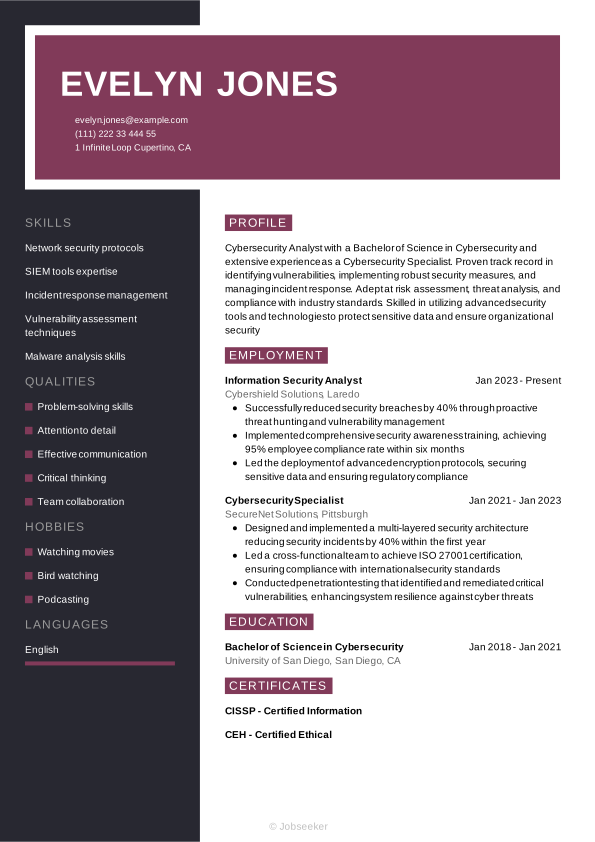
Now that you've seen what contact information to include, let's look at where to list it. These resume templates offer great examples of headers featuring a candidate's name, phone number, email, and other contact information. You can modify one for your own application by clicking on it.
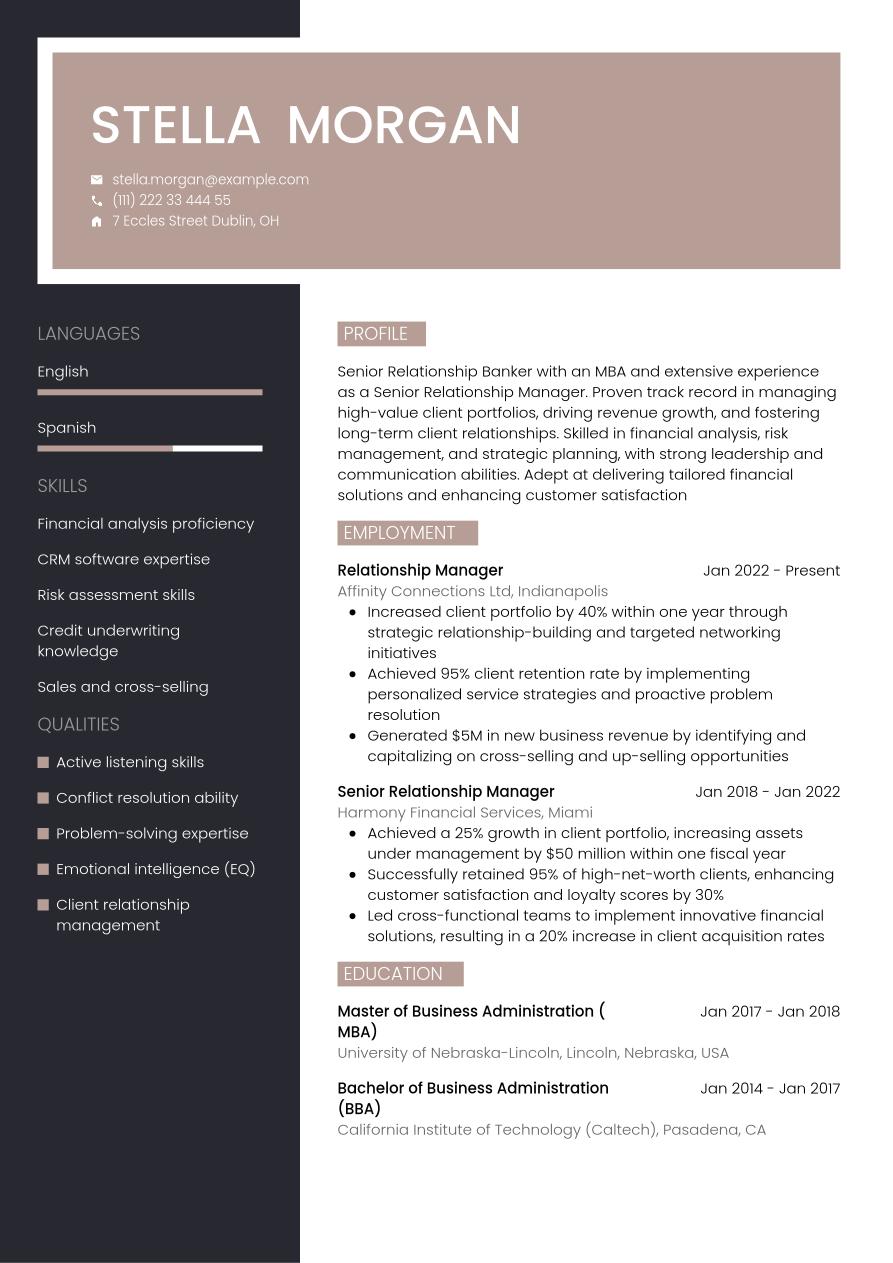
The visual header and work header are not always the same.
- The visual header is always at the top of the page. It is a design feature.
- The work header contains your contact details.
Sometimes, it will include your work header, but not always. Often this depends on the design of the document.
Here's an example of a visual header that includes the contact details:
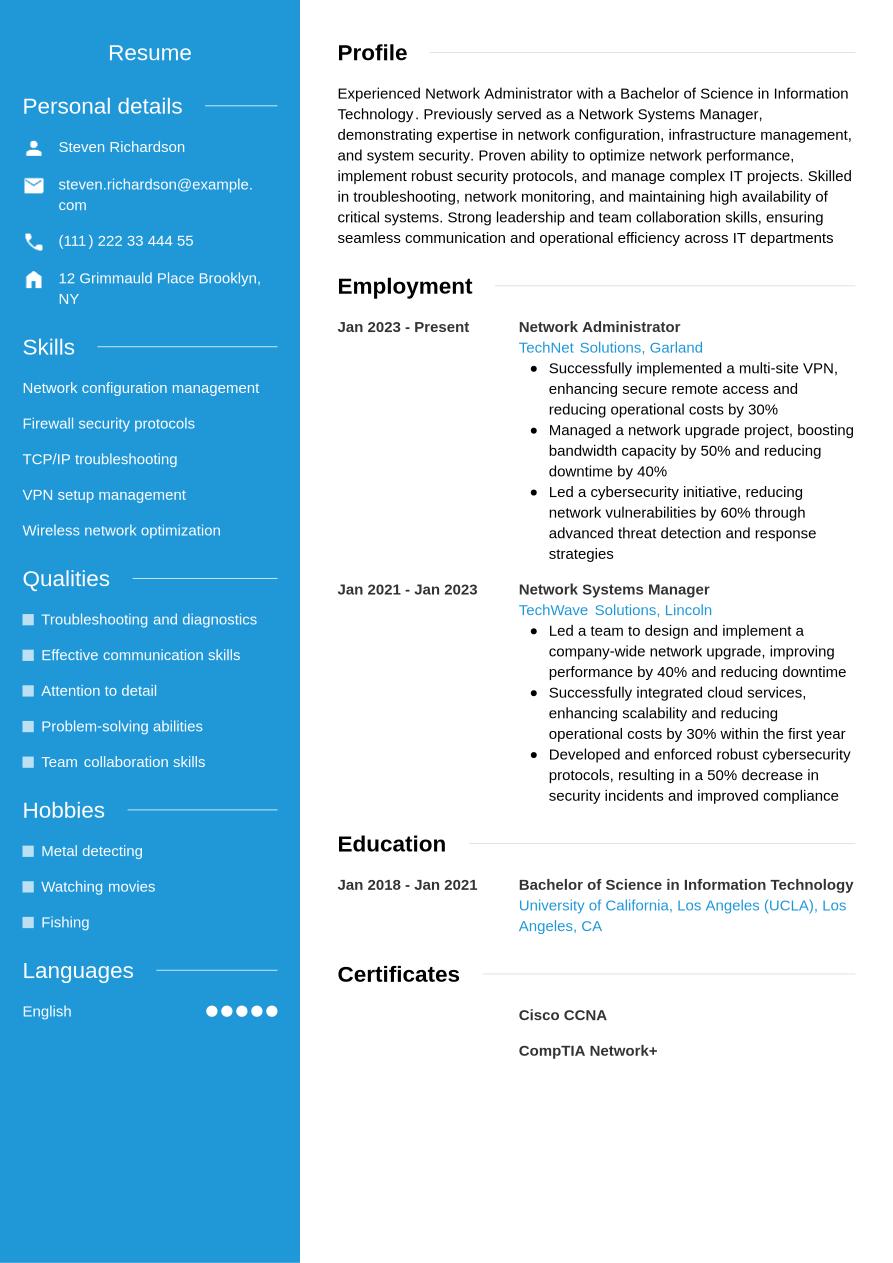
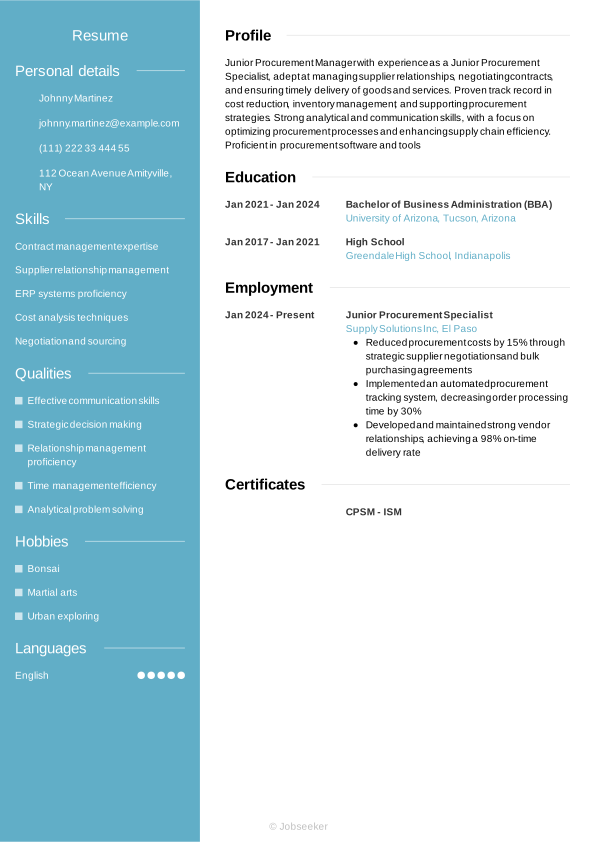
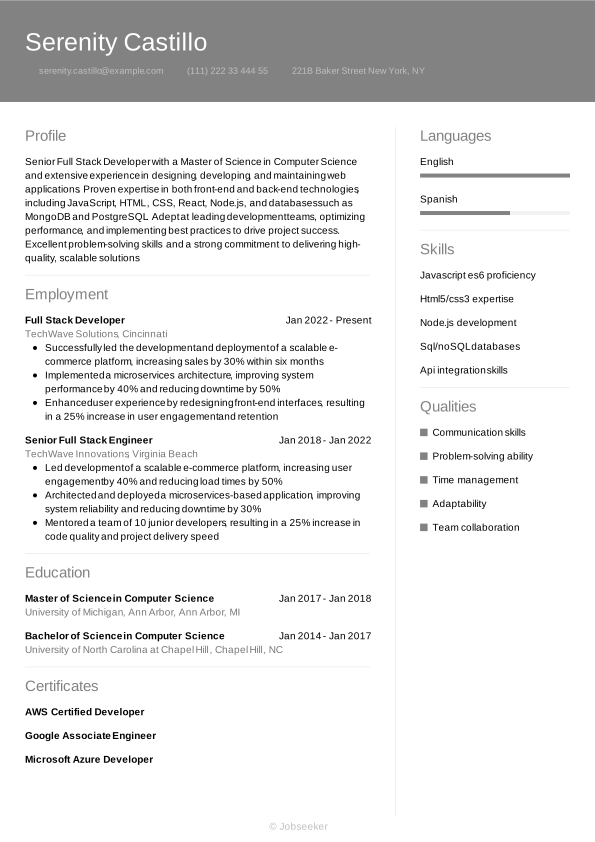
Where your work header is located largely depends on whether you choose a one-column or two-column layout.
- With a one-column layout, it will likely be at the top of the page.
- With a two-column layout, it will be on the left at the top of the column.
Here's an example of a two-column layout:
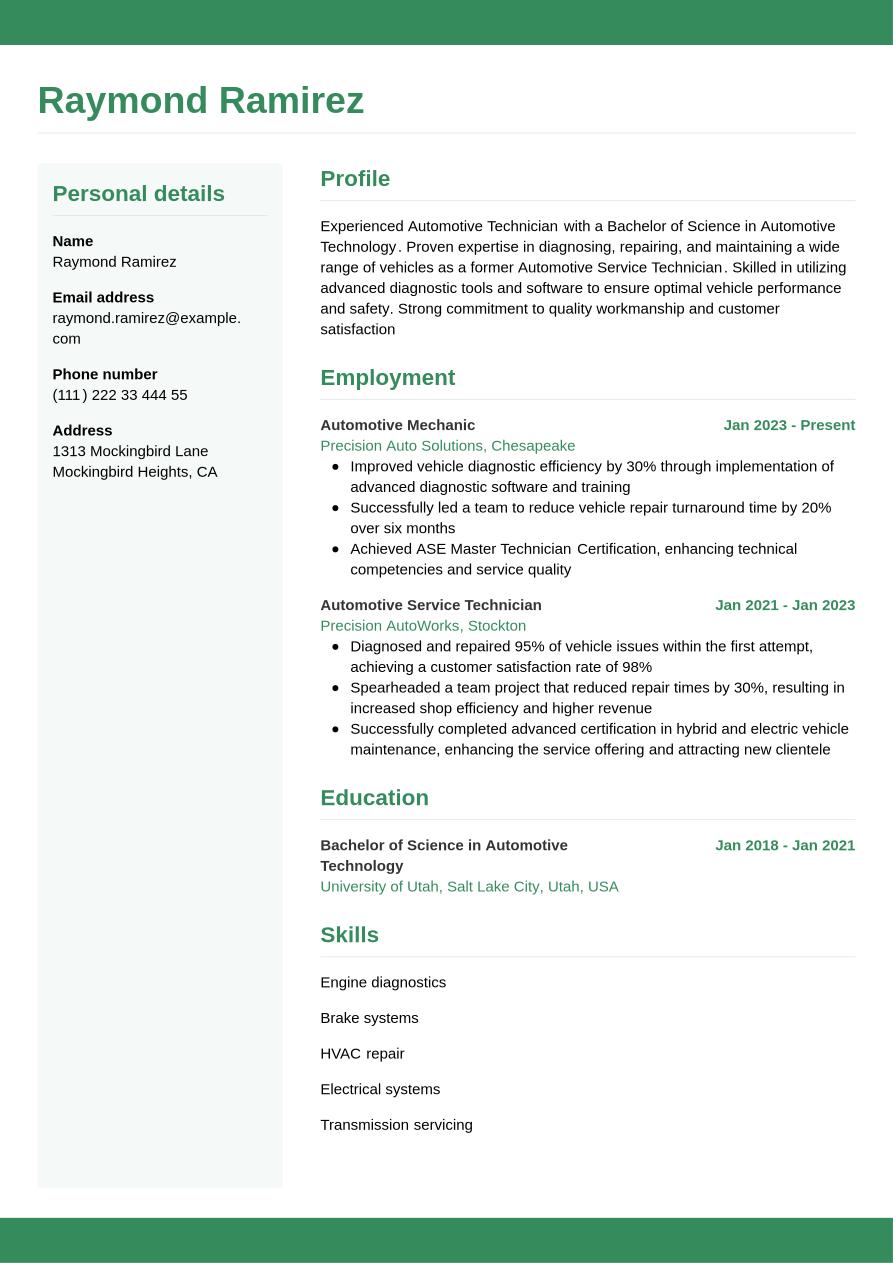
Legibility is your number one priority. You need to make sure the recruiter can clearly read your resume contact information.
- Make sure you choose a clear font
- Choose a size of at least 8 pt
- Space out your details properly for readability
Here's an example of a well-formatted contact section:
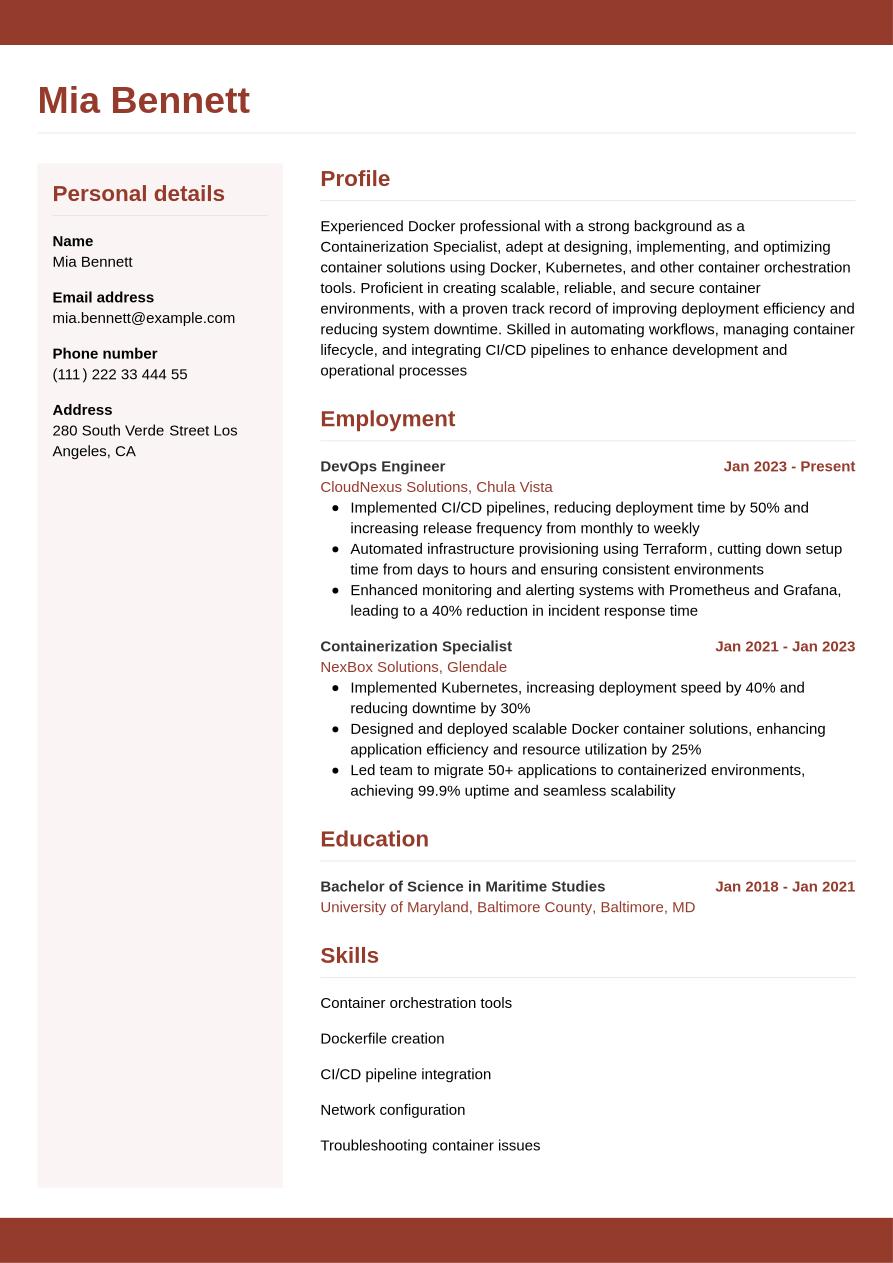
Getting too creative with your resume header is a risky move. Applicant tracking systems (ATS) may find it hard to parse information that is not clearly laid out.
Make sure that it’s obvious what each detail is and use a local format. Using the order we’ve covered above ensures your contact details have a consistent structure.
Here's an example of an ATS-friendly format:
What contact information to add to a resume (with examples)
Now that we've seen a quick overview of the right information and where to place it, let's explore the specific details to get right and look at a few examples.
1. Your name and title
Let’s get the basics right: your name and job title. While this should be relatively straightforward, it’s smart to go over the best practices.
Start with your name in large, legible font. It should match your LinkedIn profile name. The recruiter will likely look you up when reviewing your resume. If you have a title that’s relevant to the job (for example, a PhD), you can include it here. That tells the recruiter what your credentials are before they’ve even read your resume.
Next up, add the job title below your name. Many candidates aren’t quite sure how to get this right. Use the title or headline that accurately describes your last role, or career as a whole.
Tip: Match your job title to the job advert (when appropriate).
If your current title is “blog writer” but the job asks for a “content writer,” use the latter. The two roles are often interchangeable. Mirroring the language from the advert instantly tells the recruiter you’re a good match for the role.
Use professional language when including your role. Creative and clichéd terms like “ninja,” “rockstar,” and “whiz” are not likely to impress most recruiters.
Good examples
- Digital marketer
- Content writer
- PR executive
- Software developer
- Teacher
Bad examples
- Digital whiz
- Content ninja
- PR magician
- Software developing rockstar
- Guru (i.e. teacher)
Before you get started, make sure your portfolio is up to date. You can also rearrange your projects to ensure the most relevant (to the role) are at the top of the page.
2. Phone number and email address
Next, put your current phone number on your resume. Recruiters may wish to contact you by phone to arrange an interview or to conduct a preliminary screening. Your phone number should be easy to read and clear. It sits just below your name and title.
Since most job application processes are carried out almost entirely online, it’s also important to include your email address in your resume contact information.
Use a simple, professional email address from a trusted email provider. Do not use a current work email address or an unprofessional address that you created in high school
It's most professional to just use your name, or add a couple of numbers if all variations of your name are already taken. You should avoid anything that sounds juvenile. For example, email addresses featuring nicknames or random words are a no-go.
Good examples
- sam.smith@example.com
- j.wright@example.com
- drperryjackson@example.com
Bad examples
- pinkponyclub2452@example.com
- ilovecheese@example.com
- pezzajthedoc@example.com
3. Location
You don’t need to include your full address on your resume. However, it’s usually best to include a location. That is, your city, state, and maybe even your country.
When applying for remote jobs, you might think you can leave this detail out. That’s not always the case. Many companies need to know where you’re based for tax and insurance reasons.
Applying to a job somewhere else?
If you’re applying for an on-site role in another city or country, emphasize that you’re willing to relocate. You can put “Looking to relocate” or “Relocating to [city] in June” below your location.
Start by including your city/town and state acronym. You can include your country, but that is completely optional. It may be wise when you’re applying for jobs outside of the United States.
Good examples
- New York, NY
- Chicago, IL, USA
- Austin, TX (Open to relocate)
- Los Angeles, CA (Open to remote work)
Bad examples
- 142 Willow Creek Drive, Apartment 4B, Austin, TX 78701
- 67 Maple Street, Chicago, IL 60601, USA
- Austin
- East Coast
4. LinkedIn profile
Recruiters regularly check LinkedIn when reviewing candidates. Make their job easy for them by adding a custom profile URL to your resume. Make sure your LinkedIn profile is updated with your current job, accurate personal information, and a professional photo.
Next, set up your custom profile URL with something simple and short, like your name. Once your LinkedIn profile is optimized, include your customized URL on your resume header
Provide your full custom URL, excluding the “https://www”. Make sure you hyperlink the text so the recruiter can simply click on it and be taken to your profile.
5. Optional resume contact details
We’ve covered the main resume contact details you need to include. But you may want to add a few extra details into the mix. Let’s take a look at some options and how to add them to your resume:
Optional items to add | Why and how to add them? |
|---|---|
Portfolio | If you work in a creative field, including your portfolio may be a smart idea. Once again, you should add this as a URL and hyperlink. Example: github.com/your.name |
Website | It gives the recruiter a chance to see what you’re about. Creative professionals may use sites to showcase their talents. Keep it simple when including this detail. Use a short URL and hyperlink it. Example: [name]photography.com |
Social media | The golden rule is to only include them if they are relevant. If, for example, you’re a makeup artist and share your creations on Instagram, you’ll want to include it. Example: instagram.com/yourname |
Relocation notice | You can slide this nugget under your location. Make sure you’re clear about being willing to move for a role. Example: Relocating to [place] in [date] |
What contact information to leave out of your resume
When it comes to resume contact information, what you leave out is just as important as what you include. There are certain details that have no place on your application. Let’s take a look.
1. Your full address
This is potentially sensitive information, so you can leave it off your resume. The recruiter does not need to know precisely where you live and may have misconceptions about certain areas. That can lead to cases of unconscious bias which, of course, you want to avoid.
Similarly, if you’re uploading your resume to multiple sites, you don’t want it getting into the wrong hands. Having a document containing your full name and address floating around the internet is a recipe for disaster. Simply include your basic location like city and state, and leave it at that.
Expert tip
While not exactly contact information, you should also consider leaving off icons and images. You might think these visuals will make your resume stand out. However, these elements can play havoc with applicant tracking systems (ATS). The software may not be able to read your contact details unless icons are part of a well-formatted template like the ones from Jobseeker.
2. Your current work email address
Chances are, you’re not the only person who has access to your work email account. Including this on your resume may tip off your employers that you’re looking for new jobs.
Recruiters may not be comfortable contacting you at your current workplace. When they see your email, they may decide that it’s not worth the hassle of contacting you.
3. Your age or date of birth
Your age should never come into a recruiter’s hiring decision. In the United States, the Age Discrimination in Employment Act (ADEA) prevents age discrimination in the workplace. For that reason, you should never include your date of birth on your resume. This move could lead to bias on the recruiter’s part.
4. Family information or marital status
Information about your marital status, children, or plans to have them can make an employer doubt your availability and commitment to the job, and therefore should never be included. Federal law also prevents employers from discriminating against pregnant candidates, but this information is best not disclosed during the hiring process.
5. Race, religion, country of origin, and disability
Similarly to age and family information, employers are prohibited from discriminating against candidates based on factors like race, religion, country of origin, disability, or sexual orientation. These details should never be included on a resume, and employers will likely automatically reject ones that do to avoid being accused of breaking the law.
6. Sensitive personal numbers
Your passport and/or Social Security Number are highly private pieces of information and of no concern to recruiters during the hiring process. Letting these numbers circulate on a document could lead to identity theft – a costly and time-consuming problem to solve.
In rare circumstances, however, an employer may ask about your nationality or authorization to work. You can answer these types of questions if appropriate for the job; however, you should never reveal sensitive numbers while doing so.
7. Photos
Unlike in many other countries around the world, photos are uncommon on North American resumes. This is partly due to the strict laws around discrimination in hiring – employers often automatically reject resumes with photos so that they can't later be sued for discrimination based on information like race, religion, or gender visible in the photo.
However, do know that many recruiters will check out your LinkedIn profile before setting up an interview, so they will likely know what you look like even if you never include a photo on your resume.
The only exception to the no photo rule is for candidates applying to jobs where looks actually do matter, such as actors, models, or news anchors, so these professionals can benefit from looking at job-specific resume examples.
Quick guide to format your contact details
Getting your contact details right is only half the battle – you also need to make sure they are well-formatted so the recruiter and ATS systems can easily find them. Here are a few key tips to ensure a great visual presentation for your application.
Position. Place your contact information either at the top or left-hand side of your resume, depending on the layout. |
Spacing. Include white space between each piece of information to make sure it’s easy to read. |
Good alignment. Check that the section has consistent alignment throughout. |
Font. Use a readable font style and make sure it’s 8 pt or more in size. |
ATS compliance. Adopt a logical structure to make the section ATS-friendly. |
Hyperlinks. Include short URLs and hyperlinks that can be clicked. |
Limited icons or symbols. Avoid icons and symbols, which could be tricky for the ATS. |
Key takeaways for contact information on a resume
Including a clear set of resume contact details is a must. It means recruiters can easily get in touch with you and invite you to an interview. Make sure you include the basic details they need, including your name and title, location, phone number, email address, and LinkedIn URL. Of course, you can also add in optional extras, such as a link to your website or portfolio.
Looking to create a flawless contact details section the first time around? Jobseeker's resume and cover letter builders are a great place to start. Our cover letter examples and templates allow you to create a cohesive application in just a few clicks.
For more expert advice, check out our resources for your job application!

Impress potential employers with your resume
Follow step-by-step professional guidance to create a polished resume in minutes.