NED CV Example
Applying for non executive director positions requires a strong CV that showcases your best skills and career achievements. Mentioning responsibilities from your previous experience, such as providing strategic direction and scrutinising financial performance will indicate to the employer that you're a good fit for the role. In this comprehensive guide, you'll learn the steps to producing a non executive director CV that puts you in pole position to progress to the interview stage.
A strategically positioned, high-impact non executive director CV significantly strengthens your candidacy for senior-level roles. It should be designed not only to navigate ATS screening, but also to capture the attention of executive recruiters, hiring committees, or board members. By customizing each CV to mirror the organization’s priorities, growth objectives, and operational challenges, you demonstrate alignment at a strategic level, placing yourself among the strongest candidates for senior roles. Next, let’s examine the core sections of a CV and consider how to structure each one to reflect organizational impact and long-term value creation.
Main non executive director CV sections
Your approach to creating your winning non executive director CV will differ depending on your experience, your seniority and the details listed in the job description.
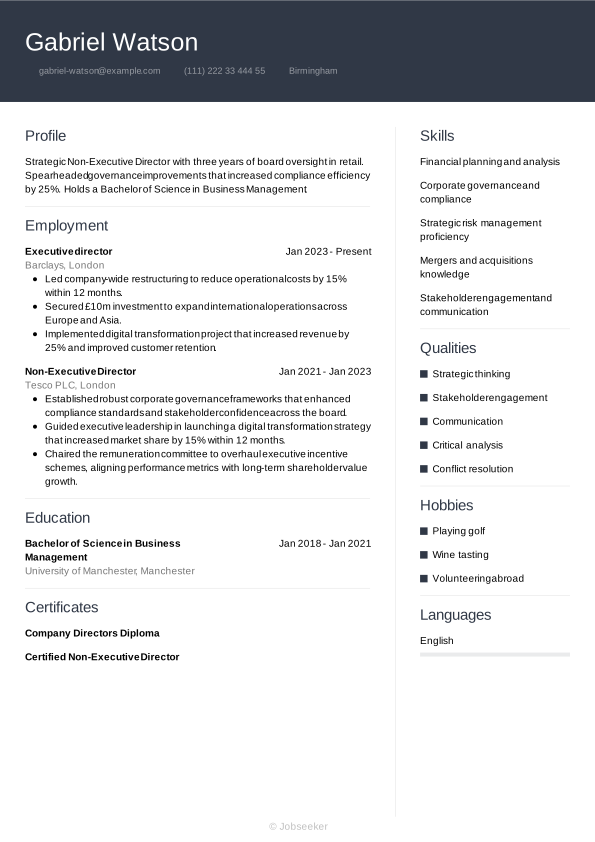
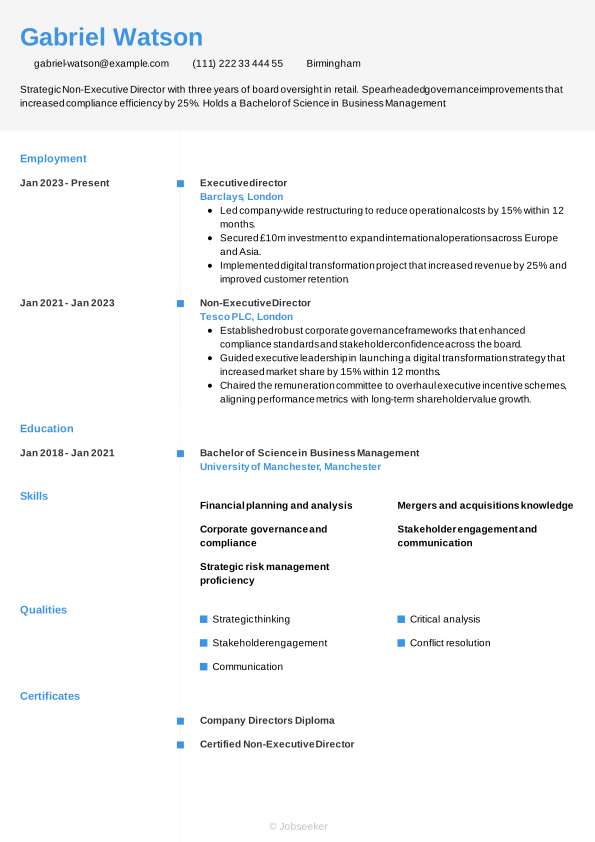
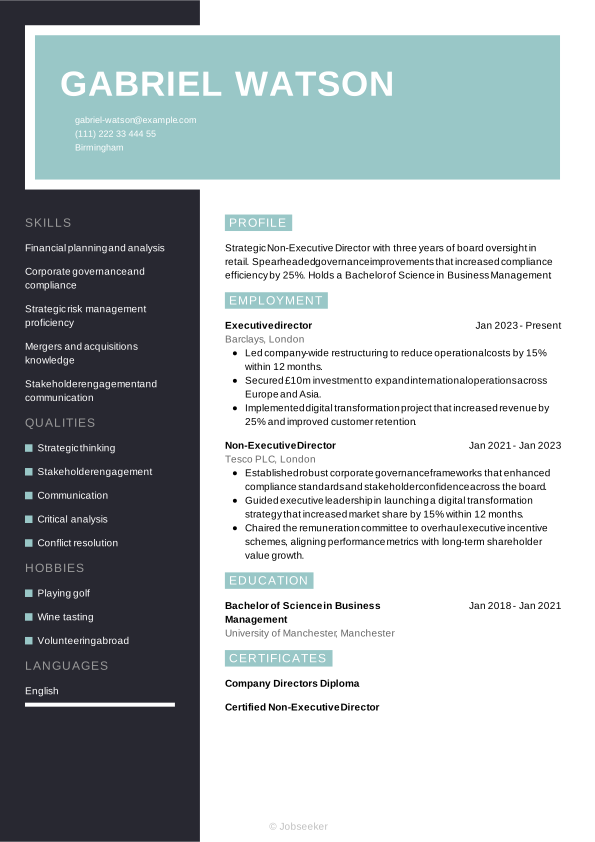
However, regardless of your seniority, a non executive director CV needs to tell a cohesive story of your professional growth. In the following sections, we’ll dive into each part of the CV step-by-step, starting with your header and moving through to your professional achievements.
CV Header
Start your non executive director CV with a header that features subtle, professional design elements and sets the tone for the document. Add your name, email address, phone number and location (your full address isn't normally needed). Additionally, consider adding a URL to your LinkedIn profile if you have one. This can help the reader to quickly access further information about your career and credentials that you haven't been able to add to your CV.
For jobs in the UK, a personal photo is usually not required on your CV. That, along with any other personal details such as age, gender, ethnicity and nationality, are generally discouraged under the terms of the Equality Act 2010, which aims to reduce and eliminate discriminatory practices, such as recruitment bias.
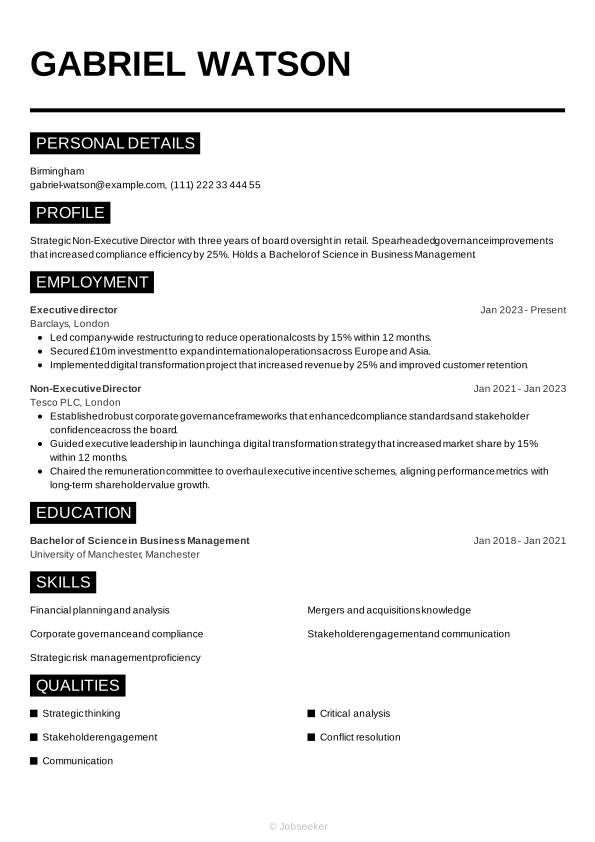
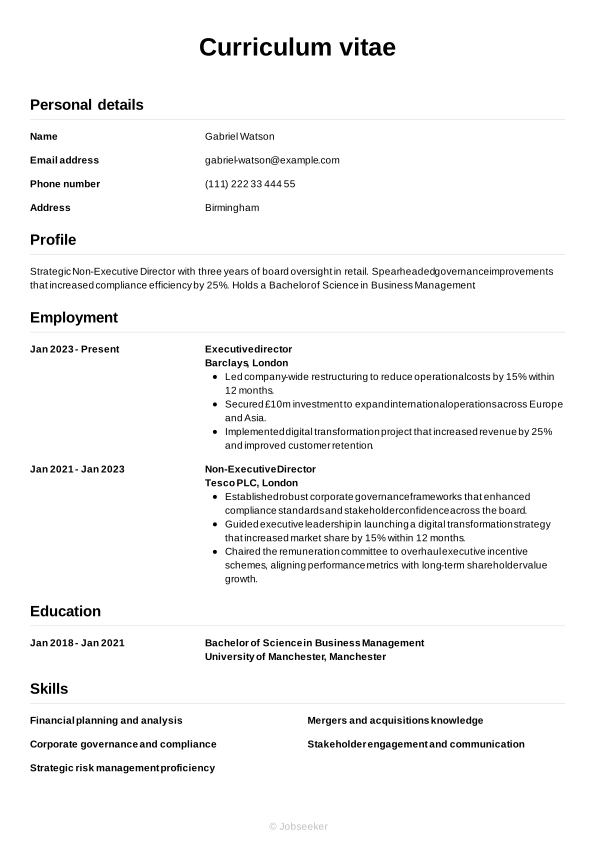
Gabriel Watson
gabriel-watson@example.com
(111) 222 33 444 55
Birmingham
linkedin․com/in/gabriel–watson–123
CV Summary
Under your header, write a brief CV summary or CV objective, outlining a few of your key skills, qualities and achievements. This short paragraph can help employers to quickly assess your suitability for the role, setting the tone for your non executive director CV. While the CV summary focuses on your key skills and achievements, a CV objective highlights your career ambitions, making it more suitable for junior candidates.
Both a CV summary and objective should be concise, with an ideal length of two or three sentences. List your key skills, personal strengths and career achievements or ambitions, taking care to ensure the content reflects the requirements listed in the job description.
A good CV summary will highlight one or two key skills that match those listed in the job description, and show how you've put them to good use in your career to date. You'll want to set yourself apart from other candidates by focusing on unique qualities or particular areas of strength that have shaped your career to date. Find an example below of a positive non executive director CV summary, characterised by evidence to support your claims and well-structured, easy-to-read sentences.
Strong example:
Seasoned non-executive director with five years’ boardroom experience across global FTSE-listed companies. Championed governance overhaul driving 20% improvement in compliance and chaired audit committees. Holds an MBA in Business Administration.
Poor example:
Seasoned non-executive director with extensive experience in supporting corporate governance and offering strategic guidance to boards in diverse industries, known for collaborative leadership style and commitment to effective decision-making processes.
Above is an example of a less effective CV summary, with some subtle, yet notable differences. An ineffective summary might be vague or generic, failing to highlight specific personal qualities that help you stand out and failing to address the requirements specified in the job description. They might also lack firm evidence of your skills, and be structured with long, hard-to-read sentences.
Professional Experience
Work experience is usually the most important section of any CV. Employers will be looking for evidence of how you've developed relevant skills in your career to date, and how you've used them to positive effect in previous roles. It's crucial to tailor your work experience section to match the requirements listed in the job description, using keywords and phrases so employers can easily see how well you fit the role and organisation.
This section should contain a list of your most relevant previous jobs in the last 10 or 15 years. Add the job title, the name of the employer, its location and your dates of employment. Include detail in bullet points, outlining the skills you used in the role and the impact they made.
When applying for senior or executive non executive director positions, you might wish to make your work experience section a little longer than that of a standard CV. This will give you more space to showcase your extensive experience and expertise in the sector, by showing more detail about each role, or by listing more previous roles.
To differentiate your work experience section from other candidates, include action verbs and quantifiable evidence that showcases the impact you made. Show your career progression through the skills you developed and used in each role. See below for an example of a strong work experience section for a non executive director CV.
Strong example:
Independent Non-Executive Director, January 2023 - Present
Kingswell Enterprises Ltd, Manchester
- Chaired the audit committee to strengthen financial controls and mitigate risk exposures.
- Spearheaded the development of corporate governance framework to boost board effectiveness and transparency.
- Led CEO succession process ensuring seamless leadership transition and strategic continuity across operations.
Poor example:
Independent Non-Executive Director, January 2023 - Present
Kingswell Enterprises Ltd, Manchester
- Oversaw cross-functional collaboration to deliver strategic objectives and improve stakeholder relationships.
- Facilitated board-level discussions to identify opportunities and drive organisational alignment with long-term vision.
- Guided senior leadership through complex challenges to optimise decision-making processes and support corporate governance.
Above you'll find a less effective example of a non executive director CV work experience section. The work experience section could fail to make an impression if it's too generic, focuses on older or irrelevant roles or lacks tailoring to the job description. It's also important to avoid focusing too much on responsibilities that don't tell the reader anything of the value you added to the role.
Education
In your education section you'll want to list your highest and most recent qualifications, particularly if they're a requirement for the role.
To be eligible for non executive director positions, you typically need to have a relevant university degree, and include it in your CV. If you have a Bachelor of Science in Business Management or another related degree that qualifies you for the role, you should definitely mention it in your CV, along with any other degrees or qualifications that highlight your most relevant skills, such as financial planning and analysis or corporate governance and compliance.
When adding your qualifications to your education section, choose the highest relevant qualifications, and list them in reverse-chronological order, starting with your most recent. For each qualification, add its name and level, the awarding body or institution, its location (if necessary) and your dates of attendance or graduation. If you want to emphasise your education in your CV, include bullet points showing specialist areas of study, projects, awards, society memberships or anything else that helps show you've got the necessary skills for the job.
It may also be useful for you to add any specialist industry qualifications, certifications or licences that you might require for the role. If you choose to add these, remember also to add an expiration date, if the licence requires renewal in the future.
Bachelor of Science in Business Management, 2018 - 2021
University of Oxford, Oxford
Skills
In your CV's skills section, you'll want to draw attention to some of your strongest skills that make you suitable for the role. Review the job description to get an idea of the most essential skills, and create a list of hard and soft skills, including some of your strongest, most unique qualities that set you apart from other candidates. For a non executive director CV, it's essential to include relevant skills for the role that match your skill set, such as critical analysis and corporate governance and compliance, to impress the reader and show you're qualified for the non executive director position.
Hard Skills
Hard skills and technical skills are specialist skills that are essential for carrying out the main responsibilities of the role. You might acquire hard skills through study, or through on-the-job training, and some hard skills may require a certification or licence. For non executive director positions, hard skills that match your abilities, such as corporate governance and compliance, and strategic risk management proficiency tend to be valued by recruiters and hiring managers. After checking the job description, include a list of four or five key hard skills in your CV to confirm that you have the necessary expertise for the role.
The best hard skills section will contain a mix of your strongest technical skills and those listed in the job description as 'essential' or 'desirable'. The closer your skills list is to matching the essential job description skills, the better your chances of success.
Below, you can find the types of skills typically featured in the hard skills section of a non executive director CV:
- Financial planning and analysis
- Corporate governance and compliance
- Strategic risk management proficiency
Soft Skills
Soft skills are the personal strengths and qualities that show employers how well you'll fit into the role and complement other members of the team. Soft skills tend to be more transferable and applicable to different roles than hard and technical skills. Transferable skills are among the most in-demand skills for employers, with rapidly changing and evolving ways of working requiring ever-more flexible and adaptable employees. Soft skills are also highly valuable for junior and entry-level positions, where candidates aren't expected to have a wealth of relevant work experience and career achievements.
Similar to your hard skills section, it's best to first review the job description to know which soft skills to focus on in your non executive director CV. You'll want to include a combination of soft skills that you can provide evidence for throughout your CV. Create a list of four or five transferable skills, combining the most essential skills from the job description with the skills that help you to stand out as a unique and compelling candidate for the position.
When writing a non executive director CV, ensure your soft skills section focuses primarily on leadership and management skills. Aim to include soft skills that highlight your ability to lead a team and represent an organisation, such as decision-making, strategic thinking, change management and communication.
Consider the following soft skills that frequently appear in a non executive director CV.
- Strategic thinking
- Stakeholder engagement
- Communication
Pro Tip:
The Public Appointments guide notes that a strong senior level CV arranges content by relevance and uses section headers with the most recent roles first. (1)
Certifications, Training and Licences
Depending on the role you're applying for, and the type of qualifications you have, you might want to include a separate section for certifications, in addition to the education section. If you've been proactive in pursuing professional development opportunities throughout your career, it's worth showcasing them. Not only do they make you more qualified, they also show a proactive and motivated mindset. Furthermore, the CV certifications and training section is a great showcase for official licences and certifications when applying for roles where these are a key requirement listed in the job description. These could include positions where the use of specialist software and equipment is a routine part of your everyday responsibilities.
These example certifications and licences are ideal for candidates applying for non executive director roles:
- Company Directors Diploma, 2023
- Certified Non-Executive Director, 2023
- Board Leadership Programme, 2023
Key Projects and Publications
If you have any published works, or have contributed to any key projects, it can be valuable to mention them in your CV. Include any major contributions you've made to the academic discourse or knowledge base in your specialist area. These could be journal articles, research papers, magazine articles or projects that received major funding, or were recognised by an industry body.
When listing publications, follow a standard citation format that's widely used in the business management sector. The most common citation style for UK CVs is the Harvard style, but you could use the APA (American Psychological Association), MHRA (Modern Humanities Research Association) or OSCOLA (Oxford University Standard for Citation of Legal Authorities), if appropriate. Take a look below at an example publication citation for a non executive director CV, based on the most suitable citation style:
Gabriel Watson. Leading digital transformation in SMEs. Journal of Corporate Governance. 12 (4) 78. 2021
Career Achievements
Creating a list of your key career achievements can be an effective way of drawing attention to the things you're most proud of from your career. In this section, add any awards or recognition you've received for achievements, and any career milestones you've reached that show you're a strong candidate for the job.
Furthermore, as a candidate for senior non executive director positions, including some of your most impressive achievements in a summary section can help you show employers your reputation and standing in the industry, as well as your career progression.
Foreign Languages
If you speak any additional languages, you might want to consider adding a languages section to your CV. Even if languages aren't a requirement of the job description, speaking a foreign language can reflect well on you as a candidate, and correlate with other soft skills that can increase your employability. Within this section, list the foreign languages you speak to a reasonable degree of competence, together with an indicator of your skill levels.
The ways to indicate your foreign language skills depend on the level of detail you want to provide. They include assigning a basic descriptive word, such as:
- English: Fluent
- Spanish: Intermediate
Alternatively, use an internationally recognised framework for languages, such as the Common European Framework of Reference (CEFR). This gives your language skills a standardised competence indicator, as follows:
- A1: Beginner
- A2: Elementary
- B1: Intermediate
- B2: Upper intermediate
- C1: Advanced
- C2: Proficiency
Data Insight:
Around half of HR specialists prefer to see your work experience in reverse-chronological order, so start from your most recent work experience and leave out any that don't align with the role you're applying for. (2)
Most effective action verbs for a non executive director CV
Starting each of your work experience bullet points with strong action verbs is a great way to showcase your key skills and qualities, and demonstrate the impact they've had in your career to date. Start each bullet point with a verb linked to the skills required in the job description, to add focus to your work experience section and make it easy for the reader to identify your strengths. When adding action verbs to your work experience bullet points, just remember to always provide quantifiable evidence that shows the value you added for each employer. Use past tense for any action verbs that describe previous roles (for example, 'developed') and present tense for current roles (for example 'collaborating').
- Advise
- Oversee
- Govern
- Guide
- Monitor
- Evaluate
- Challenge
- Strategise
- Collaborate
- Facilitate
Example of a non executive director CV
Now we've shown you everything that needs to go into your non executive director CV, we can take a look at how it comes together in its final form in the following example:
Birmingham
•
gabriel-watson@example.com
•
(111) 222 33 444 55
•
linkedin․com/in/gabriel–watson–123
Seasoned non-executive director with eight years’ experience as Senior Independent Non-Executive Board Director. Spearheaded governance improvements that reduced compliance incidents by 40%. Holds an MBA, driving strategic growth and oversight.
Non-Executive Director at FTSE100 Company
2022
-2026
British American Tobacco (London)
- Led the establishment of an independent audit committee that enhanced financial oversight and reduced compliance risks company-wide.
- Chaired the diversity and inclusion taskforce that achieved a 30% increase in female board representation within two years.
- Negotiated a strategic partnership with a leading technology firm, unlocking new digital transformation initiatives and boosting revenue streams.
Master of Business Administration
2017
-2018
University of Oxford (Oxford)
Bachelor of Science in Business Management
2014
-2017
University of Manchester (Manchester)
Financial planning and analysis
Corporate governance and compliance
Strategic risk management proficiency
Strategic thinking
Stakeholder engagement
Communication
Company Directors Diploma
Certified Non-Executive Director
English - Native
French - Advanced
Dos and don'ts for a winning non executive director CV
Tips to follow
- Use a reverse-chronological approach to listing your work experience and education, starting with your most recent activities and working back from there.
- Highlight your key skills with a dedicated skills section that matches both the hard and soft skills listed in the job description.
- List your qualifications in a dedicated education section, including grades and awards if these can help set you apart from other candidates (particularly for junior candidates).
- Use strong action verbs that show how you've used your skills to add value for employers in your career to date.
- Quantify your achievements by offering evidence that supports your claims throughout your CV wherever possible, such as key metrics, awards, and positive feedback.
Common mistakes to avoid
- Don't add personal information such as your age, gender, marital status or personal photo (unless necessary for the role).
- Don't lie or exaggerate to make your application look stronger – misleading claims about jobs or qualifications can be considered fraud.
- Don't use an unprofessional email address with inappropriate language or nicknames, but instead create a professional email address combining your name, initials, profession or other suitable details.
- Don't add unrelated information about previous work experience, as this takes up valuable space on your CV and ultimately won't increase your chances of success.
- Don't swamp your CV with industry jargon and acronyms that may confuse the reader, when simpler, clearer language can do the job.
A standard UK CV is typically between one and two sides of A4, but if you're applying for a senior role, it's acceptable to make your non executive director CV longer. The extra length can help you to show all the credentials and experience that make you suitable for such a senior role in the business management sector. This might mean including awards, publications, professional memberships, conference appearances or significant career milestones and achievements.
This can mean it's beneficial for your CV to be longer than the standard two pages. If you want a sneak preview of what your one-page, fully designed and finalised CV might look like, see our completed examples.
How to optimise your CV for ATS screening
Applicant tracking systems (ATS) are a valuable tool for many recruiters and employers, helping them manage the recruitment process by scanning and assessing CVs based on their likely fit to the job description. This saves recruiters and hiring managers the time and effort of reading every CV in detail. With many vacancies often receiving hundreds of applications, ATS software can really relieve the burden on hiring teams and free them up to focus only on the most suitable candidates.
The increasing usage of ATS apps by recruiters and employers means it's critical to adapt and prepare your applications to successfully navigate this stage of the selection process. Following the tips below will give you everything you need for an ATS-compatible CV:
- Include keywords and phrases that match the job description, giving you the best chance of appearing as a strong fit for the role.
- Use clear, standard CV headings that are easily recognisable, such as 'work experience', 'education' and 'skills'.
- Choose a simple, standard CV structure and omit any design elements that might make your CV less easy to read by automated systems, such as text boxes and columns.
- Select a widely-used font in either serif or sans serif style, with a font size between 10 and 12 for body text and 14 and 16 for heading text.
- Use bullet points in place of full sentences and paragraphs, as these are easier for ATS apps to scan and parse, and help your keywords stand out.
You might feel there are a lot of things to remember when writing an ATS-compatible CV, but with just a few small tweaks, you can ensure yours passes this stage. Use one of our expert-designed, ATS-compatible CV templates to avoid the stress of adapting your CV for ATS screening.
Jobseeker's CV templates can help your CV to make a strong first impression with recruiters. Each template is expertly designed and approved by HR specialists to help you craft a winning application.
Non executive director CV FAQs
How do I write a non executive director cover letter for my job application?
A well-crafted cover letter can be just as vital to your chances of success as your CV. To write a cover letter that makes a positive impression on the reader, adopt a formal, professional layout and use a cover letter template that matches the design of your CV.
Most cover letters include three standard paragraphs of information. The letter opens with a brief personal introduction and confirmation of the role you're applying for, and your motivations for applying. In the next paragraph, list some key skills and career achievements related to the role, taking care not to repeat your CV. Finally, end your cover letter with an expression of gratitude for considering your application, and a call to action that puts the ball in the court of the employer to arrange an interview or establish dialogue with you.
Alternatively, if applying via email, you may wish to write a shorter, more simple cover note. You can use traditional email conventions for this, which are less formal than standard letter conventions. Simply introduce yourself and confirm the role you're applying for, direct the reader to the attached documents and add your contact details in your email footer/sign-off.
Jobseeker's cover letter examples for non executive director and business management industry roles provide useful tips and guidance from HR experts on how to write a compelling cover letter.
How many years should my non executive director CV cover?
Under normal circumstances, a career history dating back 10 to 15 years is typically sufficient for showcasing the required skills and achievements for the role.
However, as a candidate of great experience, you might feel it's worth showing more of that career journey to the reader, to demonstrate your career progression from junior to senior levels and the impact you've had along the way.
As such, offering a more complete career history beyond the standard 10 to 15 years can be advantageous, to show the reader the depth of your experience in the business management sector.
How do I write a non executive director CV headline for maximum impact?
A CV headline can be an effective way of introducing yourself in your CV and setting the tone, so the reader can quickly identify whether you're likely to be a good fit for the role.
Look to craft a short. eye-catching sentence that demonstrates your greatest skills and natural strengths, and includes the job title.
For the most effective CV headline, make sure it reflects the most critical keywords and phrases from the job description. This will also help your CV to pass the ATS screening stage of the recruitment process.
The examples below show best practice for writing a CV headline at different experience levels:
- Strategic Non-Executive Director Delivering Growth
- Senior Non-Executive Board Director
What's the best non executive director CV format for 2026?
For senior level and executive non executive director applications, employers will seek evidence in your CV of extensive work experience and specialist knowledge and skills. For positions of such standing and responsibility, you'll want to reassure employers that you've got what it takes and you're a safe pair of hands.
As such, a detailed reverse-chronological CV tends to be the most effective, as it emphasises work experience ahead of other sections.
A courteous, professional cover letter can make all the difference to your job applications. Our cover letter templates have been designed by experts to help you make the best impression with hiring managers.
Key takeaways for your non executive director CV
To stand out from the crowd with your CV, tailor your approach to each individual application, incorporating keywords and phrases that match the job description. Select a suitable CV format that reflects your experience level, and focus on highlighting your key skills, and demonstrating how you've put them to good use to achieve positive outcomes in your career to date.
Finally, using an eye-catching, expert-designed CV template from Jobseeker can really give your CV an edge over those from rival candidates, helping you to achieve success in your job applications.
Sources:
- Public Appointments, Tips for a good CV
- Jobseeker, HR Trends

Impress employers with your CV
Step-by-step guidance to create a professional CV in minutes.